Pages

Showing posts with label Labour PARTY. Show all posts

Saturday, January 30, 2016

Donie's Ireland daily news BLOG update

Irish Labour party promises to slash taxes by a third if returned to power?
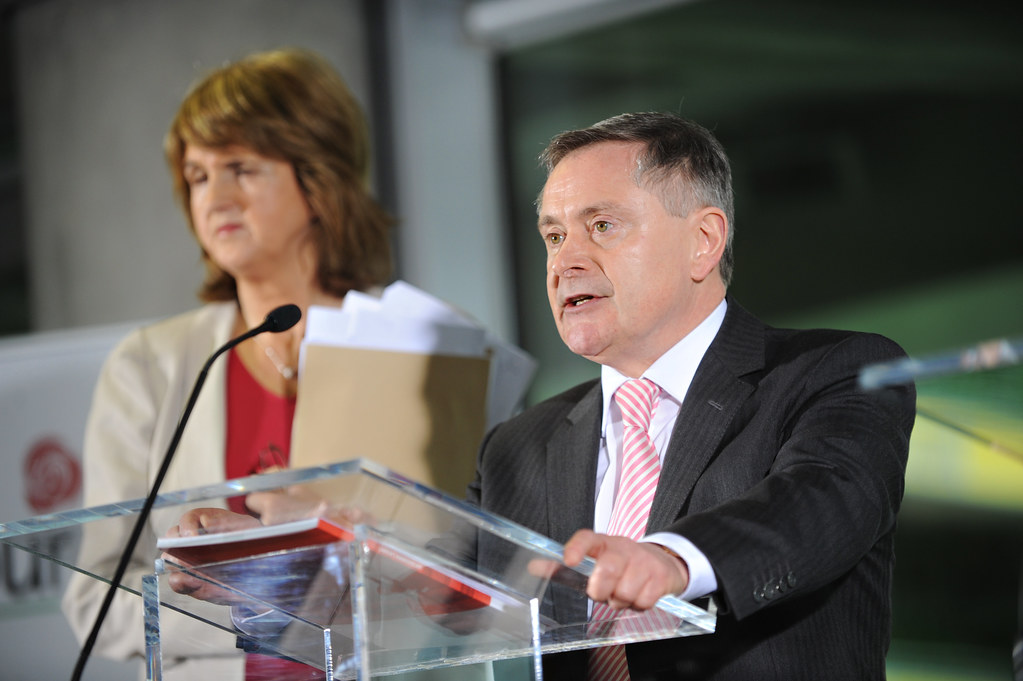
    

THE IRISH LABOUR HAS PROMISED TO REDUCE TAXES FOR WORKERS ON €25,000 BY AS MUCH AS A THIRD AS PART OF A €3BN TAX REFORM PACKAGE IF IT IS RETURNED TO POWER.

Workers on up to €50,000 would also see their taxes reduced by up to 15% under the promised reforms.
Public Expenditure Minister Brendan Howlin unveiled the tax-cut promise yesterday evening in Mullingar, ahead of Labour’s conference here today.
The plan would put more than €1,000 a year back into the pocket of a worker on €25,000. However, a high earner on €120,000 or more would not see any reductions in their tax obligations.
As part of the pre-election promise, Labour says USC would be abolished on incomes up to €72,000. Workers would also pay less PRSI once their income amounts to less than €704 a week.
Any gains under the changes for higher earners would be clawed back by adjusting their tax.
Announcing the changes, Mr Howlin said the USC was the “most draconian of the charges” introduced during the recession. However, Labour still wanted to keep a broad tax base and would limit reductions.
For more election news, analysis and general banter join us HERE
Under the proposals, a worker on €25,000 would see joint reductions in USC and PRSI result in a €1,132 saving annually, or €22 per week.
A worker on €50,000 would see €2,043 saved a year or €39 per week . Someone on a salary of €72,000 makes a saving of €3,302 or €63 per week.
Labour stressed that higher earners would see gains clawed back.
Someone on €120,000 might see USC reductions of €3,302 but these would be cancelled out by income tax-related increases.
Mr Howlin also responded to calls for the next government to have a “rainy day” fund, saying that Labour had financial plans, though this was an unallocated amount, if Ireland faced future economic challenges.
The minister would not be drawn though on what exactly these funds were, or how much.
The Irish Fiscal Advisory Council yesterday warned that the projections for increased spending by the next government were incorrect, and were several billion euro short of what was being promised by parties wanting to be in government.
With just days to go before the expected announcement of the election, Labour TDs and delegates will today discuss jobs and healthcare, among other issues, before party leader Joan Burton gives the main address at the conference tonight.

Minister Lynch rows back on inquiry into a contentious HSE sexual abuse case

CIRCUMSTANCE INVOLVES WOMAN ALLEGEDLY ABUSED IN a SOUTHEAST CARE HOME


KATHLEEN LYNCH: “THE SETTING UP OF A COMMISSION OF INQUIRY WOULD REQUIRE A GOVERNMENT DECISION AND A VOTE BY THE OIREACHTAS.”

Minister of State Kathleen Lynch has pulled back from apparently conceding that a commission of inquiry should take place into how the HSE handled allegations of serious sexual abuse at a foster home in the southeast.
In a statement last night she said serious consideration must be given before any decision was made about establishing a commission of inquiry to look at all aspects of what happened.
The Minister with responsibility for social care said a definitive judgment on this should not be made in advance of seeing a report by barrister Conor Dignam who she formally appointed on December 7th to undertake a review of two reports already completed on the matter.
“The setting up of a commission of inquiry would require a Government decision and a vote by the Oireachtas,” said Ms Lynch.
The Minister pointed out that, on first hearing of this matter in April 2014, her immediate concern was to ensure that no person was currently at risk. She received that assurance and was informed that no new admissions had been made to this private foster home since 1995, with the last resident being removed in 2009.
“The critical question of why this young vulnerable person was left in the foster home until 2009, even though the most serious concerns had been raised about her, remains the central issue.
“It is important to note that the Devine and Resilience Ireland reports, once published, may answer some of the questions that currently remain unanswered.
“The ongoing Garda investigation since 2010 has prevented publication of these two reports. It has not, however, prevented the HSE from implementing the recommendations in the Conal Devine report including a national foster care audit, which is welcome.”
In relation to the controversy about the issuing of an apology to this vulnerable person, Ms Lynch said the confusion and lack of clarity was very regrettable, and that it was important now to clearly establish the facts of what had occurred.
An in-depth investigation?
Earlier yesterday, in a radio interview, Ms Lynch said an independent inquiry into the issue might be required. She said that when she received correspondence from the Public Accounts Committee she had commissioned a “desktop review” by Mr Dignam.
Ms Lynch told RTÉ’s News at One that, after this review, Mr Dignam had suggested a more in-depth investigation take place. “I have never ruled out an independent inquiry and I do believe that’s where we are heading,” she said.
The controversy centres on how an 11-year-old girl with disabilities was placed in a foster home, despite the facility being subject to serious sex abuse allegations.
During the week the Public Accounts Committee (PAC) accused the HSE of lying to it in correspondence last December when it said a meeting had been arranged at which the alleged victim of over a decade of abuse in the foster home was to receive an apology.
HSE director general Tony O’Brien yesterday promised to give a comprehensive answer to PAC on Tuesday. Mr O’Brien said he had asked the HSE’s social care division to look very carefully at the accusations so it could “get to the bottom of it” and give a comprehensive answer to the committee.

Minister Donohoe refuses to rule out Fine Gael relying on Lowry to support a new Government

HIGH COURT FOUND TIPPERARY TD ENGAGED ‘A LITANY OF FALSIFICATION AND DECEPTION’


THE MINISTER FOR THE ENVIRONMENT ALAN KELLY SAID HE RARELY SAW THE TIPPERARY TD MICHAEL LOWRY IN EITHER THE DÁIL OR THEIR SHARED CONSTITUENCY.

Minister for Transport Paschal Donohoe has again declined to rule out the possibility of relying on Independent TD Michael Lowry for support to form a coalition government.
Speaking on Thursday, following a High Court ruling that dismissed the former minister’s appeal against a decision by the Moriarty Tribunal to only award him one-third of his legal costs, Mr Donohoe said the Government’s position was that it did not want to have to do a deal with any independents after the general election.
Reports last week suggested that initial talks had been held by Fine Gael with a number of Independents , including the TD from Tipperary, about the possibility of supporting the next government.
Taoiseach Enda Kenny has repeatedly declined to rule out the possibility of a post-election agreement with Mr Lowry.
On Wednesday, the High Court found that Mr Lowry engaged in “a litany of falsification and deception” – including the falsification of a solicitor’s files – in his failure to co-operate with the tribunal.
On Thursday Eoghan Murphy, The Fine Gael TD for Dublin South East, said he is not contemplating requesting the support of Independents. Mr Murphy said he agreed with Taoiseach’s belief that returning the Fine-Gael and LabourCoalition was the best option for the country.
Earlier in the week, Fine Gael Minister for Foreign Affairs Charlie Flanagansaid his party should not deal with any Independents, while Labour Minister for the Environment Alan Kelly launched an attack on Mr Lowry, saying he rarely saw the TD in either the Dáil or their shared constituency.
Mr Kelly said he did not believe it would be necessary to do any business with Independent TDs after the general election. “My ambition is to see this Government re-elected and I believe it will be re-elected,” he said.
Asked what his objection to Mr Lowry was, Mr Kelly said: “I don’t pay much attention to Deputy Lowry. I note I rarely ever see him in the constituency and I rarely ever see him in the Dáil, so I don’t pay much attention to him whatsoever.”
Tánaiste Joan Burton of Labour said earlier in the week that she believed Mr Lowry’s involvement in supporting the next government was “not appropriate”.

Our attitudes to ageing are impacting on our health "So says new findings"

NEGATIVITY LINKED TO POORER COGNITION.


HOW PEOPLE FEEL ABOUT AGEING APPEARS TO HAVE A DIRECT IMPACT ON THEIR HEALTH, A NEW IRISH RESEARCH HAS SHOWN.

According to the findings, those with a negative attitude to ageing have poorer mental and physical health.
The research was based on the latest data from the Irish Longitudinal Study on Ageing (TILDA) in Trinity College Dublin. TILDA is an ongoing study of people over the age of 50 in Ireland.
The study found that over a two-year period, those with a positive attitude to ageing had better cognitive abilities. However, those with a negative attitude had worse cognitive abilities and a slower walking speed.
These results stood even when others factors were taken into account, such as health changes which took place during the two years, medication, mood and other changes in life circumstances.
The study also found that a negative attitude towards ageing affected the interaction of different health conditions. The researchers pointed out that frail older adults have an increased risk of many health problems, including cognitive issues.
However, they found that among participants in this study, frail adults with a negative attitude had worse cognition compared to non-frail participants, but frail participants with a positive attitude had the same cognitive abilities as their non-frail peers.
“The way we think about, talk about and write about ageing may have direct effects on health. Everyone will grow older and if negative attitudes towards ageing are carried throughout life, they can have a detrimental, measurable effect on mental, physical and cognitive health,” commented lead researcher, Dr Deirdre Robertson.

How our plastic planet waste is the scourge of the whole World

SCIENTISTS WARN THAT THE ABILITY TO PLASTER THE PLANET IN PLASTIC IS ALARMING


HUMANS HAVE MADE ENOUGH PLASTIC SINCE THE SECOND WORLD WAR TO COAT THE EARTH ENTIRELY IN CLING FILM, AN INTERNATIONAL STUDY HAS REVEALED.

This ability to plaster the planet in plastic is alarming, say scientists – for it confirms that human activities are now having a pernicious impact on our world.
The research, published in the journal Anthropocene, shows that no part of the planet is free of the scourge of plastic waste.
Everywhere is polluted with the remains of water containers, supermarket bags, polystyrene lumps, compact discs, cigarette filter tips, nylons and other plastics. Some are in the form of microscopic grains, others in lumps. The impact is often highly damaging.
“The results came as a real surprise,” said the study’s lead author, Professor Jan Zalasiewicz, of Leicester University.
“We were aware that humans have been making increasing amounts of different kinds of plastic – from Bakelite to polyethylene bags to PVC – over the last 70 years, but we had no idea how far it had travelled round the planet. It turns out not just to have floated across the oceans, but has sunk to the deepest parts of the sea floor. This is not a sign that our planet is in a healthy condition either.”
Marker for a new epoch?
The crucial point about the study’s findings is that the appearance of plastic should now be considered as a marker for a new epoch.
Zalasiewicz is the chairman of a group of geologists assessing whether or not humanity’s activities have tipped the planet into a new geological epoch, called the Anthropocene, which ended the Holocene that began around 12,000 years ago.

HUMANS CAUSING CATASTROPHIC ECOSYSTEM SHIFTS: STUDY.

THE HOT TOPIC OF CLIMATE CHANGE.

WORLD’S OCEANS CLOGGED BY MILLIONS OF TONNES OF PLASTIC TRASH.

Most members of Zalasiewicz’s committee believe the Anthropocene has begun and this month published a paper in Science in which they argued that several postwar human activities show our species is altering geology.
In particular, radioactive isotopes released by atom bombs left a powerful signal in the ground that will tell future civilisations that something strange was going on.
In addition, increasing carbon dioxide in the oceans, the massive manufacture of concrete and the widespread use of aluminium were also highlighted as factors that indicate the birth of the Anthropocene. Lesser environmental impacts, including the rising use of plastics, were also mentioned in passing.
But Zalasiewicz argues that the humble plastic bag and plastic drink container play a far greater role in changing the planet than has been realised.
“Just consider the fish in the sea,” he said. “A vast proportion of them now have plastic in them. They think it is food and eat it, just as seabirds feed plastic to their chicks. Then some of it is released as excrement and ends up sinking on to the seabed. The planet is slowly being covered in plastic.”
In total, more than 300 million tonnes of plastic is manufactured every year, states the paper, The Geological Cycle of Plastics and Their Use as a Stratigraphic Indicator of the Anthropocene.
“In 1950, we virtually made none at all. It is an incredible rise,” added Zalasiewicz. “That annual total of 300 million tonnes is close to the weight of the entire human population of the planet. And the figure for plastic manufacture is only going to grow. The total amount of plastic produced since the Second World War is around 5 billion tonnes and is very likely to reach 30 billion by the end of the century. The impact will be colossal.”
As the paper makes clear, plastic is already on the ocean floor, remote islands, buried underground in landfill sites and in the food chain.
Even the polar regions, generally considered still to be pristine zones, are becoming affected. In 2014, researchers found “significant” amounts of plastic granules frozen in the Arctic Sea, having been swept there from the Pacific Ocean.
In some cases, wildlife adapts to the spread of plastic. For example, on islands such as Diego Garcia, hermit crabs have taken to using plastic bottles as homes. However, most of the impact on wildlife is harmful.
Creatures ranging from seabirds to turtles become entangled in plastic and drown or choke to death. “The trouble is that plastic is very slow to degrade, so we are going to be stuck with this problem for a long time,” said Zalasiewicz.

Sunday, April 7, 2013

Donie's Ireland daily news BLOG


Inquest into Savita Halappanavar’s death is to examine only 16 witnesses out of 60


Only 16 of the 60 witnesses who gave statements during the Irish Garda's probe into the death of Indian dentist Savita Halappanavar in Ireland will be called to give evidence on Monday. 

The Irish Times said last Saturday that less than one-third of 60 witnesses will be called to testify at the inquest which proceeds to a full hearing on Monday morning. The inquest opened in January for one day and was adjourned until April 8th.
Savita, from Karnataka, was 17-weeks pregnant when she died at Galway University Hospital  on Oct 28, 2012 after being admitted on Oct 21 with severe back pain. The doctors refused to abort the fetus saying that it was forbidden in the Catholic country.
The Irish Times said the weight of the witness evidence will come from personnel involved in the later days of Savita’s care at the hospital.
   According to her husband Praveen Halappanavar the couple asked repeatedly for a termination as she was miscarrying. 
Praveen’s lawyer Gerard O’Donnell said, “We will go through everything, the list of witnesses giving evidence and consider our position on those who have still not given statements as the evidence unfolds.”
In January the lawyer for Galway University Hospital, Declan Buckley, said two members of staff had been unable to file statements as they were in a “difficult position”.
The final draft of the unpublished Health Service Executive report found there was an “overemphasis” on the fetus and an “under-emphasis” on Savita’s health.
According to leaked documents of Ireland’s health ministry’s probe, doctors failed to even diagnose the infection which allegedly led to Savita’s death.
Ireland’s abortion laws are the strictest in Europe. Savita’s death caused widespread outrage in India and re-ignited protests and debate on abortion laws.

Minister Sherlock says no crisis in Labour Party despite MEP Childers resignation


MINISTER SEÁN SHERLOCK SAID THAT LABOUR WAS ONLY TWO YEARS INTO A FIVE-YEAR MANDATE AND THE PARTY FELT IT WAS PROBABLY SHOULDERING 100% OF THE BLAME

MEP Nessa Childers said taking a stand is not easy, but said she was sick and tired of worrying about offending the leadership
Ms Childers’ defection – the seventh from the parliamentary party since entering Government two years ago – has refocused attention on a growing sense of antipathy within the organisation toward what many see as self-contradictory austerity policies.
She refused to be drawn on how many more high-profile resignations might come but said she would welcome them only as a “last resort”.
60 members of the Labour Party attended the meeting of the Campaign for Labour Policies group
Labour Minister Seán Sherlock has said that there is no crisis in the Labour Party in Government.
Speaking on RTÉ’s Saturday with Claire Byrne programme, the Cork East Minister said he fully acknowledged that Labour had not yet been able to deliver on child benefit and student registration fees.
He said Labour was only two years into a five-year mandate and the party felt it was probably shouldering 100% of the blame.
Mr Sherlock said the public discourse is that the decisions that have been made are largely at the door of Labour.
Minister Sherlock said there were some people peddling the idea that the leadership was trying to stifle a conference.
He said it was decided by the party’s executive last October not to hold a conference until autumn because of the Irish presidency of the European Union.
Minister Sherlock said Labour was going through a very difficult phase.
He said it was not the first time it has been at this juncture when it decided to go into government in very tough economic times.
He acknowledged that there are members who have left the parliamentary party but said there was a unitary level of purpose among those who meet weekly in the party.
Earlier, more than 60 Labour Party members met in Dublin to campaign for the party’s policies to be implemented in Government.
The group have called for an immediate special party conference to seek an urgent review of the Programme for Government.
MEP Nessa Childers urged Labour Party members to take action to save the party and the people it represents.
Ms Childers, who yesterday resigned from Labour’s Parliamentary Party, got a standing ovation at the meeting this morning.
She said taking a stand is not easy, but said she was sick and tired of worrying about offending the leadership.
The party is running out of time and urgent action is required, even if that means getting into conflict with Labour TDs, she said.

Property tax inquiries on rise as owners wrestle with self-assessment


Figures show comparatively few people have filed returns so far, but numbers picking up

Latest figures suggest that comparatively few people have fully engaged with the property tax, but the past week will have encouraged Ministers.
Only 5 per cent of people who have received formal notification of the tax have so far filed returns, but there is evidence of a pickup in engagement. The numbers who have made returns have more than doubled since last weekend.
The deadline for sending in paper returns is May 7th, while the deadline for filing online is May 28th. As of last weekend, 15,237 forms had been filed online, with 10,145 paper returns. Figures released yesterday, however, showed something of a spike with 36,888 forms filled out online and 23,068 paper returns. There is still a long way to go – a total of 1,193,154 letters have been issued, including those through the online system, covering 1,351,289 different properties.
Members of the public have made a significant number of queries about various aspects of the tax. There have so far been 64,294 calls to Revenue’s designated helpline.
This is a considerable jump from the figures last week, which showed that 35,846 members of the public had contacted the helpline. More than 9,612 calls came on Thursday of this week – the highest volume of calls to date on any one day.
Part of the reason for the rise in returns filed and calls to the helpline that day could be attributable to the news on Wednesday that the European Commission was unhappy with the self-assessed nature of the tax.
In an internal report reviewing Ireland’s performance under the four-year international bailout, commission staff raised concerns that some homeowners could undervalue their properties.
Revenue’s website for valuing property has received 804,826 hits to date – up from 751,679 last week.
A spokesperson for Revenue said last night they were asking property owners to engage “reasonably and honestly” with the process.
“This is a self-assessed tax, which means that you assess the value of your property having regard to the guidance available, your knowledge of the property, and the local area.
“Their self-assessment will be accepted. The band system means you don’t have to be precise and Revenue does not expect people to pay for a professional valuation.”

Men are happier in life than women  especially when it comes to appearances


  • Women are happier with aspects of their life such as love, sex and family 
  • The average Briton rates their level of happiness at 64 per cent
  • Being married and over 55 also increases satisfaction with life 
  • Lack of money makes us most depressed, as does bad weather 

Men are generally happier in life than women, particularly when it comes to their appearance, new research has found. 

A detailed study into 12 aspects of modern life found men experience higher levels of happiness in seven of them, including salary, appearance and body shape.
Women’s scores were higher than men in the love life, family life and sex life categories.
Overall, the average adult rates their current happiness level at an encouraging 64 per cent.
The study, commissioned by Benenden Health, also found the typical woman’s happiness scored highly in general health and their living location.
Other areas in which men emerged as happier than the opposite sex were career prospects, ‘how other people see you’, finances and job security.
The nation’s mood emerged amid a detailed study which initially asked people to opt for ‘cup half full’ or ‘cup half empty’ and then examined the reasoning behind their decision.
And the results claim to have settled the age-old debate around the popular saying, with six in ten people claiming they adopt a positive outlook overall.
The biggest barrier to feeling content in day-to-day life was money worries, which affected 46 per cent of respondents.
In fact, it would take just £132 extra a month for the average person to make ends meet and dramatically improve their overall happiness.
The researchers say this proves it’s not just a big windfall that would help increase the average person’s outlook on life, but in fact a relatively modest sum.
Unsurprisingly, those questioned said better weather would improve their mood – and would be the thing most likely to raise their optimism day to day, along with receiving more affection from a partner.
Eating a better diet, a job that is more satisfying and finally shaking a long term injury or illness all featured in the top 10 wishes for a brighter outlook.
More reassurance from the boss, spending more time with family and good performance from sports teams also featured in the list.
One of the more bizarre findings was that a third of people studied would be more optimistic in life if their partner showed them more commitment.
And, perhaps contrary to popular belief, getting hitched seems to do wonders for a brighter perspective on life with married people rating significantly happier than singles in almost all categories.
Despite this, one fifth couples said they had actually become less optimistic in life since getting married.
When looking forwards the study was split 50/50 between those who thought they had good reason to be positive and those searching for reasons to be optimistic about their life.
However, there was a clear trend towards happiness growing with age – over 55s proved the most likely to rate themselves as an eternal optimist.
The biggest barrier to feeling content in day-to-day life was money worries, which affected 46 per cent of respondents
Interestingly, the younger generation seemed less upbeat overall and were most likely to say their outlook has become gloomier in recent times.
This trend rises directly with age, with the under 25s most likely to say their perspective on life has become more negative and the over 55s least likely to feel their optimism has declined.
The study also found despite the lingering economic doom, soaring cost of living and stagnant housing market the majority of us have adopted a Monty Python-style ‘Always look on the bright side of life’ attitude.
Paul Keenan of Benenden Health, which commissioned the report, said: ‘Given the pessimistic economic outlook, the financial restraints everyone is under and the grim weather, it’s good to discover deep down, there seems to be a positive and forward-looking attitude across Britain.
‘Certainly, a positive attitude goes a long way towards creating a feeling of well-being which in turn can only be good for our long term health.
‘This doesn’t detract from the fact many families have real difficulties and struggles to face in the current economic climate – but perhaps serves to demonstrate the British “stiff upper lip” is alive and well in the 21st century.’
He added: ‘It’s interesting to see men are more likely to adopt a more upbeat view overall – although that particular finding is likely to be a debate that will rumble on and on.’

Ming Flanagan says: I can achieve great things for my good people


Independent TD Luke Ming Flanagan has made a desperate plea to voters for support, admitting he has made mistakes but claiming he will go on to do “great things” for his people.

Amid recent calls for his resignation, Mr Flanagan also defended his place in the Dáil.
The Roscommon-South Leitrim TD recently admitted having penalty points quashed for using his phone while driving in June 2011. Gardaí wiped two penalty points and a fine off his record after he wrote to them about being caught using his phone behind the wheel in Roscommon.
In a letter addressing voters in a local newspaper this week, he called on constituents to boot out Fine Gael representatives at the next election because of the Government decision to close Roscommon Hospital’s emergency department.
“Many people say: ‘Sure, they will never do that [reopen the unit]’. Well fine, then remove them at the next opportunity, the 2014 local election,” Mr Flanagan wrote in the Roscommon People.
The TD recently also claimed a “senior county council official” helped cancel another set of points for the same offence on a separate occasion and told him he had “sorted out” the points with a garda.
Defending his continued presence in the Dái, Mr Flanagan argued that it was more productive to attend committee hearings rather than Leaders’ Questions with Enda Kenny.
“I could alternatively have attended Leaders’ Questions, but what would I have achieved?” he wrote. “I would get to hear our Taoiseach fail to answer a single question. I would have got to hear him call Gerry Adams a terrorist, say that Micheál Martin had ruined the country, and that the technical group are a rabble.”
He claimed he had spoken in the Dáil more than his constituency colleagues, Fine Gael TDs Frank Feighan and Denis Naughten.
“Every week my office carries out approximately 250 hours’ work,” he said. “We deal with hundreds of calls every month. Each and every one is answered and followed up on, sometimes for months on end. Much of these requests come in electronic form whether that be through email, Twitter, or Facebook.”
Independent TDs have rounded on Mr Flanagan and called on him to leave the Dáil’s technical group because his penalty points scandal is distracting from business.
However, Mr Flanagan pledged to change for his supporters. “I will admit and have admitted that I have made mistakes,” he said. “When I have done so I put up my hand. I believe I am worth my place in Dáil Éireann. I believe I can go on to achieve great things for my people.”

Happy cows make for tastier meat, says animal expert


Seeing the world through the eyes of a cow has led Temple Grandin to become one of the most influential figures in the global meat industry.

The American animal- welfare expert attended the All-Ireland State Veterinarians Conference in Dublin to share her insights into how to make the meat industry more humane.
Dr Grandin is the most famous autistic adult in the world – having been the subject of an award-winning movie starring Claire Danes.
Severely autistic as a child, she was unable to speak until she was four and was bullied and taunted at school.
But her instinctive affinity with animals and acute visual sense paved the way for her career, with ‘Time’ magazine dubbing her one of the 100 most influential people in the world.
She has been credited with transforming the animal- slaughter methods used by massive corporations such as McDonalds and Burger King.
Dr Grandin told vets yesterday that humane systems resulted in better meat as high stress levels at slaughter flooded the body with hormones that could ruin its quality. She urged them to get down to cow level to see what the cows were seeing as a means of identifying stresses.
“Cows are highly visual, they see a shadow or a reflection and they’re terrified – you have to remove these stresses,” she said.
Dr Grandin urged the use of stringent checklists to audit animal welfare, such as the percentage of animals successfully stunned before slaughter or the number of animals suffering stressful falls, which could be prevented by non-slip flooring. “I think visually but I try and translate that into checklists, which can be used to quantify exactly how animals are faring,” she said.
On the subject of autism, Dr Grandin said she had been extremely fortunate that she had received very intensive early intervention to get her talking and able to function in the world. “The worst thing you can do with a child who’s two or three and not talking is nothing,” she said.
But she warned that children with autism should not allow it to become their sole defining feature and an excuse for never learning to work.