Pages

Showing posts with label Danger. Show all posts

Sunday, December 4, 2016

Donie's news Ireland daily BLOG update

Irish Tax trends show VAT is now the weakest link

Image result for Irish Tax trends show VAT is now the weakest link Image result for The latest Irish tax returns showed strong growth in tax revenues, led by better than expected corporation tax.

THE LATEST IRISH TAX RETURNS SHOWED STRONG GROWTH IN TAX REVENUES, LED BY BETTER THAN EXPECTED CORPORATION TAX.

The latest Exchequer returns for November show the State is well on track to hit its deficit forecast for the year, but with signs Brexit and sterling may be starting to have an impact.
VAT income in particular was coming in less strongly than expected.
As has been the trend, the latest returns showed strong growth in tax revenues, led by better than expected corporation tax. Total revenues this year were now €777m higher than profile, or expectations. Spending was coming in €784m below profile.
That leaves the Exchequer better off, with an excess of spending over income of €407m compared to €1.7bn last year.
Exchequer Returns to the end of November showed more tax had been paid this year than at the same time in 2015 across all four of the main areas.
As well as corporation tax coming in ahead, income tax ended November 5.9pc, or €978m, higher than at the same time last year.
However, VAT receipts closed November 6.6pc or €128m behind expectations. The Department of Finance said that was mainly accounted for by larger than expected repayments.
VAT receipts were now €413m below profile for the year to date, though in absolute terms up from last year. Excise duties recorded an expected shortfall of €24m in November, but were running just ahead of profile for the year.
“The trend in VAT receipts is a little concerning: these were 6.6pc behind profile in November, the final ‘due’ month of the year. VAT receipts are now €413m (-3.2pc) behind profile year-to-date, which might reflect the softer retail sales data in recent months,” David McNamara of Davy Stockbrokers said.
Meanwhile, the European Commission has said Ireland’s economic prospects remain bright, but warned of “clouds” on the horizon. The warning came following the conclusion of the sixth post-programme surveillance mission. The statement by the commission said: “GDP is expected to continue to grow, the future evolution of the activities of multinational enterprises remains uncertain and the external environment has become increasingly unpredictable, especially after the UK ‘leave’ vote.”

Ireland’s Central Bank denies turning away UK businesses

Image result for Ireland's Central Bank denies turning away UK businesses  Central Bank Governor Philip Lane has tweaked one of the levers of mortgage lending. Photo: Gareth Chaney / Collins
Cyril Roux, deputy governor & the Governor Philip Lane of the Central Bank of Ireland .

THE REPUBLIC OF IRELAND’S CENTRAL BANK HAS NOT TRIED TO TURN ANY UK BANKS OR FIRMS OFF SETTING UP IN IRELAND IN THE WAKE OF THE BREXIT VOTE, ITS DEPUTY HEAD SAID YESTERDAY.

Cyril Roux, the deputy governor of the Central Bank, insisted that the regulator had not discouraged investment banking or trading in Dublin, contrary to recent reports.
The statement contradicts claims that Irish authorities had discouraged UK companies from relocating in the Irish Republic after Brexit because of regulatory concerns about how they would be policed.
But Mr Roux was adamant this was not the case. “I want to be clear… we do not have such a position,” he said.
“We have not sought to dissuade any such entities from seeking authorisation, nor are we planning to do so.”
However, he reiterated that the Republic’s Central Bank  would only allow new businesses into Ireland that have a “substantive presence” in the country. Mr Roux said the bank was not concerned about the arrival of major firms, but that smaller financial institutions may attempt to use Ireland as a convenient base within Europe, while the companies retain their real operations in the UK.
“The flagship firms are not a problem,” he added. “They don’t expect to bring a big balance sheet here and have a handful of people.
“There are some other firms of a different nature who believe you can just come here and nail a brass plate and rent a room and keep on doing everything from the UK. We have to tell them it’s not going to happen.
“The Irish financial sector is set to grow, and quite possible to a significant extent.
“The bank is committed to meeting the challenge.”

Ireland fifth in Europe for non-performing bank loans

RATIO AFFECTS BANK STRESS TESTS PERFORMANCES, WITH SME SECTOR HIGHEST AT 30%

Image result for Ireland fifth in Europe for non-performing bank loans  
The CEO of AIB Bernard Byrne (above left) said the bank’s NPL ratio was about 17.5%.
Ireland has ranked fifth among European states in terms of the ratio of non-performing loans (NPLs) held by its banks, according to a report by the European Banking Authority in London.
The analysis shows Ireland with an NPL ratio of just more than 20%, ranking fifth behind Cyprus, Greece, Portugal and Slovenia.
Across the board, the rate was 5.4% with Luxembourg the best in class with a figure of about 1.5%.
In Ireland, the ratio was worst for the SME sector at 30%, with large corporates at about 13% and households at 15%.
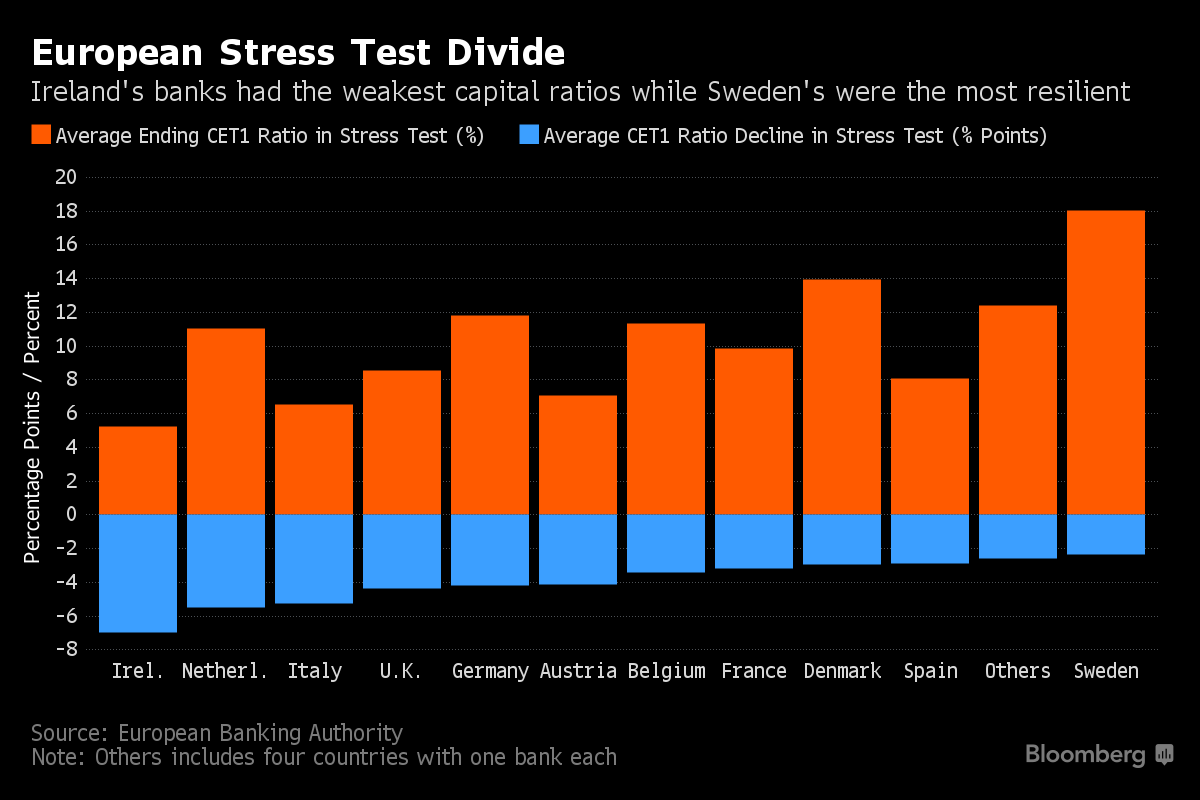
Ireland’s poor performance is clearly a factor of the crash of both the economy and property market from late 2008 onwards. The concentration of NPLs was one of the reasons why AIB and Bank of Ireland fared so badly in recent bank stress tests under the adverse scenario, in spite of both being back in profit and generating capital.
Potential improvements
The EBA said that while there are signs of potential improvements across Europe in terms of dealing with NPLs, asset quality is still weak compared to historical figures and other regions.
In its report, the EBA said action on NPLs was needed, including supervisory actions, structural reforms and development of secondary markets.
AIB chief executive Bernard Byrne told the Oireachtas finance committee last week that NPLs were a major focus of its regulators at the European Central Bank in Frankfurt. He said AIB’s ratio was about 17.5%.
The EBA also found that cyber attacks were on the rise and that banks are “struggling to demonstrate their ability to cope”.
“In this context, supervisory are focusing on IT-related risks including measures to fix rigid and outdated legacy IT systems, IT resilience, and governance and outsourcing,” it said.

As much as 9,300 plus patients on hospital trolleys last month in Ireland

WORST NOVEMBER FIGURES ON RECORD?

Image result for A lot of patients on hospital trolleys in Ireland  Image result for A lot of patients on hospital trolleys in Ireland

OVER 9,300 PATIENTS WERE LEFT WAITING ON IRELAND’S HOSPITAL TROLLEYS LAST MONTH? THE WORST NOVEMBER FIGURES EVER RECORDED, THE IRISH NURSES AND MIDWIVES ORGANISATION (INMO) HAS SAID.

Last month’s figures represent a staggering 99% increase when compared to November 2006, when 4,671 people were left waiting on trolleys. It is also a jump of 26% when compared to the same period last year, when 7,407 people were left on trolleys.
The worst affected hospitals last month included University Hospital Limerick (789), South Tipperary General Hospital (680), Cork University Hospital (648), Our Lady of Lourdes Hospital in Drogheda (607) and University Hospital Galway (594).
However, the news was not all bad. The overall trolley figures from January to November 2016, show a small reduction of 1% when compared to the same period last year. This is the first year a reduction during this period has been recorded since 2006.
Altogether, 85,731 patients were left waiting on trolleys in the first 11 months of this year, compared to 86,864 during the same period last year.
The waiting figures in the east reduced by 21%, with Connolly Hospital in Blanchardstown recording a 48% fall in its trolley waiting figures. However, many hospitals outside of Dublin recorded an increase, with the biggest jump – 162% – recorded in South Tipperary General Hospital.
The INMO said that overall, these figures are ‘very disappointing’, as they confirm that all of the measures taken to date to tackle this issue have failed to work.
“These figures are hugely disappointing, if not surprising, and confirm yet again that our health service cannot cope with the demands being placed upon it. The figures for November are particularly alarming as we enter the peak winter period, with the inevitable increased demand that takes place every year over the next three to four months,” commented INMO general secretary, Liam Doran.

Garda warning after gang target Donegal retailers in credit card scam

Image result for Garda warning after gang target Donegal retailers in credit card scam   Image result for credit card scams in ireland

GARDAƍ ARE WARNING RETAILERS TO BE ESPECIALLY VIGILANT AFTER A DUBLIN BASED GANG USED FALSE CREDIT CARDS AT A NUMBER OF STORES IN LETTERKENNY.

Crime Prevention Officer Sgt Paul Wallace told the Democrat today that the gang made off with thousands of euros worth of high end goods and cash in the scam yesterday evening.
“They used false credit cards to buy high value goods such as phones, laptops, tablets, designer watches and fragrances at a number of shops in Letterkenny on Friday evening. Another tactic they used was to ask for cashback,” he said.
Prevention is the key
Sgt Wallace appealed to shop owners to take a few minutes at the start of the day to ensure all their staff are familiar with the security protocols.
“The criminals are aware that many towns and villages are in the midst of their Christmas promotions. Shops are busy and there are a lot of inexperienced, seasonal staff doing their best.
“Taking ten minutes at the start of the day to go through all the security protocols can save a lot of anguish,” he advised.
Tips for debit and credit card security can be found at http://www.safecard.ie
Owners and staff are also advised to be extra wary if a customer they don’t know immediately asks to see the most expensive range of goods on offer, especially something that could be sold on very easily, or looks for a lot of cash back in addition to their card transactions.
Counterfeit notes in circulation.
In addition, Sgt Wallace warned that false notes, especially €50 and €20 notes, are in circulation.
Again, he said, there are some simple safety measures that can prevent a business being caught out.
“Go to the Central Bank website for guidelines on how to tell the difference between real notes and counterfeits, and ensure that your staff are familiar with these.
“We also recommend using a security light for cards and notes, as that’s the best way to reveal whether important security features are missing.
“There is a lot of helpful information easily available on how to prevent crimes such as these,” Sgt Wallace said. “They key thing is to ensure that you and your staff know about them and can spot such scams as they happen.”

‘We are at the most dangerous moment in the development of humanity’

So says, Stephen Hawking warns we are at risk of destroying Earth
Image result for 'We are at the most dangerous moment in the development of humanity'  Image result for dangerous moment in the development of humanity
  • Professor Hawking said people need to work together to tackle the issues
  • These include environmental threats like climate change and diseases
  • He also mentioned the dangers of people losing jobs to AI and robots
  • The physicist said we have technology capable of destroying the planet
We are living through the most dangerous time in the history of the human race, according to Professor Stephen Hawking.
The Cambridge University physics professor named overpopulation, climate change and diseases as just some of the threats facing our planet.
He said we have developed technology that could destroy Earth, and we must ‘retrain’ for a new world where robots have replaced many everyday jobs.
We are living through the most dangerous time in the history of the human race, according to Professor Stephen Hawking. The Cambridge University physics professor named overpopulation, climate change and diseases as just some of the threats facing our planet
Writing in a comment article in The Guardian, Professor Hawking explained what worries him about the future of our planet.
‘For me, the really concerning aspect of this is that now, more than at any time in our history, our species needs to work together,’ he said.
‘We face awesome environmental challenges: climate change, food production, overpopulation, the decimation of other species, epidemic disease, acidification of the oceans.
‘Together, they are a reminder that we are at the most dangerous moment in the development of humanity.
‘We now have the technology to destroy the planet on which we live, but have not yet developed the ability to escape it.’
‘Perhaps in a few hundred years, we will have established human colonies amid the stars, but right now we only have one planet, and we need to work together to protect it.’
The world-famous physicist has previously issued warnings to the world that robots could wipe out humanity and that leaving Earth is our only hope, and that our days on Earth are numbered,
Professor Hawking said life on Earth is at an ever-increasing risk of being wiped out by a disaster, such as a sudden nuclear war, a genetically engineered virus, or other dangers
In September the physicist warned our planet is becoming a dangerous place because of the threat of war or disease.
Our desire to create helpful digital assistants and self-driving vehicles could bring about our demise.
Professor Stephen Hawking warned that humanity faces an uncertain future as technology learns to think for itself and adapt to its environment.
Speaking at an event in London earlier this year, the physicist told the BBC: ‘The development of full artificial intelligence could spell the end of the human race.’
This echoes claims he made earlier in the year when he said success in creating AI ‘would be the biggest event in human history, [but] unfortunately, it might also be the last.’
He argues that developments in digital personal assistants Siri, Google Now and Cortana are merely symptoms of an IT arms race which ‘pale against what the coming decades will bring.’
But Professor Hawking noted other potential benefits of this technology could also be significant, with the potential to eradicate, war, disease and poverty.
‘Looking further ahead, there are no fundamental limits to what can be achieved,’ continued Professor Hawking.
‘There is no physical law precluding particles from being organised in ways that perform even more advanced computations than the arrangements of particles in human brains.’
‘I believe that life on Earth is at an ever-increasing risk of being wiped out by a disaster, such as a sudden nuclear war, a genetically engineered virus, or other dangers,’ he said.
‘I think the human race has no future if it doesn’t go to space.’
Professor Hawking made similar comments earlier this year while recording the BBC’s annual Reith Lectures on January 7.
The lecture explored research into black holes, and his warning was made during questions fielded by audience members.
When asked how the world will end, Hawking said that increasingly, most of the threats humanity faces come from progress in technology.
The scientist, who turned 74 this year, said the threats include nuclear war, catastrophic global warming and genetically engineered viruses.
‘We are not going to stop making progress, or reverse it, so we must recognise the dangers and control them,’ he said, speaking to Radio Times ahead of the lecture.
To get away from these threats, humankind will have to colonise other planets, which Hawking believes will take more than a century.
‘We will not establish self-sustaining colonies in space for at least the next hundred years, so we have to be very careful in this period,’ Hawking said.
In July, Professor Hawking and Tesla founder Elon Musk led 1,000 robotics experts in an open letter warning that ‘Autonomous weapons will become the Kalashnikovs of tomorrow’
‘The probable life span of human civilization is much greater if we’re a multi-planet species as opposed to a single-planet species,’ Elon Musk said last year.
‘If we’re a single planet species, then eventually there will be some extinction event,’ Mr Musk said.
His company SpaceX is working to send humans to space.
Last week the firm test fired one of its new Raptor ‘interplanetary transport engines’ which the company will use to carry astronauts to Mars.
This week the US Senate introduced a bipartisan bill that authorizes a new $19.5 billion (£15 billion) budget for Nasa to send a crew to the red planet, but mandated it must happen within the next 25 years
The rocket engine is three times more powerful than the one on the Falcon 9 rockets. It will ultimately be used to launch SpaceX’s manned spacecraft off our planet.
Mr Musk, chief executive of SpaceX, said the rocket will be ultimately capable of producing thrust of 690,000lbs over 382 seconds.
The engine is powered using liquid methane and liquid oxygen rather than the kerosene used in the Merlin engines of its Falcon 9 rockets.   

Sunday, September 18, 2016

Donie's Ireland daily news BLOG update

Why Nama is in such deep trouble over Project Eagle

STATE AGENCY SHOULD HAVE BLOWN THE WHISTLE ON NORTHERN IRELAND SALE BUT CHOSE NOT TO

Image result for Why Nama is in such deep trouble over Project Eagle   Image result for Why Nama is in such deep trouble over Project Eagle   Image result for Why Nama is in such deep trouble over Project Eagle

WHAT REALLY MATTERS IS THAT NAMA CHOSE TO IGNORE THE BIG RED FLAG RAISED BY PIMCO AND PROCEEDED TO SELL THE NORTHERN IRELAND PROPERTY LOAN BOOK TO CERBERUS.

Here is a question that might help you understand why Nama is in such a lot of trouble.
Imagine you are selling your house and have agreed a deal with someone. They then come along to you and say they are pulling out of the sale because they don’t like the way their solicitor is behaving. They suspect that things are not being done properly. They tell you their conscience will not let them be a party to what is going on.
A week later another buyer comes along and offers you much the same price but crucially they are using the same solicitor as the previous bidder.
You have two options:
  1. Ask the solicitor if something dodgy is going on and when he tells you he is as pure as the driven snow, you proceed to sell your house, get your money and move on. Your behaviour is legal and commercially sound.
B . Decide that you too cannot be party to something potentially dodgy. You pull out of the sale. You ring the gardaĆ­ and end up being involved in a long investigation. Other buyers start to think you are messing and that something is wrong with your house. The price falls.
Which option would you take? A? If so, then you are Nama.
Only it is not your house you are selling, it is a portfolio of properties inNorthern Ireland that is worth €1.5 billion. It is Project Eagle.
The first buyer is the US investment fund Pimco and the second is one of their peers, Cerberus.
Replace the first buyer’s conscience with Pimco’s compliance department – the people that make sure they don’t inadvertently break the law.
Replace the anonymous solicitor with law firms Brown Rudnick and Tughan and a number of prominent Northern Irish figures.
Moral dilemma
Now. Change the question to: which option should you take? And you start to see Nama’s problem. It’s more than likely that you would say B. You know you have a duty as citizen to help uphold the law and all that even if it comes at a personal cost.
And this is the problem Nama now faces. It chose A when it should have chosen B.
An individual that takes option A has only to answer to their conscience. Nama, however, is answerable to us all.
It is a State agency. It may have a commercial mandate and a very, very difficult job to do but it is ultimately an arm of the State. And the Government must be held to the highest standard. It must aspire to do what it should do in any situation, not what makes commercial sense. It’s simplistic and it’s naive but it is true none the less.
When Nama chose to sell Project Eagle to Cerberus after Pimco pulled out it lost sight of this simple fact.
It chose to overlook the obvious possibility that something suspicious was going on in the background in Northern Ireland that it should really have blown the whistle on. Right now it probably wishes it had.
For the last week, we have been subjected to the unedifying sight of two State agencies having a public squabble.
Nama and the Comptroller and Auditor General have been arguing about what the Project Eagle portfolio was really worth.
It is essentially an argument about the length of a piece of string. The price is irrelevant.
What really matters is that Nama chose to ignore the big red flag raised by Pimco and proceeded to sell the portfolio to Cerberus.
We know that it shouldn’t have and we now need to know why it did.
Temporary blindness
Was it simply a case of Nama’s commercial imperative blinding it to the bigger picture?
Nama has succeeded on its own terms and will return a profit of €2 billion to the State that will offset some of the billions poured into the banks following the crash and bailout.
But it is easy to forget that this was not a certainty in 2013 and 2014.
It also has to be remembered that there was a great deal of political pressure on the agency to sell its assets and disappear.
And this raises perhaps the most interesting question of all.
To what extent did this pressure on Nama from the government of the day drive the agency on – directly or indirectly – to do something that no government could really stand over? Turning a blind eye to possible criminal activity.
Actually, that is not the most interesting question when you think about it.
The most interesting question is: to what extent was the Irish government influenced by Northern politicians whose links to the intermediaries advising Cerberus are the focus of several investigations?

Young teachers in ASTI are €6,000 a year worse off after new pay deal

Image result for Young teachers in ASTI are €6,000 a year worse off after new pay deal   Image result for Young teachers in ASTI are €6,000 a year worse off after new pay deal

THOUSANDS OF YOUNG TEACHERS IN THE ASTI WILL BE €6,000 A YEAR WORSE OFF IF THE UNION CONTINUES ITS WAR WITH GOVERNMENT.

They are already on €796 a year less and, by January, the gap will rise to almost €1,800, and continue widening over 15 months.
By January 2018, the pay differential between young teachers will have grown to 20pc – depending on the union they are in.
An agreement announced yesterday gives newly-qualified teachers an increase of up to €2,000 a year, on top of pay restoration measures in the Lansdowne Road Agreement (LRA), which are being rolled out from this month.
But, only members of teacher unions that have signed up to the LRA – currently, the Irish National Teachers’ Organisation (INTO) and the Teachers’ Union of Ireland (TUI) – will receive the increases.
The 18,0000-member Association of Secondary Teachers Ireland (ASTI) has rejected the LRA, and as a result is also excluded from the new deal, which eliminates a key contributor to two-tier pay scales.
A teacher recruited this month, who is a member of the ASTI, is on a starting salary of €31,009, which remains frozen while they are outside the LRA.
Meanwhile, INTO and TUI members are on €31,805 – including restoration this month of €796, half an allowance for supervision and substitution duties – which will rise to €37,059 by January 2018,
There are corresponding increases for all new teachers recruited since 2012 – who suffered the most severe pay cuts – who are members of unions that have signed up to the LRA.
There is still an outstanding issue on pay equality for teachers and other pubic servants recruited in recent years, which is the general 10pc cut in pay scales implemented in 2011.
INTO general secretary Sheila Nunan said yesterday’s deal represented “significant progress” and that “for the first time, teachers who began since 2012 will have the same earnings path as all other teachers and will reach the same maximum point of salary scale.”
TUI president Joanne Irwin said it was a very significant step in the right direction in addressing the pay inequality suffered by teachers.
But the ASTI remains determined to continue its campaign on a number of pay-related fronts, which could close more than half the country’s second-level schools by end of October/early November.
The ASTI is conducting two ballots later this month, one seeking a mandate for strike action on the issue of pay for newly-qualified teachers.
The second ballot is seeking support for withdrawal from supervision and substitution duties, which would force schools to close because of lack of cover.
Powerful union.
The union’s powerful Standing Committee met yesterday and, in a statement afterwards, the ASTI said it was “campaigning for the full restoration of new teachers’ pay.”
The ASTI said that it was not party to the LRA and had received no offer on the restoration of new teachers’ pay.
“We will continue to pursue a resolution through talks. We want equal pay for equal work. ASTI members have rejected the LRA for a number of reasons, including its failure to deliver pay equalisation for new teachers,” said ASTI president Ed Byrne.

PTSB to raise mortgage extra cash in bond market for new Irish loans

Image result for PTSB to raise mortgage extra cash in bond market for new Irish loans    Image result for PTSB to raise mortgage extra cash in bond market for new Irish loans

THE PERMANENT TSB IS PLANNING TO BORROW €690M IN BOND DEBT BACKED BY IRISH HOME LOANS.

The bank has mandated Morgan Stanley as sole arranger for the transaction with Citibank, and Deutsche Bank acting along side the US giant as joint lead managers.
A road show is being held to market the bonds to potential investors.
The new bonds will be backed by a bundle of performing Irish home loans, none of which is more than one month in arrears.
The home loans behind the bond are low risk, all are owner occupier loans and the average loan to value ratio is 60pc.
Mortgage securitisation deals allow banks to access extra cash for new loans, by borrowing against loans already made. Before the crash such deals were a mainstay of the market, but they have slowed to a trickle.
Permanent tsb has not issued a deal since 2013 and no Irish bank has placed residential mortgage backed bonds with investors since May 2015.

Eye-level signs make perfect sense for dangerous beach at Strandhill Sligo

Image result for dangerous beach for swimming at Strandhill Sligo   Image result for dangerous beach for swimming at Strandhill Sligo  Image result for dangerous beach for swimming at Strandhill Sligo

A MOTHER WHO HAD ALLOWED HER FOUR CHILDREN TO SWIM AT STRANDHILL IS ONE OF THE LATEST PEOPLE TO CLAIM THEY DIDN’T SEE ANY PROHIBITING BATHING SIGNS ON THEIR WAY DOWN TO THE BEACH.

That’s according to Councillor Rosaleen O’Grady who told the meeting that she had never seen as many people in bathing there as she had this year.
“I saw a woman whose four children, aged 5-9 years were in the water. When I told her about it being prohibited, she said she didn’t see signage,” said Cllr O’Grady.
Image result for children swimming at Strandhill Sligo  She added that the woman suggested that if the signs were at eye-level she might have seen them. “I suppose she might have had a point. Signage could be put at the slip-way. I have a huge concern, people don’t seem to be heeding,” she said.
Director of Services Tom Kilfeather told members that new signs had been installed at either end of the beach after consulting with the RNLI. He also said that Irish Water Safety were currently carrying out a risk assessment on Strandhill beach. “The appropriateness level of signage and their location will be considered in that review,” he said.
Cllr O’Grady said that a risk assessment was “the way forward”. “Whatever is wrong, people are using it for bathing more and more. As people enter the water via the slipway, if there was something there at eye-level it might help,” she said.
Cathaoirleach of the County Council Cllr Hubert Keaney said it was The Sligo Champion’s recent coverage of the issue that drew his attention to the matter.
“To see people swimming there the same week as five people drowned in the UK…I was horrified because there were young children in the photo,” he said.
Cllr Sean MacManus said that he also spoke to people who didn’t see the signs. “There’s a school of thought out there that there were too many signs. What Cllr O’Grady says about signs at eye-level makes a lot of sense,” he added.

The Pacific Ocean has hidden wonders revealed on dive to underwater volcano

The Pisces IV submersible sits on the summit of Cook seamount, as seen from the Pisces V craft, during a dive to the previously unexplored underwater volcano off the coast of Hawaii’s Big Island.  Researcher Sonia Rowley logs coral samples taken from the Cook seamount expedition.   Image result for The Pacific Ocean has hidden wonders revealed on dive to underwater volcano

US SCIENTISTS FIND POSSIBLE NEW CORAL SPECIES AND RARE DUMBO OCTOPUS ON EXPEDITION TO PREVIOUSLY UNEXPLORED EXTINCT VOLCANO OFF HAWAII

Deep sea coral at the summit of the Cook seamount. ‘It won’t be any surprise to me [if this is] a new species,’ said researcher Sonia Rowley.
Image result for Scientists believe they have identified a new species of coral and found a rare Dumbo octopus Scientists believe they have identified a new species of coral and found a rare Dumbo octopus during an expedition 3,000ft (900m) down in the Pacific Ocean.
Diving in a submersible to the previously unexplored Cook seamount, an extinct volcano at the bottom of the sea 100 miles south-west of Hawaii’s Big Island, the three-person team was hoping to examine the rich variety of marine life that collects around the nutrient-rich volcanic waters.
Among other things, the researchers from the University of Hawaii and the nonprofit group Conservation International spotted such wonders as a rare type of octopus with big fins that look like Dumbo’s ears, and a potentially new species of violet-hued coral they dubbed Purple Haze.
Conservation International hopes to study 50 seamounts, or undersea volcanoes, over the next five years.
“We don’t know anything about the ocean floor,” said Peter Seligmann, chairman, CEO and co-founder of Conservation International. “What we know is that each one of those seamounts is a refuge for new species, but we don’t know what they are. We don’t know how they’ve evolved. We don’t know what lessons they have for us.”
“We don’t know what we’re going to find,” Conservation International’s Greg Stone told the Associated Press reporter on board the submersible. “There will always be the unexpected when you go into the deep ocean.”
Halfway down to the volcano, which rises 13,000ft-high (4,000m)from the ocean floor, no sunlight penetrated. The only light that could be seen from the submarine’s face-sized windows was the bluish glow of the vessel’s own bright lights. Occasionally, bioluminescent creatures drifted past in the darkness.
Stone and subpilot Terry Kerby, who helps run the Hawaii undersea research laboratory at the University of Hawaii, watched as the volcano and its rugged basalt walls came into view.
Seamounts are either active or dormant volcanoes that rise from the bottom of the ocean and never reach the surface. They are hotspots for marine life because they carry nutrient-rich water upward from the sea floor. Seamounts are believed to cover about 18 million square miles of the planet.
Cook seamount is part of a group of undersea volcanoes known as the Geologist Seamounts that are about 80 million years old and could hold many new animal species, as well as elements such as nickel and cobalt that mining companies could extract.
“My goal today is to … find out what’s living on them, find out how they support ocean life, what their effect is from ocean currents and essentially what drives the ocean, what makes the ocean what it is,” said Stone. “Seamounts are a key part of that, and something which humanity knows very little about.”
The Pisces IV submersible sits on the summit of Cook seamount, as seen from the Pisces V craft, during a dive to the previously unexplored underwater volcano off the coast of Hawaii’s Big Island.
Within minutes of the vessel’s arrival at the summit, life began to appear — a starfish clinging to a rock, joined shortly after by eels, sharks, chimaera (also known as “ghost sharks”), shrimp, crabs and two rare Dumbo octopuses. One of the octopuses changed color from white to pink to reddish brown as it swam by.
Several types of deep-sea corals were found along the seamount’s cliffs, including a vibrant purple one.
“I need to go home, look through the literature … and also go and run some genetic analyses,” said Sonia Rowley, a postdoctoral researcher at the University of Hawaii who is taking part in the project. “But as this is a new seamount … that no one had dived on before, it won’t be any surprise to me whether this is going to be a new species.”
Two other seamounts were studied over three days of expeditions: McCall, home to a large number of small deep-sea sharks, and Lo’ihi, an active volcano.
Lo’Ihi has been extensively surveyed by manned submersibles over the past 30 years. The past few times Kerby was there, he saw a large Pacific sleeper shark lurking about the volcano’s crater.
As hot vents shot out volcanic gases around them, the team released bait in the water and the 7-foot shark appeared in front of the submarine. Kerby was delighted to see his “old friend.”
The team also saw 6-foot eels and a number of new geological formations around the crater. Scientists say Lo’ihi is likely to someday become the newest island in the Hawaii chain as volcanic activity pushes the summit upward.