Pages

Showing posts with label VAT. Show all posts

Sunday, December 4, 2016

Donie's news Ireland daily BLOG update

Irish Tax trends show VAT is now the weakest link

Image result for Irish Tax trends show VAT is now the weakest link Image result for The latest Irish tax returns showed strong growth in tax revenues, led by better than expected corporation tax.

THE LATEST IRISH TAX RETURNS SHOWED STRONG GROWTH IN TAX REVENUES, LED BY BETTER THAN EXPECTED CORPORATION TAX.

The latest Exchequer returns for November show the State is well on track to hit its deficit forecast for the year, but with signs Brexit and sterling may be starting to have an impact.
VAT income in particular was coming in less strongly than expected.
As has been the trend, the latest returns showed strong growth in tax revenues, led by better than expected corporation tax. Total revenues this year were now €777m higher than profile, or expectations. Spending was coming in €784m below profile.
That leaves the Exchequer better off, with an excess of spending over income of €407m compared to €1.7bn last year.
Exchequer Returns to the end of November showed more tax had been paid this year than at the same time in 2015 across all four of the main areas.
As well as corporation tax coming in ahead, income tax ended November 5.9pc, or €978m, higher than at the same time last year.
However, VAT receipts closed November 6.6pc or €128m behind expectations. The Department of Finance said that was mainly accounted for by larger than expected repayments.
VAT receipts were now €413m below profile for the year to date, though in absolute terms up from last year. Excise duties recorded an expected shortfall of €24m in November, but were running just ahead of profile for the year.
“The trend in VAT receipts is a little concerning: these were 6.6pc behind profile in November, the final ‘due’ month of the year. VAT receipts are now €413m (-3.2pc) behind profile year-to-date, which might reflect the softer retail sales data in recent months,” David McNamara of Davy Stockbrokers said.
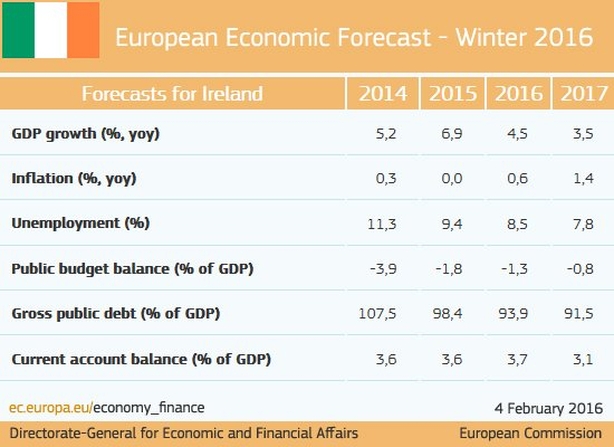
Meanwhile, the European Commission has said Ireland’s economic prospects remain bright, but warned of “clouds” on the horizon. The warning came following the conclusion of the sixth post-programme surveillance mission. The statement by the commission said: “GDP is expected to continue to grow, the future evolution of the activities of multinational enterprises remains uncertain and the external environment has become increasingly unpredictable, especially after the UK ‘leave’ vote.”

Ireland’s Central Bank denies turning away UK businesses

Image result for Ireland's Central Bank denies turning away UK businesses  Central Bank Governor Philip Lane has tweaked one of the levers of mortgage lending. Photo: Gareth Chaney / Collins
Cyril Roux, deputy governor & the Governor Philip Lane of the Central Bank of Ireland .

THE REPUBLIC OF IRELAND’S CENTRAL BANK HAS NOT TRIED TO TURN ANY UK BANKS OR FIRMS OFF SETTING UP IN IRELAND IN THE WAKE OF THE BREXIT VOTE, ITS DEPUTY HEAD SAID YESTERDAY.

Cyril Roux, the deputy governor of the Central Bank, insisted that the regulator had not discouraged investment banking or trading in Dublin, contrary to recent reports.
The statement contradicts claims that Irish authorities had discouraged UK companies from relocating in the Irish Republic after Brexit because of regulatory concerns about how they would be policed.
But Mr Roux was adamant this was not the case. “I want to be clear… we do not have such a position,” he said.
“We have not sought to dissuade any such entities from seeking authorisation, nor are we planning to do so.”
However, he reiterated that the Republic’s Central Bank  would only allow new businesses into Ireland that have a “substantive presence” in the country. Mr Roux said the bank was not concerned about the arrival of major firms, but that smaller financial institutions may attempt to use Ireland as a convenient base within Europe, while the companies retain their real operations in the UK.
“The flagship firms are not a problem,” he added. “They don’t expect to bring a big balance sheet here and have a handful of people.
“There are some other firms of a different nature who believe you can just come here and nail a brass plate and rent a room and keep on doing everything from the UK. We have to tell them it’s not going to happen.
“The Irish financial sector is set to grow, and quite possible to a significant extent.
“The bank is committed to meeting the challenge.”

Ireland fifth in Europe for non-performing bank loans

RATIO AFFECTS BANK STRESS TESTS PERFORMANCES, WITH SME SECTOR HIGHEST AT 30%

Image result for Ireland fifth in Europe for non-performing bank loans  
The CEO of AIB Bernard Byrne (above left) said the bank’s NPL ratio was about 17.5%.
Ireland has ranked fifth among European states in terms of the ratio of non-performing loans (NPLs) held by its banks, according to a report by the European Banking Authority in London.
The analysis shows Ireland with an NPL ratio of just more than 20%, ranking fifth behind Cyprus, Greece, Portugal and Slovenia.
Across the board, the rate was 5.4% with Luxembourg the best in class with a figure of about 1.5%.
In Ireland, the ratio was worst for the SME sector at 30%, with large corporates at about 13% and households at 15%.
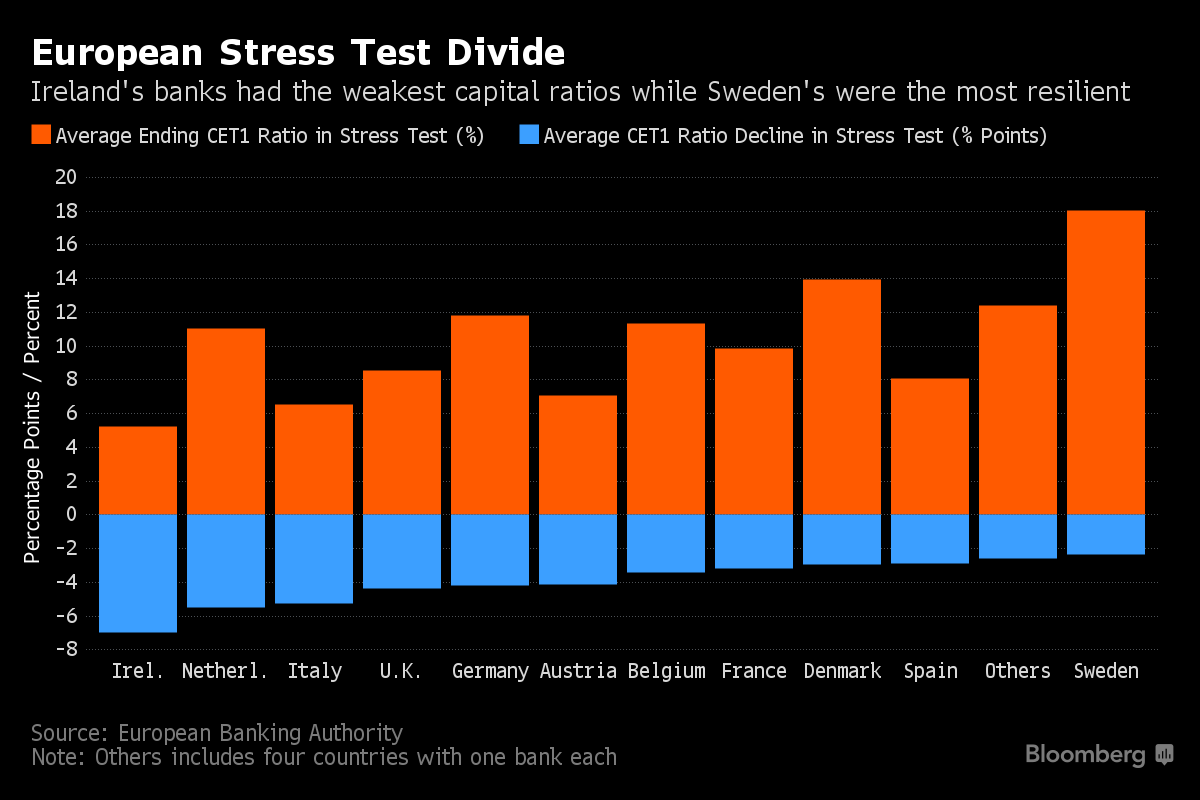
Ireland’s poor performance is clearly a factor of the crash of both the economy and property market from late 2008 onwards. The concentration of NPLs was one of the reasons why AIB and Bank of Ireland fared so badly in recent bank stress tests under the adverse scenario, in spite of both being back in profit and generating capital.
Potential improvements
The EBA said that while there are signs of potential improvements across Europe in terms of dealing with NPLs, asset quality is still weak compared to historical figures and other regions.
In its report, the EBA said action on NPLs was needed, including supervisory actions, structural reforms and development of secondary markets.
AIB chief executive Bernard Byrne told the Oireachtas finance committee last week that NPLs were a major focus of its regulators at the European Central Bank in Frankfurt. He said AIB’s ratio was about 17.5%.
The EBA also found that cyber attacks were on the rise and that banks are “struggling to demonstrate their ability to cope”.
“In this context, supervisory are focusing on IT-related risks including measures to fix rigid and outdated legacy IT systems, IT resilience, and governance and outsourcing,” it said.

As much as 9,300 plus patients on hospital trolleys last month in Ireland

WORST NOVEMBER FIGURES ON RECORD?

Image result for A lot of patients on hospital trolleys in Ireland  Image result for A lot of patients on hospital trolleys in Ireland

OVER 9,300 PATIENTS WERE LEFT WAITING ON IRELAND’S HOSPITAL TROLLEYS LAST MONTH? THE WORST NOVEMBER FIGURES EVER RECORDED, THE IRISH NURSES AND MIDWIVES ORGANISATION (INMO) HAS SAID.

Last month’s figures represent a staggering 99% increase when compared to November 2006, when 4,671 people were left waiting on trolleys. It is also a jump of 26% when compared to the same period last year, when 7,407 people were left on trolleys.
The worst affected hospitals last month included University Hospital Limerick (789), South Tipperary General Hospital (680), Cork University Hospital (648), Our Lady of Lourdes Hospital in Drogheda (607) and University Hospital Galway (594).
However, the news was not all bad. The overall trolley figures from January to November 2016, show a small reduction of 1% when compared to the same period last year. This is the first year a reduction during this period has been recorded since 2006.
Altogether, 85,731 patients were left waiting on trolleys in the first 11 months of this year, compared to 86,864 during the same period last year.
The waiting figures in the east reduced by 21%, with Connolly Hospital in Blanchardstown recording a 48% fall in its trolley waiting figures. However, many hospitals outside of Dublin recorded an increase, with the biggest jump – 162% – recorded in South Tipperary General Hospital.
The INMO said that overall, these figures are ‘very disappointing’, as they confirm that all of the measures taken to date to tackle this issue have failed to work.
“These figures are hugely disappointing, if not surprising, and confirm yet again that our health service cannot cope with the demands being placed upon it. The figures for November are particularly alarming as we enter the peak winter period, with the inevitable increased demand that takes place every year over the next three to four months,” commented INMO general secretary, Liam Doran.

Garda warning after gang target Donegal retailers in credit card scam

Image result for Garda warning after gang target Donegal retailers in credit card scam   Image result for credit card scams in ireland

GARDAƍ ARE WARNING RETAILERS TO BE ESPECIALLY VIGILANT AFTER A DUBLIN BASED GANG USED FALSE CREDIT CARDS AT A NUMBER OF STORES IN LETTERKENNY.

Crime Prevention Officer Sgt Paul Wallace told the Democrat today that the gang made off with thousands of euros worth of high end goods and cash in the scam yesterday evening.
“They used false credit cards to buy high value goods such as phones, laptops, tablets, designer watches and fragrances at a number of shops in Letterkenny on Friday evening. Another tactic they used was to ask for cashback,” he said.
Prevention is the key
Sgt Wallace appealed to shop owners to take a few minutes at the start of the day to ensure all their staff are familiar with the security protocols.
“The criminals are aware that many towns and villages are in the midst of their Christmas promotions. Shops are busy and there are a lot of inexperienced, seasonal staff doing their best.
“Taking ten minutes at the start of the day to go through all the security protocols can save a lot of anguish,” he advised.
Tips for debit and credit card security can be found at http://www.safecard.ie
Owners and staff are also advised to be extra wary if a customer they don’t know immediately asks to see the most expensive range of goods on offer, especially something that could be sold on very easily, or looks for a lot of cash back in addition to their card transactions.
Counterfeit notes in circulation.
In addition, Sgt Wallace warned that false notes, especially €50 and €20 notes, are in circulation.
Again, he said, there are some simple safety measures that can prevent a business being caught out.
“Go to the Central Bank website for guidelines on how to tell the difference between real notes and counterfeits, and ensure that your staff are familiar with these.
“We also recommend using a security light for cards and notes, as that’s the best way to reveal whether important security features are missing.
“There is a lot of helpful information easily available on how to prevent crimes such as these,” Sgt Wallace said. “They key thing is to ensure that you and your staff know about them and can spot such scams as they happen.”

‘We are at the most dangerous moment in the development of humanity’

So says, Stephen Hawking warns we are at risk of destroying Earth
Image result for 'We are at the most dangerous moment in the development of humanity'  Image result for dangerous moment in the development of humanity
  • Professor Hawking said people need to work together to tackle the issues
  • These include environmental threats like climate change and diseases
  • He also mentioned the dangers of people losing jobs to AI and robots
  • The physicist said we have technology capable of destroying the planet
We are living through the most dangerous time in the history of the human race, according to Professor Stephen Hawking.
The Cambridge University physics professor named overpopulation, climate change and diseases as just some of the threats facing our planet.
He said we have developed technology that could destroy Earth, and we must ‘retrain’ for a new world where robots have replaced many everyday jobs.
We are living through the most dangerous time in the history of the human race, according to Professor Stephen Hawking. The Cambridge University physics professor named overpopulation, climate change and diseases as just some of the threats facing our planet
Writing in a comment article in The Guardian, Professor Hawking explained what worries him about the future of our planet.
‘For me, the really concerning aspect of this is that now, more than at any time in our history, our species needs to work together,’ he said.
‘We face awesome environmental challenges: climate change, food production, overpopulation, the decimation of other species, epidemic disease, acidification of the oceans.
‘Together, they are a reminder that we are at the most dangerous moment in the development of humanity.
‘We now have the technology to destroy the planet on which we live, but have not yet developed the ability to escape it.’
‘Perhaps in a few hundred years, we will have established human colonies amid the stars, but right now we only have one planet, and we need to work together to protect it.’
The world-famous physicist has previously issued warnings to the world that robots could wipe out humanity and that leaving Earth is our only hope, and that our days on Earth are numbered,
Professor Hawking said life on Earth is at an ever-increasing risk of being wiped out by a disaster, such as a sudden nuclear war, a genetically engineered virus, or other dangers
In September the physicist warned our planet is becoming a dangerous place because of the threat of war or disease.
Our desire to create helpful digital assistants and self-driving vehicles could bring about our demise.
Professor Stephen Hawking warned that humanity faces an uncertain future as technology learns to think for itself and adapt to its environment.
Speaking at an event in London earlier this year, the physicist told the BBC: ‘The development of full artificial intelligence could spell the end of the human race.’
This echoes claims he made earlier in the year when he said success in creating AI ‘would be the biggest event in human history, [but] unfortunately, it might also be the last.’
He argues that developments in digital personal assistants Siri, Google Now and Cortana are merely symptoms of an IT arms race which ‘pale against what the coming decades will bring.’
But Professor Hawking noted other potential benefits of this technology could also be significant, with the potential to eradicate, war, disease and poverty.
‘Looking further ahead, there are no fundamental limits to what can be achieved,’ continued Professor Hawking.
‘There is no physical law precluding particles from being organised in ways that perform even more advanced computations than the arrangements of particles in human brains.’
‘I believe that life on Earth is at an ever-increasing risk of being wiped out by a disaster, such as a sudden nuclear war, a genetically engineered virus, or other dangers,’ he said.
‘I think the human race has no future if it doesn’t go to space.’
Professor Hawking made similar comments earlier this year while recording the BBC’s annual Reith Lectures on January 7.
The lecture explored research into black holes, and his warning was made during questions fielded by audience members.
When asked how the world will end, Hawking said that increasingly, most of the threats humanity faces come from progress in technology.
The scientist, who turned 74 this year, said the threats include nuclear war, catastrophic global warming and genetically engineered viruses.
‘We are not going to stop making progress, or reverse it, so we must recognise the dangers and control them,’ he said, speaking to Radio Times ahead of the lecture.
To get away from these threats, humankind will have to colonise other planets, which Hawking believes will take more than a century.
‘We will not establish self-sustaining colonies in space for at least the next hundred years, so we have to be very careful in this period,’ Hawking said.
In July, Professor Hawking and Tesla founder Elon Musk led 1,000 robotics experts in an open letter warning that ‘Autonomous weapons will become the Kalashnikovs of tomorrow’
‘The probable life span of human civilization is much greater if we’re a multi-planet species as opposed to a single-planet species,’ Elon Musk said last year.
‘If we’re a single planet species, then eventually there will be some extinction event,’ Mr Musk said.
His company SpaceX is working to send humans to space.
Last week the firm test fired one of its new Raptor ‘interplanetary transport engines’ which the company will use to carry astronauts to Mars.
This week the US Senate introduced a bipartisan bill that authorizes a new $19.5 billion (£15 billion) budget for Nasa to send a crew to the red planet, but mandated it must happen within the next 25 years
The rocket engine is three times more powerful than the one on the Falcon 9 rockets. It will ultimately be used to launch SpaceX’s manned spacecraft off our planet.
Mr Musk, chief executive of SpaceX, said the rocket will be ultimately capable of producing thrust of 690,000lbs over 382 seconds.
The engine is powered using liquid methane and liquid oxygen rather than the kerosene used in the Merlin engines of its Falcon 9 rockets.   

Saturday, August 20, 2016

Donie's Ireland daily news BLOG update

CSO had intensive talks with EU officials on Ireland’s GDP surge

EUROSTAT ACCEPTS HOW IRELAND CALCULATES GDP, CSO SAYS IRISH VISIT A ‘FINAL VERIFICATION’


THE FORTHCOMING EUROSTAT VISIT IS ‘ROUTINE’, ACCORDING TO THE CSO.

The Central Statistics Office said it has held “intensive discussions” with the EU’s statistics agency on the recent sharp revision of Ireland’s economic growth last year to 26%.
“Eurostat has held intensive discussions with the CSO on the changes to our National Accounts and Balance of Payments statistics, driven by the location of capital assets in Ireland and accepts the recent [gross domestic product] revisions,” Jennifer Banim, assistant director general with the CSO, said.
A planned mission by Eurostat staff to Ireland next month reported last Thursday on receipt of records released under the Freedom of Information Act, amounts to “final verification” of the data.
Eurostat said in the internal document, circulated to Irish officials last month, that the initial explanations provided by Ireland for the surprising data “look plausible”.

‘A ROUTINE PROCESS’

“The forthcoming Eurostat visit is part of an ongoing routine process of verification of GDP and GNI (gross national income) figures for all states,” Ms Banim said.
  • ‘Leprechaun economics’: EU mission to audit 26% GDP rise
The GDP revision on July 12th has prompted widespread criticism among economists about the relevance of the data, which has skewed various widely-followed gauges, including Government debt relative to the economy’s size. Moody’s, one of the world’s main credit ratings agencies, said at the time that the country’s highly volatile economic performance is one of its main concerns about the country’s creditworthiness.
The surge, including the impact of US companies merging with Irish firms to gain a tax benefit, contract manufacturing and aircraft leasing activity, served to push Ireland’s debt level below 80% of GDP compared to previous estimates of 94%.
While the CSO calculated GDP along Eurostat criteria, Nobel Prize-winning economist Paul Krugman famously said last month the Irish figures were best summed up as “leprechaun economics”.
The GDP statistics “accurately reflect the complex and highly globalised nature of the Irish economy,” Ms Banin said. “In this context, the figures are highly relevant and plan an important role in understanding the complexity of our economy.”

Vat cut in 2011 drives increase in Irish hospitality jobs


THE RESTAURANTS ASSOCIATION OF IRELAND IS CLAIMING THE CREATION OF 45,260 NEW JOBS IN THE HOSPITALITY AND FOOD SECTOR SINCE 2011 IS LARGELY DUE TO A REDUCED VAT RATE FOR THE SECTOR.

A report by economist Jim Power, which the association commissioned, looked at direct and indirect jobs created and an estimate of the social welfare savings, as well as the increase in revenue for the exchequer.
Using statistics from the Central Statistics Office, it concluded the number of people directly employed in the accommodation and food services sector was 145,900 in the first quarter of this year which was 31,000 more than in the second quarter of 2011.
The report argued if the “multiplier effect” was applied to the total number of employees, the number of indirect jobs increased by 14,260.
The association said the total contribution to the exchequer through payroll taxes from the sector is €695m.
“The total contribution to the exchequer is €147.6m,” it said. “The reduction in social welfare payments, assuming the extra employment took people off the live register, is estimated at €620m.”
Adrian Cummins, the association’s chief executive, said: “Our report highlights that the introduction of the low Vat rate in July 2011 has been a major driver of local employment growth.
He added: “45,260 new jobs have been created in the food and accommodation sector across the whole country since this initiative has been introduced.
“Our figures show that 31,000 direct jobs and 14,260 indirect jobs have been developed in this sector since July 2011. It is a substantial number of new jobs to result from just one government action. The 9% Vat rate has benefited regions greatly across the country and we would like to see that maintained.”
The association also pointed out that on a national scale, tourism has also increased every year since the new Vat rate was introduced, with overall visits to Ireland rising by almost 30% since July 2011.
“There is further good news for Ireland’s tourism sector regarding Ireland’s Value for Money (VFM) rating as the number of visitors rating Ireland ‘good’ or ‘very good’ VFM has increased from 28% to 58% from 2009 to 2015 and the number of visitors rating Ireland ‘very poor’ or ‘poor’ for VFM has fallen sharply from 40% in 2009 to 8% in 2015,” it said.
Last year, Siptu criticised the failure of Minister for Finance Michael Noonan, in Budget 2016, to end the 9% Vat rate for the hotel and restaurant sector.
It said retention of the Vat break came at a time when the tourism and hospitality sector was experiencing steady growth and increased revenues, but said employers in the hospitality sector were continuing to veto the Joint Labour Committee (JLC) process for agreeing statutory minimum wages and conditions for workers in the sector.

Promoting the West of Ireland in Britain a good initiative


TOURISM IRELAND HAS TEAMED UP WITH FLYBE AND IRELAND WEST AIRPORT KNOCK TO PROMOTE FLIGHTS TO KNOCK FROM MANCHESTER, BIRMINGHAM AND EDINBURGH AND GROW TOURIST NUMBERS TO THE WEST OF IRELAND THIS AUTUMN. THE JOINT CAMPAIGN WILL RUN IN BRITAIN DURING AUGUST AND SEPTEMBER.

Working with airlines and airports to build demand for flights is a key priority for Tourism Ireland and this campaign includes an online article in the Daily Record in Scotland, and an online article in the Birmingham Mail and the Manchester Evening News.
Julie, Tourism Ireland’s Deputy Head of Great Britain, said: “We are delighted to partner with Flybe and Ireland West Airport Knock once again, to maximise the promotion of flights from Birmingham, Edinburgh and Manchester and help grow tourist numbers to the West of Ireland this autumn.”

Ireland’s Filipino adoption deal gets the go ahead


A WELCOME AND POSITIVE DEVELOPMENT IN THE BEST INTEREST OF CHILDREN: THAT’S THE CHILDREN’S RIGHTS ALLIANCE RESPONSE TO IRELAND’S AGREEMENT ON INTER-COUNTRY ADOPTION WITH THE PHILIPPINES.

Chief executive Tanya Ward said the importance of adoption agreements, such as the process signed in Dublin yesterday between Ireland and the Philippines, could not be overstated.
“Given the sums of money involved, inter-country adoption can encourage malpractice and corruption, with children and prospective adoptive parents at risk of being exploited for financial gain,” she said.
“Children have been denied the right to grow up with their parents and families because of child trafficking, abduction, and through the deception of birth parents.”
The Children’s Rights Alliance represents a group of organisations working to ensure the rights of all children and young people in Ireland are respected.
Ms Ward said Ireland and the Philippines had ratified the 1993 Hague Convention on Protection of Children and Co-operation in Respect of Inter-country Adoption and it clearly outlined how the adoption process would operate between the countries.
Minister for Children and Youth Affairs, Dr Katherine Zappone said the convention provided an assurance for children, their families and the state that appropriate procedures had been followed and that the adoption was in the best interests of the child.
“My aim is to have safe and secure adoptions. It is against this background that my department is working to create the appropriate legislation, policy and administrative frameworks which will ensure a well-regulated regime of adoption,” said Ms Zappone.
She believed the agreement between the Adoption Authority of Ireland and the Philippines Inter-country Adoption Board would provide a clear road map on how the inter-country adoption process would operate between Ireland and the Philippines.
The agreement on administrative arrangements between the two countries was drafted by the chair of the Adoption Authority of Ireland, Dr Geoffrey Shannon, who said it reflected the legal diversity and common goals of the contracting states.
There have been 10 children adopted from the Philippines since the establishment of the Adoption Authority in 2010.
The administrative agreement between Ireland and the Philippines is the third to be concluded by the authority. In 2012, an administrative arrangement was reached between Ireland and Vietnam and that was followed by one between Ireland and the US in 2013.
Speaking on RTƉ radio, Dr Shannon, said the central authority in the sending country, in this case the Philippines, would consider what set of parents best met the needs of the child being adopted. “So you have the professional matching of a child with suitable adoptive parents,” he said.
There were 82 inter-country adoptions to Ireland last year. Families here have adopted children from Bulgaria, China, Thailand, India, Poland, and Lithuania. Inter-country adoptions can take place between countries that have ratified the Hague Convention or with which Ireland has a bilateral agreement.

Otzi the 5,300-Year-Old  Iceman was wearing clothing from five separateAnimal Species

   Researchers believe they have discovered the origin of his garments and quiver – a bag for holding arrows. From top left clockwise in this image is a shoe with grass interior (left) and leather exterior (right), the sheepskin coat, leggings made from goat hide, a hat made from bear fur, a grass coat and a leather loincloth  

OTZI THE ICEMAN, A MUMMY FOUND IN 1991 ON A GLACIER IN THE TYROLEAN ALPS, WAS CLOTHED IN A BEARSKIN CAP, GOATSKIN LEGGINGS, SHEEPSKIN COAT, COW SKIN SHOES AND A DEERSKIN QUIVER WHEN HE WAS KILLED IN AN ATTACK ABOUT 5,300 YEARS AGO, NEW RESEARCH SHOWS.

Researchers had previously thought that at least the leggings or pants consisted of some type of fox, dog or wolf. New DNA analysis shows that instead they were made of goatskin from a species of goat that still inhabits the Alps today, according to an article on National Geographic. The researchers in the new study also examined his quiver.
An article on Smithsonian.com says the Iceman’s shoes were fashioned from the leather of cattle, possibly because it is tough material. His coat, which had white and black stripes, was made with sheepskin for warmth. His quiver was made of deerskin and his hat of bearskin.
Researchers discovered that Ɩtzi’s leather hide coat and loincloth were made of sheepskin, which has been known from previous studies. New analysis shows that instead of being one wild sheep, the coat and cloth were crafted from four individual wild sheep.
A similar pair of goat leather leggings may indicate that the skin of goats was used in clothing for some specific quality, National Geographic says. That pair of leggings is about 4,500 years old and was discovered in Switzerland.
The researchers, who published their findings in Scientific Reports, based their analysis on ancient DNA markers in nine leather pieces from among Ɩtzi’s attire.
The Tyrolean Iceman, a 5,300-year-old (Copper Age) natural mummy, discovered in the Italian Ɩtztal Alps in 1991 provides a direct archaeological link to prehistoric Europe. Two decades of analysis concerning this individual have provided insights into ancestry, diet, tools, lifestyle, health and attire. Despite multiple studies and their relatively good preservation, ambiguity still persists as to the species of origin for the majority of the Iceman’s clothes. A more complete characterisation of his garments is therefore required, if we are to maximise the information provided by these artefacts and gain further insights into the choice of raw material from which Copper Age populations manufactured their clothes.
The article states that ancient, preserved leathers give valuable information about how people used secondary products of animals. It says until recently, the material of Ɩtzi’s clothing was so decomposed that biomolecular research on it has been thwarted in part because structural features of the leather and fur needed to identify them with a microscope are missing or damaged.
So the researchers used genetic and DNA analysis to better ascertain what animal skins comprised the clothing.
The researchers wrote that “The Iceman’s garments and quiver are from an assemblage of at least five different species of animal. The coat alone was a combination of at least four hides and two species: goat and sheep. This result may indicate a haphazard stitching together of clothing based upon materials that were available to the Iceman, as ancient rudimentary leather is posited to rapidly deteriorate after manufacture.”
Research has shown Ɩtzi was what the authors call an agro-pastoralist (farmer-livestock herder), but his quiver and hat show that he also may have been a trapper and hunter of wild animals.
In May 2015, Ancient Origins reported Ɩtzi was a victim of homicide. Researchers say he suffered a quick, violent death that was over quickly but may not have been painless, National Geographic reports . He had an arrow wound, but his death probably came from a blow to the back of his head.
The new study on the DNA of the animals his clothes were made from is the latest of many years of post-mortem studies on Ɩtzi’s body and artifacts. Scientists in June 2014 decoded Ɩtzi’s genome from a hip bone sample. However the tiny sample weighing no more than 0.1 g provides so much more information. A team of scientists from EURAC in Bolzano/Bozen together with colleagues from the University of Vienna successfully analyzed the DNA of unicellular organisms in the sample. They found evidence for the presence of Treponema denticola , an opportunistic pathogen involved in the development of periodontal disease. Thus, by just looking at the DNA, the researchers could support a CT-based diagnosis made last year which indicated that the Iceman suffered from periodontitis.     

Thursday, August 4, 2016

Donie's Ireland daily news BLOG

Ireland’s tax revenues lower than expected for last month of July due to VAT shortfall

LATEST EXCHEQUER RETURNS SHOW TAX REVENUE OF €26.6BN COLLECTED IN FIRST SEVEN MONTHS

 -

AT THE END OF JULY, THE EXCHEQUER RECORDED A SURPLUS OF €862 MILLION VERSUS A DEFICIT OF €648 MILLION FOR THE SAME PERIOD LAST YEAR.

Tax revenues came in below target in July due to a shortfall in VAT receipts, while corporation taxes and excise duties also came in lower than expected. The figures indicate that consumer spending growth may have slowed in the run-up to the Brexit vote.
Tax revenues remain ahead of target for the first seven months as a whole, but analysts and government officials will now be closely monitoring the monthly figures to see if weaker trends persist in the run up to the Budget. Official forecasts for next year will be finalised in October and will determine whether, as expected, there will be €1 billion available for additional tax and spending measures on Budget day.
The latest exchequer returns show tax revenue of €26.6 billion was collected in the first seven months of the year, up €2 billion or 8.5% versus the same period in 2015 and €644 million or 2.5% ahead of target.
However, total tax revenue for the month of July were down €98 million or 2.3% below expectations as VAT receipts came in €61 million or 3.3% below the €1.83 billion target.
On a cumulative basis, Vat receipts are now down €292 million or 3.5% below expectations. However, they are still 4.2% ahead in year-on-year terms for the first seven months. This suggests that consumer spending is running ahead of last year, but that the rate of growth may have slowed in recent months.
Income tax receipts of €1.5 billion were collected in the month of July, up €65 million or 4.5% versus the same month a year earlier and on target. This reflects rising employment and some increase in wages.

IN A NUTSHELL WHAT ARE THE EXCHEQUER RETURNS?

The monthly exchequer returns provide details of taxes collected by the Exchequer and government spending. They are one of the most up-to-date indicators of activity in the economy. The figures for each month are published on the second working day of the following month.
The figures give details of taxes collected in all the main areas – such as income tax, VAT, corporation tax and so on. They also show how much each Government department spent. The key comparisons are usually with the same month last year, and with the targets set by the Department of Finance.
Corporation tax receipts were 16.5% or €23 million lower than forecast for the month. However, on a cumulative basis, corporation receipts are up €482 million or 17.2% higher than expected at €3.3 billion. Corporation taxes have been very volatile, and some large one-off payments boosted figures in earlier months.
Also suggesting some weakness in spending, excise duties were €25 million or 5% below target in July. Duties of €3.6 billion were recorded at the end of the month, this is €376 million or 11.5% ahead of target and up €723 million or 24.7% in year-on-year terms.
Stamp duties receipts were €3 million above expectations at €114 million. In cumulative terms, stamp duties of €581 million at the end of July were down €35 million or 5.7% against target but up 11.8% versus the same period a year ago.
The exchequer returns show €21 million was collected in local property tax receipts last month, bringing the total for the year to date to €315 million.
At the end of July, the exchequer recorded a surplus of €862 million versus a deficit of €648 million for the same period last year. The Department of Finance attributed the improvement to a year-on-year rise in tax revenue, which was partially offset by increased expenditure and reduced non-tax revenue.
The latest returns show non-tax revenue of €2.27 billion at the end of July, were down €224 million or 9.1% versus last year. The decrease was largely due to a one-off dividend of €203 million received by the Exchequer from ESB early in 2015.

A MIXED BAG?

Conall Mac Coille, chief economist at Davy described the latest returns as a “mixed bag.”
“On balance, the weakness in the month probably reflects volatility and the unwinding of some of the strength in corporation taxes earlier in the year,” he said.
Elsewhere, Peter Vale, tax partner at Grant Thornton said the exchequer figures would reassure the Government that there will be some fiscal space in October’s budget, notwithstanding the impact of Brexit.
“Slightly worryingly, the figures show VAT receipts continuing to lag behind target. If this trend accelerates post Brexit, we could see the VAT figures falling further behind at the end of September. A resultant drop in VAT receipts could impact on the scope for tax cuts or spending increases in the Budget,” said Mr Vale.
“On the positive side, income tax figures remain on track, reflecting the strong labour market. Again, it will likely be some time before we see the impact of Brexit flowing through to the tax numbers, he added.
Philip O’Sullivan, chief economist at Investec said he saw little reason to quibble with the Department of Finance’s cautious guidance of a full-year deficit of €2 billion versus a deficit of €1.5 billion for the first seven months of 2016. for the same period a year earlier, a € 3.1 billion deficit was recorded.

Ireland’s youth unemployment rate rises to 16% for month of July

CSO FIGURES SHOW OVERALL UNEMPLOYMENT UNCHANGED FROM JUNE, BUT DOWN FROM LAST YEAR


THE NUMBER OF PEOPLE UNEMPLOYED IN IRELAND IN JULY WAS 169,000, A RATE OF 7.8%, DOWN BY 29,800 FROM JULY 2015, ACCORDING TO CSO DATA.

The unemployment rate was unchanged at 7.8% in July versus June, but was down from 9.2% compared to the same month a year ago.
New figures from the Central Statistics Office (CSO) show the number of people unemployed last month was 169,000. This marks a decline of 29,800 compared to July 2015.
The youth unemployment rate rose to 16% from 15.4% last month, the latest data show.
The number of males unemployed fell by just 100 from June to July to 107,900. The number of women unemployed rose by 100 versus the previous month to 61,200.
Overall, the unemployment rate for men stood at 9.1% at the end of last month, unchanged from June and down from 10.6% for July 2015. The unemployment rate for women was unchanged versus June at 6.2% but declined from 7.6 per cent compared to the same month a year earlier.
Davy economist Conall Mac Coille said that while the latest figures should be taken as evidence of a slowdown in the labour market, initial estimates tend to be revised heavily. He added that it is too early to discern any negative impact from Brexit on hiring patterns.

Leo Varadkar wants new sugar tax in next October’s Irish Budget


LEO VARADKAR BELIEVES THE MEASURES SHOULD BE INCLUDED IN NEXT OCTOBER’S IRISH BUDGET.

SOCIAL PROTECTION MINISTER LEO VARADKAR HAS SAID HE IS IN FAVOUR OF INTRODUCING A SO-CALLED ‘SUGAR TAX’ IN THE BUDGET.

A ten cent levy on a can of fizzy drink would yield the exchequer €100m, according to pre-budget documents published by the Department of Finance.
While Mr Varadkar said he believes the measures should be included in October’s Budget, he warned that a sugar tax is not the complete solution to tackling obesity.
“Yeah. I think a sugar tax is a good idea. I don’t think it’s the solution to obesity. A lot of different measures are going to be required to get on top of obesity,” he said.
The Dublin West TD also acknowledged Independent.ie reports that the drinks industry is considering legal action to stave off such a tax.
“I suppose when you introduce any change, any new tax, or any change to the law, there’s always the risk it could be challenged legally by those who don’t agree with it,” Mr Varadkar said.
Mr Varadkar made the remarks at the launch of the 23rd edition of the ‘Working for You’ handbook by the Irish National Organisation of the Unemployed (INOU).
At the event in Dublin City on Wednesday, INOU chairperson Ann Fergus called on Mr Varadkar to fully restore the Christmas Bonus in the budget.
The minister told reporters the issue will be considered during discussions with Public Expenditure Minister Paschal Donohoe.

Galway City sets sights on All-Ireland Fleadh Cheoil for 2020


PICTURES FROM FLEADH CHEOIL NA HƉIREANN IN SLIGO LAST YEAR 2015.

GALWAY MAY HOST FLEADH CHEOIL NA HƉIREANN FOR THE FIRST TIME IN 2020.

Galway will be applying to host Fleadh Cheoil na hƉireann in 2020, a festival that could boost city coffers to the tune of €50m.
Never before held in Galway City, the massive event was only ever staged in County Galway in 1955 when it took place in Loughrea.
The application to host the event in the city is being made by the Moycullen branch of Galway Comhaltas. The chairman of the Moycullen branch, Caomhan Ɠ Fatharta, told the Galway City Tribune they were laying the groundwork for their application by manning a stand at the All-Ireland Fleadh in Ennis from August 9, urging other counties to throw their support behind the bid.
The branch has received a commitment from NUI Galway to host the event in three years’ time after successfully holding the county final last year, with plans to hold the Connacht finals there next year.
“Galway never had the facilities to apply for this before but now the university has two big halls – the Bailey Allen and the Kingfisher – that can hold 2,200 people. We will possibly need a third venue such as the Big Top which holds 1,000,” explained Caomhan.
“We have a lot of work done on this in the Moycullen branch. We’re trying to sort out meetings with the City Council, County Council and councillors to all get behind this as well as the 2020 team because of the enormous cost implications of staging this – it costs €800,000 to run.
“But we plan to definitely submit an application for 2020 after this year’s All-Ireland.”
The spin-offs are huge. In 2013 the jamboree of music, song and dance went north for the first time to Derry City, which staged the biggest event ever held in Comhaltas’ history when 430,000 attended.
There is no reason why Galway could not be even bigger.
Ennis will stage the event this year and next 2016-17, with a destination yet to be decided for 2018 and 2019. Sligo was the venue for the past two years where it was claimed by those in the know that it was one of the most successful Fleadh Cheoil’s ever.
The venue is decided by votes from branches from across the county and internationally. The week before the Fleadh – which generally takes place on the second or third week of August – is also a hive of activity as young musicians undertake week-long tutoring.
Peadar Brick, chairperson of the Galway Comhaltas, declined to comment ahead of a meeting on the issue next week.
He did point out that NUIG boasted the most appropriate facilities in the county as they were compact, capable of holding large crowds with 20 venues on site for different competitions.
The event is generally held in a location for two years in a row. Due to its timing, it will not clash with the other flagship events in the city such as the Galway International Arts Festival or the Galway Races.
Recently the head of Comhaltas CeoltóirĆ­ Ɖireann told the Galway City Tribune that he would welcome an application to host a future Fleadh Cheoil na hƉireann in Galway City.
LabhrĆ”s Ɠ MurchĆŗ, director-general of Comhaltas CeoltóirĆ­ Ɖireann, remarked: ”Galway City is a wonderful place, it’s such a vibrant city in so many ways because of the language and being so close to the Connemara Gaeltacht and it’s so compact – that’s why Derry was so successful, everything was near together.
“Personally, I spent my younger days in the Connemara Gaeltacht and we used to come into Galway City. I’ve often thought, gosh, wouldn’t this be a great location for the Fleadh Cheoil. The fact that Galway is well used to holding big events like the Galway Races is another Brownie point for Galway that it could well handle large crowds.”

Dwindling prey putting big cats and other carnivores on the brink of extinction


WHILE DIRECT INTERFERENCE BY HUMANS IS STILL A MAJOR REASON WHY LARGE CARNIVORES ARE UNDER THREAT, PREY DEPLETION COULD PROVE THEIR ULTIMATE KILLER.

A new report into prey species across hundreds of different animals makes for worrying reading, with large carnivores’ dinner menu shortening by the day.

AN WIDESPREAD ISSUE?

Noting the clouded leopard, tiger, dhole and Ethiopian wolf in a particularly worrying state, each have at least 40% of their prey classified as threatened on the International Union for the Conservation of Nature (IUCN) Red List.
Replace the Ethiopian wolf with the leopard and the collection have over 50% of their prey in decline. Other carnivores like snow leopards are seeing prey declines, too. Sadly protected areas won’t do the job, with just 6.9% of the 494 prey species studied actually traversing in protected zones.
Of course of the carnivores that themselves are on the IUCN Red List, a higher rate of prey depletion was apparent.
The Ethiopian wolf has less prey now than in years past,

AN ENDANGERED SPECIES

“There is a strong relationship between prey and carnivore abundance,” reads the study, led by Christopher Wolf from Oregon State University College of Forestry.
“Approximately 10,000kg of prey supports about 90kg of large carnivore biomass, regardless of species.
“When sufficient prey is unavailable, large carnivore populations will decline, possibly becoming locally extinct. This can be compounded by large carnivore conflicts with livestock, which increase as carnivores search for alternative food sources.”
The study shows just how complicated conservation is, with numerous stakeholders – some unwitting, some not needed to come together and try to thrash out a plan to aid big cats and other predators.

TIGERS AND WOLVES

Earlier this year a report into tiger habitats around the world found that a doubling (and even trebling) of numbers in the wild is possible, as long as the remaining forested areas where they live survive.
Last summer we spoke with Mike Balzer, an Englishman charged with heading up the WWF’s Tigers Alive initiative. At the time, he was hopeful that the drop in the number of wild tigers around the world – which has gone from 100,000 at the start of the 20th century, to just 3,200 now – had stopped.

TIGERS NEED SIGNIFICANT AMOUNTS OF PREY TO SURVIVE,

National, rather than international, approaches can work on occasion, too. For example Yellowstone National Park in the US has worked wonders on wolf populations.
Though in many examples of numbers bouncing back, human intervention is a common ingredient.
Large predators are said to be “ecologically important” in Wolf’s prey report. As well as keeping crop-damaging herbivores in check, they played a vital role in attracting tourists to developing countries.
“These results show the importance of a holistic approach to conservation that involves protecting both large carnivores directly and the prey upon which they depend,” reads the report.