Irish Tax trends show VAT is now the weakest link


THE LATEST IRISH TAX RETURNS SHOWED STRONG GROWTH IN TAX REVENUES, LED BY BETTER THAN EXPECTED CORPORATION TAX.
The latest Exchequer returns for November show the State is well on track to hit its deficit forecast for the year, but with signs Brexit and sterling may be starting to have an impact.
VAT income in particular was coming in less strongly than expected.
As has been the trend, the latest returns showed strong growth in tax revenues, led by better than expected corporation tax. Total revenues this year were now €777m higher than profile, or expectations. Spending was coming in €784m below profile.
That leaves the Exchequer better off, with an excess of spending over income of €407m compared to €1.7bn last year.
Exchequer Returns to the end of November showed more tax had been paid this year than at the same time in 2015 across all four of the main areas.
As well as corporation tax coming in ahead, income tax ended November 5.9pc, or €978m, higher than at the same time last year.
However, VAT receipts closed November 6.6pc or €128m behind expectations. The Department of Finance said that was mainly accounted for by larger than expected repayments.
VAT receipts were now €413m below profile for the year to date, though in absolute terms up from last year. Excise duties recorded an expected shortfall of €24m in November, but were running just ahead of profile for the year.
“The trend in VAT receipts is a little concerning: these were 6.6pc behind profile in November, the final ‘due’ month of the year. VAT receipts are now €413m (-3.2pc) behind profile year-to-date, which might reflect the softer retail sales data in recent months,” David McNamara of Davy Stockbrokers said.
Meanwhile, the European Commission has said Ireland’s economic prospects remain bright, but warned of “clouds” on the horizon. The warning came following the conclusion of the sixth post-programme surveillance mission. The statement by the commission said: “GDP is expected to continue to grow, the future evolution of the activities of multinational enterprises remains uncertain and the external environment has become increasingly unpredictable, especially after the UK ‘leave’ vote.”
Ireland’s Central Bank denies turning away UK businesses


Cyril Roux, deputy governor & the Governor Philip Lane of the Central Bank of Ireland .
THE REPUBLIC OF IRELAND’S CENTRAL BANK HAS NOT TRIED TO TURN ANY UK BANKS OR FIRMS OFF SETTING UP IN IRELAND IN THE WAKE OF THE BREXIT VOTE, ITS DEPUTY HEAD SAID YESTERDAY.
Cyril Roux, the deputy governor of the Central Bank, insisted that the regulator had not discouraged investment banking or trading in Dublin, contrary to recent reports.
The statement contradicts claims that Irish authorities had discouraged UK companies from relocating in the Irish Republic after Brexit because of regulatory concerns about how they would be policed.
But Mr Roux was adamant this was not the case. “I want to be clear… we do not have such a position,” he said.
“We have not sought to dissuade any such entities from seeking authorisation, nor are we planning to do so.”
However, he reiterated that the Republic’s Central Bank would only allow new businesses into Ireland that have a “substantive presence” in the country. Mr Roux said the bank was not concerned about the arrival of major firms, but that smaller financial institutions may attempt to use Ireland as a convenient base within Europe, while the companies retain their real operations in the UK.
“The flagship firms are not a problem,” he added. “They don’t expect to bring a big balance sheet here and have a handful of people.
“There are some other firms of a different nature who believe you can just come here and nail a brass plate and rent a room and keep on doing everything from the UK. We have to tell them it’s not going to happen.
“The Irish financial sector is set to grow, and quite possible to a significant extent.
“The bank is committed to meeting the challenge.”
Ireland fifth in Europe for non-performing bank loans
RATIO AFFECTS BANK STRESS TESTS PERFORMANCES, WITH SME SECTOR HIGHEST AT 30%

The CEO of AIB Bernard Byrne (above left) said the bank’s NPL ratio was about 17.5%.
Ireland has ranked fifth among European states in terms of the ratio of non-performing loans (NPLs) held by its banks, according to a report by the European Banking Authority in London.
The analysis shows Ireland with an NPL ratio of just more than 20%, ranking fifth behind Cyprus, Greece, Portugal and Slovenia.
Across the board, the rate was 5.4% with Luxembourg the best in class with a figure of about 1.5%.
In Ireland, the ratio was worst for the SME sector at 30%, with large corporates at about 13% and households at 15%.
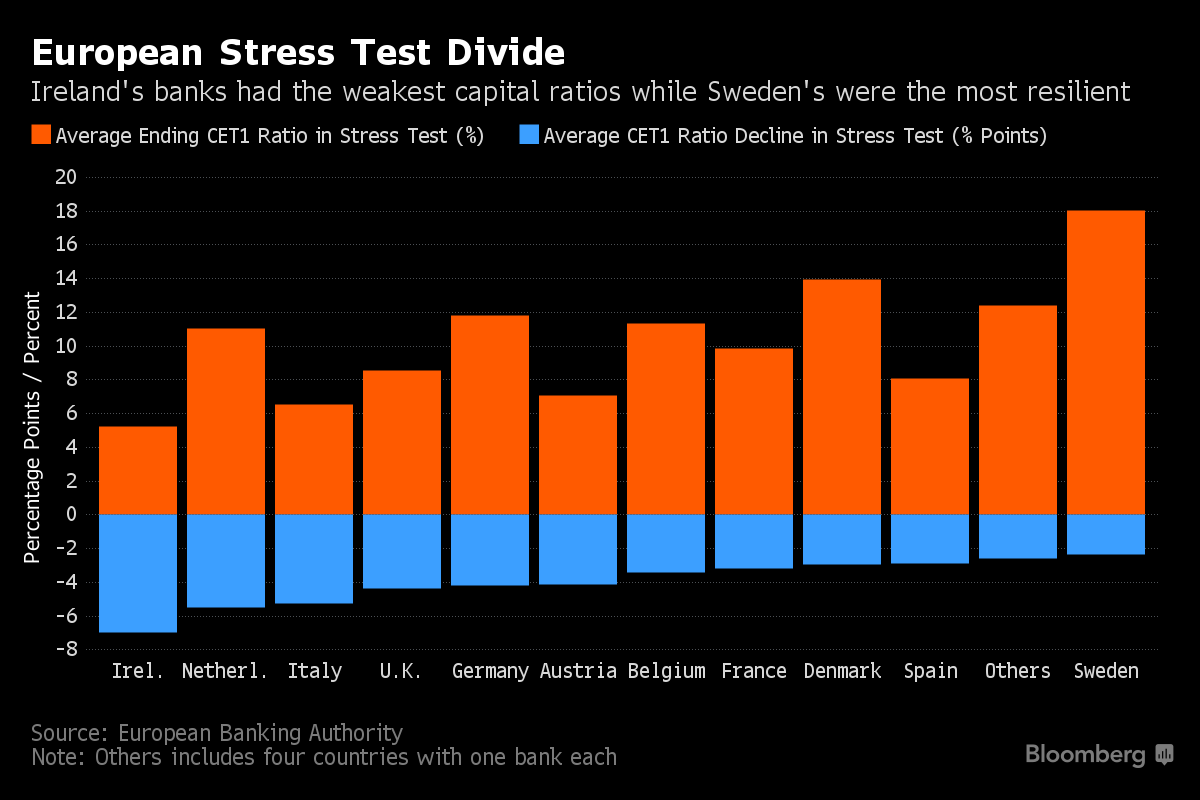
Ireland’s poor performance is clearly a factor of the crash of both the economy and property market from late 2008 onwards. The concentration of NPLs was one of the reasons why AIB and Bank of Ireland fared so badly in recent bank stress tests under the adverse scenario, in spite of both being back in profit and generating capital.
Potential improvements
The EBA said that while there are signs of potential improvements across Europe in terms of dealing with NPLs, asset quality is still weak compared to historical figures and other regions.
In its report, the EBA said action on NPLs was needed, including supervisory actions, structural reforms and development of secondary markets.
AIB chief executive Bernard Byrne told the Oireachtas finance committee last week that NPLs were a major focus of its regulators at the European Central Bank in Frankfurt. He said AIB’s ratio was about 17.5%.
The EBA also found that cyber attacks were on the rise and that banks are “struggling to demonstrate their ability to cope”.
“In this context, supervisory are focusing on IT-related risks including measures to fix rigid and outdated legacy IT systems, IT resilience, and governance and outsourcing,” it said.
As much as 9,300 plus patients on hospital trolleys last month in Ireland
WORST NOVEMBER FIGURES ON RECORD?


OVER 9,300 PATIENTS WERE LEFT WAITING ON IRELAND’S HOSPITAL TROLLEYS LAST MONTH? THE WORST NOVEMBER FIGURES EVER RECORDED, THE IRISH NURSES AND MIDWIVES ORGANISATION (INMO) HAS SAID.
Last month’s figures represent a staggering 99% increase when compared to November 2006, when 4,671 people were left waiting on trolleys. It is also a jump of 26% when compared to the same period last year, when 7,407 people were left on trolleys.
The worst affected hospitals last month included University Hospital Limerick (789), South Tipperary General Hospital (680), Cork University Hospital (648), Our Lady of Lourdes Hospital in Drogheda (607) and University Hospital Galway (594).
However, the news was not all bad. The overall trolley figures from January to November 2016, show a small reduction of 1% when compared to the same period last year. This is the first year a reduction during this period has been recorded since 2006.
Altogether, 85,731 patients were left waiting on trolleys in the first 11 months of this year, compared to 86,864 during the same period last year.
The waiting figures in the east reduced by 21%, with Connolly Hospital in Blanchardstown recording a 48% fall in its trolley waiting figures. However, many hospitals outside of Dublin recorded an increase, with the biggest jump – 162% – recorded in South Tipperary General Hospital.
The INMO said that overall, these figures are ‘very disappointing’, as they confirm that all of the measures taken to date to tackle this issue have failed to work.
“These figures are hugely disappointing, if not surprising, and confirm yet again that our health service cannot cope with the demands being placed upon it. The figures for November are particularly alarming as we enter the peak winter period, with the inevitable increased demand that takes place every year over the next three to four months,” commented INMO general secretary, Liam Doran.
Garda warning after gang target Donegal retailers in credit card scam


GARDAÍ ARE WARNING RETAILERS TO BE ESPECIALLY VIGILANT AFTER A DUBLIN BASED GANG USED FALSE CREDIT CARDS AT A NUMBER OF STORES IN LETTERKENNY.
Crime Prevention Officer Sgt Paul Wallace told the Democrat today that the gang made off with thousands of euros worth of high end goods and cash in the scam yesterday evening.
“They used false credit cards to buy high value goods such as phones, laptops, tablets, designer watches and fragrances at a number of shops in Letterkenny on Friday evening. Another tactic they used was to ask for cashback,” he said.
Prevention is the key
Sgt Wallace appealed to shop owners to take a few minutes at the start of the day to ensure all their staff are familiar with the security protocols.
“The criminals are aware that many towns and villages are in the midst of their Christmas promotions. Shops are busy and there are a lot of inexperienced, seasonal staff doing their best.
“Taking ten minutes at the start of the day to go through all the security protocols can save a lot of anguish,” he advised.
Tips for debit and credit card security can be found at http://www.safecard.ie
Owners and staff are also advised to be extra wary if a customer they don’t know immediately asks to see the most expensive range of goods on offer, especially something that could be sold on very easily, or looks for a lot of cash back in addition to their card transactions.
Counterfeit notes in circulation.
In addition, Sgt Wallace warned that false notes, especially €50 and €20 notes, are in circulation.
Again, he said, there are some simple safety measures that can prevent a business being caught out.
“Go to the Central Bank website for guidelines on how to tell the difference between real notes and counterfeits, and ensure that your staff are familiar with these.
“We also recommend using a security light for cards and notes, as that’s the best way to reveal whether important security features are missing.
“There is a lot of helpful information easily available on how to prevent crimes such as these,” Sgt Wallace said. “They key thing is to ensure that you and your staff know about them and can spot such scams as they happen.”
‘We are at the most dangerous moment in the development of humanity’
So says, Stephen Hawking warns we are at risk of destroying Earth


- Professor Hawking said people need to work together to tackle the issues
- These include environmental threats like climate change and diseases
- He also mentioned the dangers of people losing jobs to AI and robots
- The physicist said we have technology capable of destroying the planet
We are living through the most dangerous time in the history of the human race, according to Professor Stephen Hawking.
The Cambridge University physics professor named overpopulation, climate change and diseases as just some of the threats facing our planet.
He said we have developed technology that could destroy Earth, and we must ‘retrain’ for a new world where robots have replaced many everyday jobs.
We are living through the most dangerous time in the history of the human race, according to Professor Stephen Hawking. The Cambridge University physics professor named overpopulation, climate change and diseases as just some of the threats facing our planet
Writing in a comment article in The Guardian, Professor Hawking explained what worries him about the future of our planet.
‘For me, the really concerning aspect of this is that now, more than at any time in our history, our species needs to work together,’ he said.
‘We face awesome environmental challenges: climate change, food production, overpopulation, the decimation of other species, epidemic disease, acidification of the oceans.
‘Together, they are a reminder that we are at the most dangerous moment in the development of humanity.
‘We now have the technology to destroy the planet on which we live, but have not yet developed the ability to escape it.’
‘Perhaps in a few hundred years, we will have established human colonies amid the stars, but right now we only have one planet, and we need to work together to protect it.’
The world-famous physicist has previously issued warnings to the world that robots could wipe out humanity and that leaving Earth is our only hope, and that our days on Earth are numbered,
Professor Hawking said life on Earth is at an ever-increasing risk of being wiped out by a disaster, such as a sudden nuclear war, a genetically engineered virus, or other dangers
In September the physicist warned our planet is becoming a dangerous place because of the threat of war or disease.
Our desire to create helpful digital assistants and self-driving vehicles could bring about our demise.
Professor Stephen Hawking warned that humanity faces an uncertain future as technology learns to think for itself and adapt to its environment.
Speaking at an event in London earlier this year, the physicist told the BBC: ‘The development of full artificial intelligence could spell the end of the human race.’
This echoes claims he made earlier in the year when he said success in creating AI ‘would be the biggest event in human history, [but] unfortunately, it might also be the last.’
He argues that developments in digital personal assistants Siri, Google Now and Cortana are merely symptoms of an IT arms race which ‘pale against what the coming decades will bring.’
But Professor Hawking noted other potential benefits of this technology could also be significant, with the potential to eradicate, war, disease and poverty.
‘Looking further ahead, there are no fundamental limits to what can be achieved,’ continued Professor Hawking.
‘There is no physical law precluding particles from being organised in ways that perform even more advanced computations than the arrangements of particles in human brains.’
‘I believe that life on Earth is at an ever-increasing risk of being wiped out by a disaster, such as a sudden nuclear war, a genetically engineered virus, or other dangers,’ he said.
‘I think the human race has no future if it doesn’t go to space.’
Professor Hawking made similar comments earlier this year while recording the BBC’s annual Reith Lectures on January 7.
The lecture explored research into black holes, and his warning was made during questions fielded by audience members.
When asked how the world will end, Hawking said that increasingly, most of the threats humanity faces come from progress in technology.
The scientist, who turned 74 this year, said the threats include nuclear war, catastrophic global warming and genetically engineered viruses.
‘We are not going to stop making progress, or reverse it, so we must recognise the dangers and control them,’ he said, speaking to Radio Times ahead of the lecture.
To get away from these threats, humankind will have to colonise other planets, which Hawking believes will take more than a century.
‘We will not establish self-sustaining colonies in space for at least the next hundred years, so we have to be very careful in this period,’ Hawking said.
In July, Professor Hawking and Tesla founder Elon Musk led 1,000 robotics experts in an open letter warning that ‘Autonomous weapons will become the Kalashnikovs of tomorrow’
‘The probable life span of human civilization is much greater if we’re a multi-planet species as opposed to a single-planet species,’ Elon Musk said last year.
‘If we’re a single planet species, then eventually there will be some extinction event,’ Mr Musk said.
His company SpaceX is working to send humans to space.
Last week the firm test fired one of its new Raptor ‘interplanetary transport engines’ which the company will use to carry astronauts to Mars.
This week the US Senate introduced a bipartisan bill that authorizes a new $19.5 billion (£15 billion) budget for Nasa to send a crew to the red planet, but mandated it must happen within the next 25 years
The rocket engine is three times more powerful than the one on the Falcon 9 rockets. It will ultimately be used to launch SpaceX’s manned spacecraft off our planet.
Mr Musk, chief executive of SpaceX, said the rocket will be ultimately capable of producing thrust of 690,000lbs over 382 seconds.
The engine is powered using liquid methane and liquid oxygen rather than the kerosene used in the Merlin engines of its Falcon 9 rockets.


/snorkeling+tourists+in+Brazil+(credit,+Benjamin+Geffroy)_mid.jpg)

