Pages

Showing posts with label Healthy walking. Show all posts

Saturday, July 11, 2015

Donie's Ireland daily news BLOG

Airline shares jump as Ryanair agrees to sell Aer Lingus 30% stake 


Shares in airlines have jumped after Ryanair voted to accept International Airlines Group’s (IAG) offer for its 29.8% stake in Aer Lingus.

Ryanair and IAG shares were up almost 3%, while Aer Lingus was up 1.8%.
The formal acceptance paves the way for the €1.3bn (£940m) bid by BA and Iberia owner IAG for Aer Lingus to go ahead.
It is subject to backing by competition authorities. European Union approval is now the last remaining hurdle to the tie-up.
IAG’s plans include building a new transatlantic hub at Dublin airport.
Ryanair’s chief executive Michael O’Leary said in a statement: “We believe the IAG offer for Aer Lingus is a reasonable one in the current market and we plan to accept it, in the best interests of Ryanair shareholders.
“The price means that Ryanair will make a small profit on its investment in Aer Lingus over the past nine years.”
Ryanair has attempted to buy Aer Lingus three times. Its takeover quest began in 2006, just after Aer Lingus was floated on the stock market by the Irish government.
Ryanair’s initial bid illustrates the wild swings in Aer Lingus’s value since then. Its first offer was €2.80 a share. The second, two years later, was half that and its most recent offer in 2012 was €1.30 a share.
The Irish government, which sold its 25% stake in Aer Lingus to IAG in May, recommended that Ryanair accept IAG’s offer.
The deal values Aer Lingus shares at around €2.50 (£1.87) per share.
Aer Lingus is Heathrow Airport’s fourth busiest operator, behind BA, Lufthansa and Virgin Atlantic.
If the deal is approved, IAG would gain more take-off and landing slots at Heathrow Airport, allowing it to operate more flights.
Ryanair said it had planned to use Aer Lingus to gain slots at mainstream airports.
Travellers have been surprised in the past by the distance of some of Ryanair’s airports from the city they thought they were flying to.
Michael O’Leary said Ryanair did not need Aer Lingus now: “Our original strategy for Aer Lingus (to use it as a mid-priced brand to offer competition to flag carriers at primary airports) has been overtaken by the successful rollout – since Sept 2013 – of Ryanair’s “Always Getting Better” strategy, which has seen the Ryanair brand successfully enter many of Europe’s primary airports.”

Irish Navy ship heading for 2nd Mediterranean rescue operation
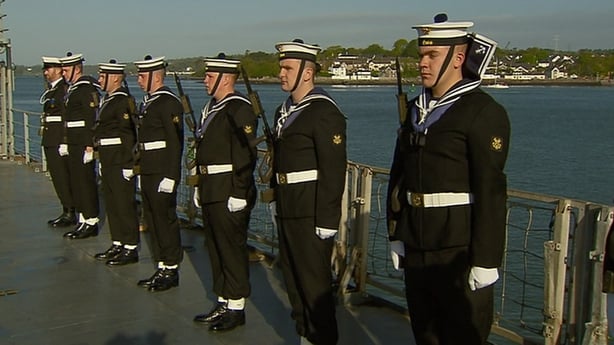
   

The Irish Naval vessel LE Niamh will join up with operations to rescue migrants

An Irish Navy ship has been tasked to the Mediterranean to renew efforts to rescue migrants.
The LE Niamh is replacing the LE Eithne which berthed in Malta during the week after saving 3,377 men, women and children from waters between Libya and Sicily over the last eight weeks.
The decision to send the Irish Navy was taken earlier this year in response to the huge numbers of migrants dying as they fled war, persecution and crippled economies and attempted to make it to Europe.
But documents have exposed the Irish Government’s reluctance to join an international humanitarian missions over the previous two years as officials advised a “low profile” during discussions and warned increasing rescue missions could encourage life-threatening migration.
Simon Coveney, Defence Minister, met the crew of the LE Eithne as their mission ended.
“I conveyed to the personnel our deep appreciation for the outstanding manner in which they performed their duties on overseas service on behalf of the Government and the people of Ireland. I am pleased to be here today to convey my appreciation to you, in advance of your deployment,” he said.
The LE Niamh under the command of Lieutenant Commander Daniel Wall is travelling from Haulbowline, Cork tonight and is expected to remain in the Mediterranean until September.
It has 55 sailors and two medics from the Army Medical Corps on board.
Mr Coveney added: “I want to wish Lieutenant Commander Daniel Wall and the crew of LE Niamh a safe and successful mission. You are travelling to the Mediterranean with my best wishes and with those of the rest of the nation.”

Working parents in Ireland to get six months off after a new child


Working parents will get six months’ paid leave in the first year after their child is born, under new plans being considered by the Coalition.

Squeezed middle-income working families with small children are set to benefit from a range of measures being recommended in a Government report on childcare, obtained by the Irish Independent.
The report also finds that just over one in four children under school-going age is in formal childcare and the existing free year of childcare is too short in terms of hours each day and number of weeks a year.
Six months’ paid parental leave – to be shared between the parents and in addition to maternity leave – is the big-ticket item in the report compiled by a high-powered committee.
The measure would take a decade to implement in full but would build up gradually from a month to a full six months.
“The proposal is to increase parental choice to remain as the primary care-giver of their child in the first year of life and to provide as much support as possible to the developing relationship between the parents and the child,” the childcare report says.
Meanwhile, Finance Minister Michael Noonan says he will cut the Universal Social Charge by 1pc in October’s Budget.
“I’m going to cut the USC by at least 1% and maybe a bit more,” he said.

Walking briskly can help us to prevent heart failure


Picking up the pace and cutting down on smoking and drinking can prevent heart failure, say health experts

Walking briskly at two miles per hour, exercising away 845 calories a week and limiting alcohol to two drinks a night can halve the risk of heart failure scientists have found.
Adults who walked briskly, were moderately active in their leisure time, drank moderately, did not smoke and avoided obesity were far less likely to develop heart problems.
Researchers in the US studied the lifestyles of 4,500 adults for two decades tracking their diet, walking habits, leisure activity, exercise, alcohol use, smoking status, weight, height, waist circumference and heart health through questionnaires and physical exams.
Researchers found that adults who walked at a pace 2 miles per hour or faster had a lower risk of developing heart failure.
Participating in leisure activities that burned more than 845 or more calories a week, not smoking, modest alcohol intake of one drink or more a week (but not more than 1-2 drinks/day), and avoiding obesity were also associated with reduced rates of heart failure.
Time to cut back? A modest intake of alcohol can also help prevent heart failure
Intriguingly diet did not seem to make much difference to heart health.
“It’s encouraging to learn that older adults can make simple changes to reduce their heart failure risk, like engaging in moderate physical activity, not smoking and maintaining a healthy weight,” said lead thor Dr Liana Del Gobbo, of Tufts University, Boston.
“Although dietary patterns were not related to heart failure risk in this study, eating a healthy diet is of critical importance for preventing other cardiovascular diseases, type 2 diabetes, and other chronic diseases” said lead author Liana Del Gobbo, PhD, research fellow at Tufts University.
Heart failure is a condition where the heart fails to pump as much blood as the body needs when the muscle becomes too weak or stiff to work properly. It leads to breathlessness, feeling very tired and ankle swelling.
It usually occurs following a heart attack and in its severest form heart failure has a life expectancy worse than many cancers.
More than 500,000 people in Britain suffer from the conditon, and almost as many have damaged hearts but, as yet, have no symptoms. Hundreds of patients require new hearts and 200 transplants take place in the UK each year. But two out of 10 people will die waiting for an organ due to a severe shortage of donors.
Charities said the study showed that living a healthy lifestyle was crucial to preventing heart failure.
Professor Jeremy Pearson, Associate Medical Director at the British Heart Foundation, said: “More than half a million people across the UK have been diagnosed with heart failure, an incurable condition where your heart has been permanently damaged, often following a heart attack.
“This research shows that not smoking, maintaining a healthy weight, and getting plenty of exercise are associated with a significantly reduced risk of heart failure, a really debilitating disease.
“We know that even small changes can make a big difference to your heart health, and it’s never too late to start.
“Recent advances in regenerative medicine have made mending damaged hearts a realistic goal, but we must fund more research to make this happen.”

2014 was a bumper year for Irish birth rate’s


IRELAND HAD THE HIGHEST BIRTH RATE IN THE EU LAST YEAR AT 14.4 PER ONE THOUSAND RESIDENTS.

That is compared to the EU average of 10.1.
According to EU population estimates from Eurostat, Ireland now has a population of 4.6 million – just 0.9% of the EU population.
With 16% of the total EU population, Germany continues to be the most populated EU country, ahead of France at just over 13%, and the UK at 12.9%.

Smoking is linked to Schizophrenia

A study says?


People with schizophrenia are three times more likely to smoke than those who don’t have the mental health condition, a study published in Lancet Psychiatry says.

Experts at King’s College London say that although links have been noted before between tobacco use and psychosis, there’s been little research into the possibility that smoking can cause schizophrenia.
Past studies have looked at why people with psychotic conditions smoke. Explanations have included relief from boredom or distress and a desire to self-medicate.
Reviewing the Evidence
To explore the subject further, researchers reviewed 61 studies that included nearly 15,000 tobacco users and 273,000 non-users. They found that 57% of people diagnosed with schizophrenia for the first time were smokers.
Also, people who were diagnosed for the first time were three times more likely to smoke than those who hadn’t had schizophrenia.
A possible explanation is that heavy cigarette smoking increases the ability to make the chemical dopamine in part of the brain. Dopamine is thought to play an important role in the development of schizophrenia.
The Role of Dopamine
“Excess dopamine is the best biological explanation we have for psychotic illnesses such as schizophrenia,” says Robin Murray, professor of psychiatric research at King’s College London, in a statement. “It is possible that nicotine exposure, by increasing the release of dopamine, causes psychosis to develop.”
The authors say it’s hard to prove from available research that smoking tobacco actually causes schizophrenia. For instance, they were unable to filter out the effects of other substances, such as marijuana.
Still, as a precaution, co-author Sameer Jauhar urges people working with schizophrenia patients to try to get them to take part in smoking cessation programs.
“Regardless of these findings, there is overwhelming evidence that nicotine use through tobacco smoking is one of the most dangerous drug problems in the world,” says Michael Bloomfield, MD, clinical lecturer in psychiatry at University College London. “Anyone who needs help in stopping smoking should speak with their doctor.”

‘Legendary’ beetle found on Wimbledon Common


The single specimen of the False Click Beetle, Eucnemis capucina, discovered on the 1,140-acre Wimbledon Common in south-west London.

It was famously home to the Wombles, but Wimbledon Common now has an even more unusual resident, scientists have discovered.
A single specimen of the globally rare False Click Beetle has been discovered in the 1,140-acre green space in south-west London, the first ever seen in the capital.
And like the pointy-nosed “wombling free” creatures that starred in the cult 1970s children’s TV series, the insect is known for its environmental credentials.
The Wombles’ goal in life was to keep Wimbledon Common tidy by clearing up and recycling rubbish. Similarly, the False Click Beetle, Eucnemis capucina, is associated with unspoiled natural environments.
A member of staff at London’s Natural History Museum made the surprise find during a recent insect survey conducted with the Conservators of Wimbledon Common.
Dr Max Barclay, manager of the museum’s 10 million strong beetle collection, said: “Sampling beetles is like taking a blood test, it gives you quick idea of a whole ecosystem’s health. This beetle is associated with only the best and oldest woodlands, and previously was known only from the New Forest and Windsor Forest.
“To find such a species at Wimbledon Common shows that the conservators are taking good care of the site, and managing it for wildlife, and that there are old important trees there that can support populations of rare insects.
“Insects are the bottom of the animal food chain, so if insect populations are healthy it bodes well for bats, birds and other animals.”
He added: “Eucnemis is a kind of legendary beetle. No-one I know has ever seen it, and the newest specimens in Natural History Museum are from the 1930s. Finds such as these are a perfect example of how our research and collections show the diversity of life on our planet.”
The beetle is considered a “Grade One” indicator of good quality ancient woodland.
Keita Matsumoto, who found the insect, said: “It was a lucky shot. I’m pleased I was swinging my insect net that afternoon instead of my tennis racquet.”
In total the survey recorded more than 100 species of beetle, many of which had not been reported in the area before.  

Sunday, August 31, 2014

Donie's Ireland daily news BLOG update

Unhappy Irish doctors planning a protest march on Dail


Family doctors are planning to down their stethoscopes and march on the Dail for the first time in their history in protest at funding cuts which they say are putting patients at risk.

The GPs are proposing to hand in a petition to Health Minister Leo Varadkar calling for more investment in general practice in the wake of cuts to fees for treating medical card holders and other services in recent years.
The doctors are to be asked to give free GP visits to children under six and everyone over 70 from the beginning of next year – but the fees they will be paid have yet to be agreed.
Up to now doctors have tended to confine their protests to representation through their membership bodies and public statements, rather than taking to the streets.
It is unclear how large the turnout will be, but the hope is that several hundred will leave their surgeries and take to the streets for the public display of discontent on September 24.
The National Association of General Practitioners said it cannot call on any GP to join the march due to competition law, but it is expected to help in organising the demonstration and transport.
GPs have become increasingly vocal in the last year, with rising numbers with established practices opting to uproot and go abroad to earn a better living.
Meanwhile, the Labour Relations Commission has proposed a committee, chaired by heart surgeon Eilis McGovern, be set up to assess which newly-recruited consultants get higher starting salaries.
The group will also include two Irish Medical Organisation representatives.
Under new proposals recruits are entitled to starting pay of between €120,000 and €155,000. Doctors with experience could get up to €155,000.
The Labour Relations Commission said the committee could assess each doctor’s claim and decide how much they should get on top of the basic €120,000.
If the doctor wants to challenge the salary they are offered they can appeal to the chief executive of the Labour Relations Commission, Kieran Mulvey.
The HSE is to begin a recruitment campaign to secure more new consultants for hospitals in a bid to reduce waiting lists.
Dr Gerard Crotty, president of the Irish Hospital Consultants Association, said the HSE’s decision to begin advertising jobs, without agreement from doctors’ bodies, had the potential to worsen the recruitment crisis.

US economy expands by 4.2% following contraction

BUSINESS INVESTMENT INCREASED 8.1%, THE MOST SINCE EARLY 2012


A surge in demand for airplanes helped push orders for durable goods up at a record pace in July, boosting prospects for sustained growth in US manufacturing,

The US economy expanded more than previously forecast in the second quarter, propelled by the biggest gain in business investment in more than two years that bodes well for the rest of 2014.
Gross domestic product, the value of all goods and services produced, rose at a 4.2 per cent annualised rate, up from an initial estimate of 4 per cent and following a first-quarter contraction, according to the latest figures.
Corporate profits climbed by the most in almost four years. The improvement has carried over into the second half with companies such as General Electric seeing more orders for equipment and a strengthening job market underpinning consumer spending, which accounts for about 70 per cent of the economy.
Better prospects for growth signal Federal Reserve officials will continue to wind down monthly asset purchases. “The economy is clearly doing better,” Jim O’Sullivan, chief US economist at High Frequency Economics in Valhalla, New York, said before the report.
“Business spending is picking up. We’ll see stronger consumer spending in coming months.”
Another report today showed the number of Americans filing for unemployment benefits were little changed last week as employers held on to staff in an improving economy. Claims decreased by 1,000 to 298,000 in the week ended August 23rd from 299,000 in the prior period, the Department of Labor reported.
Business investment increased at an 8.1 percent annualised rate, the most since the first three months of 2012. Companies are buying more equipment as earnings improve. Today’s report also offered a first look at corporate profits. Before-tax earnings rose 8 per cent last quarter, the most since the third quarter of 2010, after a 9.4 per cent drop in the prior period. They were still down 0.3 per cent from the same time last year.
Corporate investment data are indicating a pickup. A surge in demand for airplanes helped push orders for durable goods up at a record pace in July, boosting prospects for sustained growth in manufacturing,

Walking a mile each day ‘cuts cancer death risk by 50%

PHYSICAL ACTIVITY DESCRIBED AS ‘WONDER DRUG’ FOR BREAST AND PROSTATE PATIENTS


  • Patients can cut risk of dying by half by walking one mile a day, study finds
  • Those with breast cancer can reduce risk by up to 40% via physical activity
  • For bowel cancer patients, doubling walking distance ‘halves risk of dying’
  • Research carried out by Walking for Health, run by Macmillan and Ramblers
  • Calculations were based on walking one mile at a moderate pace of 3mph
Cancer patients can cut their risk of dying by up to half – simply by walking just one mile a day, according to experts.
A study revealed physical activity as a ‘wonder drug’, with those diagnosed with breast and prostate cancers able to cut their risk of death by up to 40 per cent.
And for bowel cancer patients, doubling the walking distance was found to halve the risk of dying.
The calculations are based on walking one mile at a moderate pace of 3mph, which would take just 20 minutes a day.
The research by Walking for Health, a network of walking groups run by Macmillan Cancer Support and the Ramblers, found physical activity can also reduce the impact of some debilitating side effects of cancer treatment, such as swelling around the arm, anxiety, depression, fatigue, impaired mobility and weight changes.
The charity estimates that 1.6million of the two million people living with cancer in the UK are not active at recommended levels.
Ciarán Devane, chief executive of Macmillan Cancer Support, said: ‘Today’s research highlights the very simple reality – walking can save lives.
‘We cannot continue to turn a blind eye to what is a very simple and obvious solution. Physical activity is a wonder drug and health care professionals must prescribe physical activity, such as walking, as a standard part of cancer recovery.’
Sandra Sayce, 51, who is married and lives in Middlesex, joined her local Walking for Health group in 2011 following years of treatment for melanoma.
She said ‘I had been ill with cancer for several years, which at its worst had left me unable to walk more than 50 metres.
‘When I joined my local Walking for Health group it gave me the push I needed to make those vital first steps back into physical activity; despite the cold January weather, I was able to take part in the simple, easy-going walk which was crucial to beginning my recovery.
‘Since then I’ve gone from strength, and I’ve started to feel more happy and less tired. I really do think that making the decision to go on that first walk was crucial to getting myself to the position I’m in now.’
It is unclear how activity helps, but the effect goes further than simply weight control, which cuts down on the amount of cancer-promoting hormones produced by body fat.
The latest thinking is exercise may break down oestrogen to produce ‘good’ metabolites that lower the risk of some cancers.
The reduction in risk of death from cancer is based on research review evidence in Macmillan Cancer Support’s Move More report.
It says breast cancer patients cut the risk by 40 per cent if they do recommended levels of activity, compared with those doing less than an hour a week.
The risk is reduced by 30 per cent for men with prostate cancer.
Bowel cancer sufferers who walk 18 miles a week – 2.5 miles or around 50 minutes a day – can cut their risk of dying by 50 per cent.
Walking for 150 minutes a week at 3mph results in total walking of 7.5 miles in a week – just over a mile, or 20 minutes a day.
Government guidelines advise all adults to do 150 minutes of moderate activity such as gardening, dancing or brisk walking, or 75 minutes of vigorous exercise including playing sport, running or aerobics every week.
Just 36 per cent of British women meet the moderate activity target.
Benedict Southworth, chief executive of the Ramblers, said: ‘The benefits of walking are numerous. It is increasingly clear that walking even short distances regularly can make the world of difference for those recovering from and managing cancer or other serious health conditions.
‘Walking for Health offers free, short group walks across England, which are the perfect way to build confidence and fitness in a friendly, supportive space.
‘All walks are led by friendly, knowledgeable people, specially trained for the job. Many of our walkers have long term conditions such as cancer themselves and find the companionship and fresh air a wonderful therapy.
‘We want to put walking at the centre of efforts to tackle physical inactivity and echo Macmillan’s call for health professionals to prescribe walking to those who are recovering from cancer or other health conditions.’

Iceland lowers volcano eruption alert for aviation


Iceland reduced its aviation warning level to orange on Friday after concluding that a small eruption in the Bardarbunga volcano system that triggered a hours-long red alert actually posed no threat to aircraft.

No sign of ash like that from the Eyjafjallajokull eruption that shut much of Europe’s air space in 2010 has been detected this time. But the Icelandic Metrological Office said a no-fly zone in a radius of 3 nautical miles just above the Bardarbunga volcano in central Iceland would remain in effect.
“The small eruption is not a threat to aviation and the published aviation warning area has been cancelled,” the Met Office said in a statement.
Iceland’s largest volcanic system, which cuts a 190-km-long and up to 25-km-wide swathe across the North Atlantic island, has been hit by thousands of earthquakes over the last two weeks and scientists have been on high alert in case of an eruption.
Reykjavik’s Met Office said that just after midnight an estimated 1-km-long fissure eruption began in a lava field north of the Vatnajokull glacier, which covers part of the Bardarbunga system.
While the risk of an ash cloud is highest in case of a sub-glacial eruption, Icelandic authorities for a few hours raised the aviation warning level to red, the highest on a five-color scale and indicating that an eruption is imminent or under way, with a risk of spewing ash.
The latest eruption was at the tip of a magma dyke 40 km from the main Bardarbunga crater and activity subsided to relatively low levels after peaking between 0020 and 0200 GMT, Met Office seismologist Martin Hensch said earlier.
He said that it was impossible to say how the eruption would develop.
“One of the concerns is that the fissure opens into the glacier but presently there is no sign of that happening,” he said, adding that the eruption was 6-8 km from the glacier.
Nick Petford, a vulcanology expert at the University of Northampton in Britain, said fissure eruptions were often spectacular, but relatively low key and often died out in a couple of days. But there could be a sting in the tail, he said.
“Exactly the same thing happened in 2010 with the Eyjafjallajokull volcano,” Petford said. “The main eruption was in April, but in March there was a fissure eruption which was a precursor to the much larger eruption.”
The Eyjafjallajokull event was particularly disruptive because it pushed ash up to precisely the elevation used by transatlantic aircraft, while prevailing winds propelled the cloud into European air space. The ash was also particularly sticky due to its chemical composition.
Petford said that if the current eruption subsided, scientists would be looking for signs of more quakes deeper under the volcano, which would suggest more magma was welling up, and for any swelling of the volcano that could be measured using GPS.
“Those are pretty clear evidence that large amounts of magma are being stored within the volcano and that’s a good indication it will explode.”

Whiskey sent into space is coming back to Earth

  
There’s a lot of research happening on the International Space Station that can help us make advancements in science, technology and what we know about our universe. However, they usually don’t seem as fun as this recent research program about to make its way back to Earth.
A Scottish whiskey distillery set up an experiment several years ago to have astronauts develop whiskey particles in space. Now, the whiskey is making its way back home.
Ardbeg, a Scotch whisky distillery in Islay, Scotland, partnered with the Texas-based space research company NanoRacks to get the experiment off the ground. They sent 20 vials of whiskey particles, along with pieces of charred oak that they were treated with, into space in 2011. The vials didn’t contain actual whiskey liquor but microbes that could be later used to brew whiskey.
The particles landed at the International Space Station where they have been orbiting the planet 15 times a day at 17,227 miles per hour. The point of the experiment is to see how the compounds in the vials, technically known as “terpenes,” interact with the charred oak in Earth’s gravity and then in micro-gravity in space. Terpenes can be found inflavorings and paints, in addition to whiskey.
“NASA approved the project since terpenes have never been grown in zero-gravity conditions,” NanoRacks CEO Jeffrey Manber told ABC News.
Manber also told ABC News that the findings of the research won’t just impact future production of alcoholic beverages. The results of the experiment can also impact consumer products in general and help us better understand materials and biologicals.
The vials will be back on Earth on Sept. 12 where they will land in Kazakhstan. There’s a nifty countdown clock featuring a bottle of Ardbeg whiskey soaring through space in case you need to quell your anticipation. Once the specimens are back on Earth, they will be shipped to NanoRack in Texas where the results of the maturation process will be examined. The findings will be revealed in a paper at a later date.
Whiskey particles aren’t even the weirdest objects to have been sent into space. LEGO figurines were launched into space as part of a partnership between NASA and the LEGO Group to encourage children to study science and technology. The original lightsaber Luke Skywalkerused in “Star Wars Episode IV: Return of the Jedi” went out of this world with the Space Shuttle Discovery in 2007. There’s even a company devoted to launching people’s cremated remains into space called Celestis. One of its most famous participants is Gene Roddenberry, the creator of “Star Trek,” whose remains are expected to be launched into space, along with his wife Majel, in 2016.