Pages

Showing posts with label Irish Navy. Show all posts

Saturday, July 11, 2015

Donie's Ireland daily news BLOG

Airline shares jump as Ryanair agrees to sell Aer Lingus 30% stake 


Shares in airlines have jumped after Ryanair voted to accept International Airlines Group’s (IAG) offer for its 29.8% stake in Aer Lingus.

Ryanair and IAG shares were up almost 3%, while Aer Lingus was up 1.8%.
The formal acceptance paves the way for the €1.3bn (£940m) bid by BA and Iberia owner IAG for Aer Lingus to go ahead.
It is subject to backing by competition authorities. European Union approval is now the last remaining hurdle to the tie-up.
IAG’s plans include building a new transatlantic hub at Dublin airport.
Ryanair’s chief executive Michael O’Leary said in a statement: “We believe the IAG offer for Aer Lingus is a reasonable one in the current market and we plan to accept it, in the best interests of Ryanair shareholders.
“The price means that Ryanair will make a small profit on its investment in Aer Lingus over the past nine years.”
Ryanair has attempted to buy Aer Lingus three times. Its takeover quest began in 2006, just after Aer Lingus was floated on the stock market by the Irish government.
Ryanair’s initial bid illustrates the wild swings in Aer Lingus’s value since then. Its first offer was €2.80 a share. The second, two years later, was half that and its most recent offer in 2012 was €1.30 a share.
The Irish government, which sold its 25% stake in Aer Lingus to IAG in May, recommended that Ryanair accept IAG’s offer.
The deal values Aer Lingus shares at around €2.50 (£1.87) per share.
Aer Lingus is Heathrow Airport’s fourth busiest operator, behind BA, Lufthansa and Virgin Atlantic.
If the deal is approved, IAG would gain more take-off and landing slots at Heathrow Airport, allowing it to operate more flights.
Ryanair said it had planned to use Aer Lingus to gain slots at mainstream airports.
Travellers have been surprised in the past by the distance of some of Ryanair’s airports from the city they thought they were flying to.
Michael O’Leary said Ryanair did not need Aer Lingus now: “Our original strategy for Aer Lingus (to use it as a mid-priced brand to offer competition to flag carriers at primary airports) has been overtaken by the successful rollout – since Sept 2013 – of Ryanair’s “Always Getting Better” strategy, which has seen the Ryanair brand successfully enter many of Europe’s primary airports.”

Irish Navy ship heading for 2nd Mediterranean rescue operation
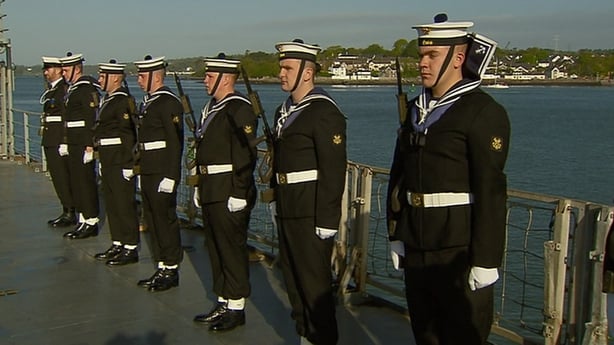
   

The Irish Naval vessel LE Niamh will join up with operations to rescue migrants

An Irish Navy ship has been tasked to the Mediterranean to renew efforts to rescue migrants.
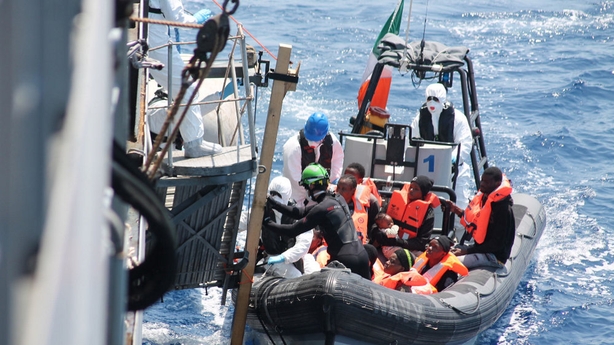
The LE Niamh is replacing the LE Eithne which berthed in Malta during the week after saving 3,377 men, women and children from waters between Libya and Sicily over the last eight weeks.
The decision to send the Irish Navy was taken earlier this year in response to the huge numbers of migrants dying as they fled war, persecution and crippled economies and attempted to make it to Europe.
But documents have exposed the Irish Government’s reluctance to join an international humanitarian missions over the previous two years as officials advised a “low profile” during discussions and warned increasing rescue missions could encourage life-threatening migration.
Simon Coveney, Defence Minister, met the crew of the LE Eithne as their mission ended.
“I conveyed to the personnel our deep appreciation for the outstanding manner in which they performed their duties on overseas service on behalf of the Government and the people of Ireland. I am pleased to be here today to convey my appreciation to you, in advance of your deployment,” he said.
The LE Niamh under the command of Lieutenant Commander Daniel Wall is travelling from Haulbowline, Cork tonight and is expected to remain in the Mediterranean until September.
It has 55 sailors and two medics from the Army Medical Corps on board.
Mr Coveney added: “I want to wish Lieutenant Commander Daniel Wall and the crew of LE Niamh a safe and successful mission. You are travelling to the Mediterranean with my best wishes and with those of the rest of the nation.”

Working parents in Ireland to get six months off after a new child


Working parents will get six months’ paid leave in the first year after their child is born, under new plans being considered by the Coalition.

Squeezed middle-income working families with small children are set to benefit from a range of measures being recommended in a Government report on childcare, obtained by the Irish Independent.
The report also finds that just over one in four children under school-going age is in formal childcare and the existing free year of childcare is too short in terms of hours each day and number of weeks a year.
Six months’ paid parental leave – to be shared between the parents and in addition to maternity leave – is the big-ticket item in the report compiled by a high-powered committee.
The measure would take a decade to implement in full but would build up gradually from a month to a full six months.
“The proposal is to increase parental choice to remain as the primary care-giver of their child in the first year of life and to provide as much support as possible to the developing relationship between the parents and the child,” the childcare report says.
Meanwhile, Finance Minister Michael Noonan says he will cut the Universal Social Charge by 1pc in October’s Budget.
“I’m going to cut the USC by at least 1% and maybe a bit more,” he said.

Walking briskly can help us to prevent heart failure


Picking up the pace and cutting down on smoking and drinking can prevent heart failure, say health experts

Walking briskly at two miles per hour, exercising away 845 calories a week and limiting alcohol to two drinks a night can halve the risk of heart failure scientists have found.
Adults who walked briskly, were moderately active in their leisure time, drank moderately, did not smoke and avoided obesity were far less likely to develop heart problems.
Researchers in the US studied the lifestyles of 4,500 adults for two decades tracking their diet, walking habits, leisure activity, exercise, alcohol use, smoking status, weight, height, waist circumference and heart health through questionnaires and physical exams.
Researchers found that adults who walked at a pace 2 miles per hour or faster had a lower risk of developing heart failure.
Participating in leisure activities that burned more than 845 or more calories a week, not smoking, modest alcohol intake of one drink or more a week (but not more than 1-2 drinks/day), and avoiding obesity were also associated with reduced rates of heart failure.
Time to cut back? A modest intake of alcohol can also help prevent heart failure
Intriguingly diet did not seem to make much difference to heart health.
“It’s encouraging to learn that older adults can make simple changes to reduce their heart failure risk, like engaging in moderate physical activity, not smoking and maintaining a healthy weight,” said lead thor Dr Liana Del Gobbo, of Tufts University, Boston.
“Although dietary patterns were not related to heart failure risk in this study, eating a healthy diet is of critical importance for preventing other cardiovascular diseases, type 2 diabetes, and other chronic diseases” said lead author Liana Del Gobbo, PhD, research fellow at Tufts University.
Heart failure is a condition where the heart fails to pump as much blood as the body needs when the muscle becomes too weak or stiff to work properly. It leads to breathlessness, feeling very tired and ankle swelling.
It usually occurs following a heart attack and in its severest form heart failure has a life expectancy worse than many cancers.
More than 500,000 people in Britain suffer from the conditon, and almost as many have damaged hearts but, as yet, have no symptoms. Hundreds of patients require new hearts and 200 transplants take place in the UK each year. But two out of 10 people will die waiting for an organ due to a severe shortage of donors.
Charities said the study showed that living a healthy lifestyle was crucial to preventing heart failure.
Professor Jeremy Pearson, Associate Medical Director at the British Heart Foundation, said: “More than half a million people across the UK have been diagnosed with heart failure, an incurable condition where your heart has been permanently damaged, often following a heart attack.
“This research shows that not smoking, maintaining a healthy weight, and getting plenty of exercise are associated with a significantly reduced risk of heart failure, a really debilitating disease.
“We know that even small changes can make a big difference to your heart health, and it’s never too late to start.
“Recent advances in regenerative medicine have made mending damaged hearts a realistic goal, but we must fund more research to make this happen.”

2014 was a bumper year for Irish birth rate’s


IRELAND HAD THE HIGHEST BIRTH RATE IN THE EU LAST YEAR AT 14.4 PER ONE THOUSAND RESIDENTS.

That is compared to the EU average of 10.1.
According to EU population estimates from Eurostat, Ireland now has a population of 4.6 million – just 0.9% of the EU population.
With 16% of the total EU population, Germany continues to be the most populated EU country, ahead of France at just over 13%, and the UK at 12.9%.

Smoking is linked to Schizophrenia

A study says?


People with schizophrenia are three times more likely to smoke than those who don’t have the mental health condition, a study published in Lancet Psychiatry says.

Experts at King’s College London say that although links have been noted before between tobacco use and psychosis, there’s been little research into the possibility that smoking can cause schizophrenia.
Past studies have looked at why people with psychotic conditions smoke. Explanations have included relief from boredom or distress and a desire to self-medicate.
Reviewing the Evidence
To explore the subject further, researchers reviewed 61 studies that included nearly 15,000 tobacco users and 273,000 non-users. They found that 57% of people diagnosed with schizophrenia for the first time were smokers.
Also, people who were diagnosed for the first time were three times more likely to smoke than those who hadn’t had schizophrenia.
A possible explanation is that heavy cigarette smoking increases the ability to make the chemical dopamine in part of the brain. Dopamine is thought to play an important role in the development of schizophrenia.
The Role of Dopamine
“Excess dopamine is the best biological explanation we have for psychotic illnesses such as schizophrenia,” says Robin Murray, professor of psychiatric research at King’s College London, in a statement. “It is possible that nicotine exposure, by increasing the release of dopamine, causes psychosis to develop.”
The authors say it’s hard to prove from available research that smoking tobacco actually causes schizophrenia. For instance, they were unable to filter out the effects of other substances, such as marijuana.
Still, as a precaution, co-author Sameer Jauhar urges people working with schizophrenia patients to try to get them to take part in smoking cessation programs.
“Regardless of these findings, there is overwhelming evidence that nicotine use through tobacco smoking is one of the most dangerous drug problems in the world,” says Michael Bloomfield, MD, clinical lecturer in psychiatry at University College London. “Anyone who needs help in stopping smoking should speak with their doctor.”

‘Legendary’ beetle found on Wimbledon Common


The single specimen of the False Click Beetle, Eucnemis capucina, discovered on the 1,140-acre Wimbledon Common in south-west London.

It was famously home to the Wombles, but Wimbledon Common now has an even more unusual resident, scientists have discovered.
A single specimen of the globally rare False Click Beetle has been discovered in the 1,140-acre green space in south-west London, the first ever seen in the capital.
And like the pointy-nosed “wombling free” creatures that starred in the cult 1970s children’s TV series, the insect is known for its environmental credentials.
The Wombles’ goal in life was to keep Wimbledon Common tidy by clearing up and recycling rubbish. Similarly, the False Click Beetle, Eucnemis capucina, is associated with unspoiled natural environments.
A member of staff at London’s Natural History Museum made the surprise find during a recent insect survey conducted with the Conservators of Wimbledon Common.
Dr Max Barclay, manager of the museum’s 10 million strong beetle collection, said: “Sampling beetles is like taking a blood test, it gives you quick idea of a whole ecosystem’s health. This beetle is associated with only the best and oldest woodlands, and previously was known only from the New Forest and Windsor Forest.
“To find such a species at Wimbledon Common shows that the conservators are taking good care of the site, and managing it for wildlife, and that there are old important trees there that can support populations of rare insects.
“Insects are the bottom of the animal food chain, so if insect populations are healthy it bodes well for bats, birds and other animals.”
He added: “Eucnemis is a kind of legendary beetle. No-one I know has ever seen it, and the newest specimens in Natural History Museum are from the 1930s. Finds such as these are a perfect example of how our research and collections show the diversity of life on our planet.”
The beetle is considered a “Grade One” indicator of good quality ancient woodland.
Keita Matsumoto, who found the insect, said: “It was a lucky shot. I’m pleased I was swinging my insect net that afternoon instead of my tennis racquet.”
In total the survey recorded more than 100 species of beetle, many of which had not been reported in the area before.  

Monday, June 8, 2015

Donie's Ireland daily news BLOG update

Anti-water charge protests groups around Ireland plan another national day

Image result for Anti-water charge protests groups around Ireland plan another national day  
Anti-water charges groups from around the country have announced plans for another national day of demonstration.
60 groups from across the country have decided to join forces, in order to bolster their opposition to the fees.
Up to 300 people attended a forum in Dublin earlier where plans for a large protest in Dublin this coming July were discussed.
Anti-Austerity Alliance TD Paul Murphy has said that it is important that the campaign reaches every corner of the country.
“This is really a campaign to make sure that every part of the country has active local groups giving people the arguments why not to pay,” said Deputy Murphy.
“People need to see that in their local community there are other people like them who are not paying and that gives them confidence to stick together. So we had a series of workshops about how that can take place across the country. People can fundraise and organise street meetings, public meetings and protests.”

Over 500 migrants rescued by Irish Navy Vessel the LÉ Eithne this weekend


Over 500 migrants have been rescued in the Mediterranean by the Irish Navy Vessel the LÉ Eithne this weekend.

Efforts are continuing to save more people tonight as hundreds more flee war torn countries during a good spell of weather.
A British ship the HMS Bulwark has more than a thousand migrants on board this evening.
One of them, Abdul Karim Saleh says he left Sudan with a toothbrush, a passport photo of himself and a few hundred euro, leaving his family behind.
“My brothers and sisters are very young, I came to try to help them. We have no schools, we have no hospitals, so it is a difficult life,” said Mr Saleh.

Mayo investment of €180m. to create 130 jobs on new power generating station

   
The Taoiseach Enda Kenny has announced a new 42 megawatt biomass combined heat and power generating station is to be built in Mayo with the creation of 350 jobs over the next two years. 
The location of the project is the old Ashai site in Killala and will involve an investment of €180 million.
The company involved, Mayo Renewable Power, is backed by an American investment company based in New Jersey, Weichert Enterprise.
Stated Deputy Kenny: “I thank Gerald Crotty, the chairman of Mayo Renewable Power, for selecting Mayo as the location for the power station and for his determination in seeing this important project through.
“Building work will start on the site this month and will give employment of up to 350 people during the two-year construction phase.
“When in operation up to 30 people will be employed full-time at the plant and in excess of 100 will be employed indirectly in growing, harvesting, transport and other ancillary services associated with the plant.
“This investment is a vote of confidence in the Irish economy and is part of the recovery that is beginning to spread to every region of Ireland.
It will be the largest biomass power station to have been built in this country to date and will contribute to reducing our greenhouse emissions.
“The overarching objective of the Government’s energy policy is to ensure secure and sustainable supplies of competitively priced energy to all consumers. Bioenergy has a critical role to play in meeting our target to ensure 16% of our energy requirements come from renewable sources by 2020.
“In order to meet this target, Ireland is committed to meeting 40% of electricity demand, 12% of its heat, and 10% of its transport, from renewable sources. The new Mayo plant will help us meet our targets.
“The power station will burn biomass such as Willow, Spruce, Miscanthus and Mesquite, and the ‘waste heat’ from the station will be used in an adjoining fuel processing plant to refine the biomass for commercial use.
“This will offer a great opportunity to farmers in the region to grow biomass crops which require little maintenance and where they will have a ready market for sales.
“This investment is another positive announcement for Mayo and will, no doubt, assist in attracting further investment to the country.”

Why are signs up and down the UK losing their letters?

   
Have you noticed letters conspicuously missing from cinemas, street signs, and book shops around the country? Bu there’s a very important reason why it happens.
It’s National Blood Week starting from June 8 and NHS Blood and Transplant have launched the campaign, to highlight the need for more blood donors.
The letters A, O, and B have gone missing on signs for Odeon, Waterstones, and even Downing Street.
There are 40% fewer new blood donors now than there were 10 years ago and, if we want the nation’s blood stocks to remain at a safe level for the future, 204,000 new volunteers are needed to come forward this year.
A, O, and B are the letters which make up the blood types, and the campaign is hoping to show that unless more donations are made, types could go missing and there may not be enough available for patients when they need it.

Fake Orca whale capsizes in effort to scare off seal lions out of Oregon port


There’s some-fin fishy about that orca, isn’t there? Hang on, that’s not a real Orca at all!

Whale whale whale, what do we have here? Whale hello there.

In an effort to scare off sea lions from the docks of the Oregon coast docks, a fake, life-size orca with a human man sitting inside (no, we’re not making this up) was spotted bobbing about in the sea.
The 32ft killer whale replica made the usually boisterous sea lions silent with fear as he sailed into view on Thursday night. However, his intimidating presence didn’t last long as the orca-boat capsized and floated around belly-up for some time. Having a whale of a time (Joshua Bessex/AP) It all got a little bit over-whale-ming (Joshua Bessex/AP)
Still, Port of Astoria executive director Jim Knight says there’s “a chance” they’ll try the orca again today.
Earlier on Thursday, officials had to find a replacement motor for the 32-foot replica that belongs to a whale watching business. It was brought overland from Bellingham, Washington. John Wilfer, whale driver The Oregon sea lions think the ocra boat looks a  bit seal The presence of sea lions hanging out near Astoria put jobs as risks as they damage docks, prevent boaters from using the docks and eat lots of salmon.

Endangered ducklings take their first paddle at UK zoo

   
Two very rare, and very cute white-winged ducklings have been spotted paddling in their pond for the first time at Chester Zoo.
The pair who hatched out last month were caught on camera enjoying their first dip with their mum.
The species are listed as endangered by the International Union for the Conservation of Nature.
It’s thought there are as few as 250 white-winged ducks left in the wild.
They birds are normally found near swamps and woodlands but widespread destruction of forests and wetlands means they are under threat.      

Friday, May 29, 2015

Donie's Ireland daily news BLOG

Irish naval vessel the LÉ Eithne rescues 201 migrants off the coast of Libya

Irish ship responded to vessels in potential distress off Libya coast

   
The Irish navy vessel LÉ Eithne completing the rescue of dozens of migrants off the coast of Libya on Thursday.
Irish naval vessel the LÉ Eithne completed the rescue of 201 migrants off the coast of Libya on Thursday.
The Irish Flagship received an alert at 8am from the Italian Marine Rescue Coordination Centre and the Italian Task Force Commander. It said there were five vessels in potential distress approximately 60 km off the coast of the North African state.
The LÉ Eithne, which was tasked by the Italian coastguard to recover the occupants of two of the vessels, arrived at the scene at 10am. The other three were attended to by other naval vessels.
It was the first time the LÉ Eithne had been involved in a rescue operation of migrants in the Mediterranean. It was carried out in co-operation with Italian, German and British ships.
The migrants were part of a flotilla of five makeshift inflatable vessels that were attempting to cross the South Central Mediterranean. The migrants included men, women, children, and one infant.
Sea conditions during the rescue were calm.
Minister for Defence Simon Coveney said the navy was providing an “invaluable asset” in terms of the migrant crisis.
“LÉ Eithne under the command of her captain, Commander Pearse O’Donnell, and her crew are providing an invaluable asset in assisting with the Mediterranean migrant crisis,” he said.
“The operation today demonstrates clearly the value of our participation in this important humanitarian mission.”
The navy said it is providing medical assistance, food, water and dry clothes to those in need.
The migrants will be transferred to the HMS Bulwark where they will be transported to a port in Italy.

Ireland’s blue flag awards 2015:

Is your local beach on the list?

Six beaches conferred with ‘dual’ Blue Flag and Green Coast status


Portmarnock is one of six beaches that have achieved dual Blue Flag and Green Coast status.

Blue Flags have been awarded to 81 beaches and five marinas around the State’s coastline – six more than last year.
Six of the 81 beaches are also among 58 locations conferred with national Green Coast status by Minister for Environment Alan Kelly on behalf of An Taisce.
Portmarnock, Portrane and Donabate in north Dublin, Salthill and Silver Strand in Galway and Rosses Point in Sligo have secured this “dual status”, according to the environmental organisation.
Wexford’s Ballinesker beach has been given a Blue Flag for the first time, as has the marina at Kinsale Yacht Club, Co Cork, while the coveted status has been regained at Cork’s Redbarn and Garretstown beaches.
Five beaches which lost out last year due to works associated with severe winter storm damage have also regained their flags: Miltown Malbay and Spanish Point in Co Clare, Mulranny and Bertra in Co Mayo and Rossbeigh, Co Kerry.
Wicklow’s Brittas Bay North, Enniscrone, Co Sligo and Skerries south beach in the Fingal area of north Dublin lost their flags due to failure to comply with water quality requirements.
Beaches have to meet a total of 33 criteria for the Blue Flag status, which is administered by An Taisce on behalf of the Foundation for Environmental Education. In the North, 10 beaches and two marinas have been awarded blue-flag status.
Kerry and Donegal are leading counties with a total of 13 Blue Flags, while Mayo has a total of 12 and Clare has a total of nine.
Co Galway’s five beaches retaining Blue Flags include Loughrea lake in the east of the county, while the city retained its two flags at Salthill and Silverstrand.
The five marinas which hold Blue Flags are Killinure in Co Westmeath, Kilmore Quay and New Ross in Co Wexford, the Royal Cork Yacht Club at Crosshaven, and Kinsale, Co Cork.
Green Coast awards, which are given to areas classified as “exceptional places to visit”, were conferred on Bishop’s Quarter and Seafield in Co Clare, for the first time, while Ballyhealy, Ballmoney, Booley Bay, Grange and St Helen’s Bay in Co Wexford also secured this status.
Fingal’s The Burrow and Cork’s Inchydoney East have received Green Coast awards for the first time.
Donegal’s Rathmullan and Sligo’s Enniscrone failed to meet the Green Coast water quality standards, while Ballycastle in Co Mayo and Skerries in north Dublin did not apply to retain their 2014 Green Coast designations.
Minister for the Environment Alan Kelly, who presented at total of 144 awards at Ballinskelligs beach, Co Kerry, paid tribute to the “sterling efforts of local authorities, An Taisce and local communities” in ensuring that their beaches “meet the standards of excellence required for a Blue Flag or Green Coast award”.
An Taisce’s coastal programmes manager Annabel FitzGerald noted that those beaches and marinas which “achieved the accolade” had complied with “strict criteria relating to water quality, safety, facilities for visitors, beach management, environmental education and the provision of information”.
She also paid tribute to the volunteers involved in 440 “clean coast” groups, noting that over 500,000 pieces of litter and other items were removed from the marine environment during some 800 beach cleans last year.
     County,                 Beach.                             
AntrimPortrush (Mill) West
AntrimPortrush Whiterocks
ClareCappa Pier, Kilrush
ClareKilkee
ClareDoonbeg
ClareSpanish Point
ClareMiltown Malbay
ClareLahinch
ClareFanore, Ballyvaughan
ClareBallycuggeran, Killaloe
ClareMountshannon
CorkRedbarn, Pilmore
CorkGarrylucas, Ballinspittle
CorkGarretstown, Ballinspittle
CorkInchydoney, Clonakilty
CorkOwenahincha, Rosscarbery
CorkTragumna, Skibbereen
CorkBarleycove
DerryMagilligan (Benone), Limavady
DerryDownhill, Castlerock
DerryCastlehill
DerryPortstewart
DonegalBundoran
DonegalRossnowlagh
DonegalMurvagh, Laghy
DonegalFintra, Killybegs
DonegalNaran/Portnoo
DonegalCarrickfinn, Anagary
DonegalKillahoey, Dunfanaghy
DonegalMarblehill, Dunfanaghy
DonegalDownings, Rosguill Peninsula
DonegalMagherwarden/Portsalon, Fanad
DonegalLisfannon, Fahan
DonegalCuldaff
DonegalStroove
DownCrawfordsburn, Bangor
DownTyrella, Downpatrick
DownMurlough Beach, Newcastle
DownCranfield Bay, Kilkeel
DublinPortrane
DublinBalcarrick
DublinDonabate
DublinPortmarnock
DublinSeapoint
DublinKilliney
GalwayLoughrea Lake
GalwayTraught, Kinvara
GalwaySalthill
GalwaySilver Strand
GalwayTrá Mhór, Indreabhán
GalwayTrá an Dóilin, An Cheathrú Rua
GalwayCill Mhuirbhigh, Cill Rónáin, Aran
KerryDerrynane, Caherdaniel
KerryDerrynane
KerryBallinskelligs
KerryWhite Strand, Caherciveen
KerryKells, Caherciveen
KerryRossbeigh
KerryInch
KerryVentry
KerryMagherabeg, Castlegregory
KerryFenit
KerryBanna, Ardfert
KerryBallyheigue
KerryBallybunion North
KerryBallybunion South
LouthCarlingford, Templetown
LouthClogherhead
LouthPort, Clogherhead
MayoCarrowmore, Louisburg
MayoBertra, Murrisk
MayoClare Island harbour
MayoDooega, Achill Island
MayoKeel, Achill Island
MayoKeem, Achill Island
MayoDugort, Achill Island
MayoGolden Strand, Achill Island
MayoMullaghroe, Belmullet
MayoElly Bay, Belmullet
MayoRoss Killala, Belmullet
SligoRosses Point
WaterfordCounsellors’ Strand, Dunmore
WaterfordDunmore East
WaterfordTramore
WaterfordDungarvan
WaterfordClonea
WexfordCourtown
WexfordMorriscastle
WexfordBallinesker
WexfordCurracloe
WexfordRosslare
WicklowGreystones
WicklowArklow
WicklowBrittas Bay South

This new app could test the eyes of hundreds of people living in developing countries

   
A new app has been created to accurately test the eyes of people living in remote rural areas in developing coutries.
The Portable Eye Examination Kit (Peek) is designed for use anywhere in the world and doesn’t rely on large hardware or electricity supply for standard testing methods.
READ MORE: Here’s what Google has in store for you with its latest version of Android .
Peek has a series of apps inlcuding the Peek Acuity which determines how clearly a person sees.
It features a letter E on the screen in four different positions. The tester then swipes in the direction the patient thinks the arms of the E are facing.
The app was tested on 233 people in Kenya aged 55 and over and produced results that were as accurate as standard paper eye test charts or those in clinics.
Dr Andrew Bastawrous, who co-founded Peek, had the idea for the app when transporting heavy eye equipment to difficult-to-reach areas of Kenya. (PEEK)
He said: “With most of the world’s blind people living in low-income countries, it is vital we develop new tools to increase early detection and appropriate referral for treatment. Mobile phone use is now so widespread that it seemed to be an ideal platform.
“In this study we aimed to develop and validate a smartphone-based visual acuity test for eyesight which would work in challenging circumstances, such as rural Africa, but also provide reliable enough results to use in routine clinical practice in well-established healthcare systems.
“Our ultimate hope is that the accuracy and easy to use features of Peek will lead to more people receiving timely and appropriate treatment and be given the chance to see clearly again.” (PEEK)
Peek was developed by the Glasgow Centre for Ophthalmic research, the University of Strathclyde and the London School of Hygiene and Tropical Medicine, where Dr Bastawrous is a lecturer.

Less protein ‘key to longer life’

CUTTING DOWN ON PROTEIN AND UPPING CONSUMPTION OF CARBOHYDRATES MAY BE THE KEY TO LIVING A LONGER, HEALTHIER LIFE,

New research suggests.


                 Reduce              Consumption                  Increase

In tests on mice, changing the mix of protein and carbs produced the same benefits as reducing calorie consumption by 40%.

Previous research has shown that strict calorie restriction can improve metabolism and extend lifespan across a wide range of species. But such a drastic strategy would be challenging for most people and may harm health.
Eating smaller amounts of high quality protein and a lot of healthy carbohydrates might prove more practical for humans, scientists believe.
Good sources of protein include eggs, milk, white meat and soya. Consuming healthy carbohydrates means choosing foods such as fresh fruits and vegetables, whole grains and pulses, and avoiding refined sugar, white bread and pastries.
Researcher Dr Stephen Simpson, from the University of Sydney in Australia, said: “We’ve shown that when compared head-to-head, mice got the same benefits from a low protein, high carbohydrate diet as a 40% caloric restriction diet.
“Except for the fanatical few, no one can maintain a 40% caloric reduction in the long-term, and doing so can risk loss of bone mass, libido and fertility.”
The mice were observed for eight weeks as they ate a range of diets with different protein and carbohydrate ratios in conditions where food was restricted or provided at all times.
Low protein/high carbohydrate (LPHC) diets when food was always available delivered the same benefits as calorie restriction in terms of insulin activity, blood sugar and cholesterol levels, the scientists found.
Even though mice on LPHC diets ate more – increasing their food and energy intake by 25% to 30% – their metabolism was higher than that of calorie-restricted mice and they did not gain extra weight.
Calorie restriction did not provide any additional benefits for LPHC mice.
If the findings – published in the journal Cell Reports – apply to humans, adjusting protein and carbohydrate intake could lead to healthier ageing, said the researchers.
Dr Simpson added: “It still holds true that reducing food intake and body weight improves metabolic health and reduces the risk of diseases like Type 2 diabetes, obesity, and fatty liver disease.
“However, according to these mouse data and emerging human research, it appears that including modest intakes of high-quality protein and plenty of healthy carbohydrates in the diet will be beneficial for health as we age.”

Early humans migrated out of Africa through Egypt rather than Ethiopia, new study says

  
A study of present-day genomes of north-east Africans suggests the northern route through Egypt and the Sinai was more likely
Early humans migrated out of Africa more than 60,000 years ago through Egypt rather than crossing the shallow sea that separated Ethiopia from the Arabian Peninsula as some archaeologists have suggested, a study of the DNA of modern people has found.
Scientists have long argued about which of the two migratory routes the first humans took when they emerged from Africa to colonise the Middle East, Asia and other parts of the globe. Now a study of present-day genomes of north-east Africans suggests the northern route through Egypt and the Sinai was more likely.
The study analysed the genomes of 100 Egyptians and 125 Ethiopians and compared their DNA to people currently living in Eurasia and to other parts of Africa. It concluded that the ancient migratory route through the Sinai Peninsula has left its mark on the DNA of people living in Egypt today, scientists said.
Modern Egyptians show a greater genetic similarity than modern Ethiopians to present-day Eurasians which supports the idea that Egypt, and not Ethiopia, was the last stop on the African continent before early humans came out of Africa to colonise other parts of the world, they said.
“If people left Africa from the north then people who live there now should show the highest genetic similarity to Eurasians. If they left from the south through Ethiopia, then Ethiopians should show the highest similarity,” said Luca Pagani of the Wellcome Trust Sanger Institute in Cambridge, and lead author of the study published in the American Journal of Human Genetics.
“Two geographically plausible routes have been proposed: an exit through the current Egypt and Sinai, which is the northern route, or one through Ethiopia, the Bab el Mandeb strait, and the Arabian Peninsula, which is the southern route,” Dr Pagani said.
“In our research, we generated the first comprehensive set of unbiased genomic data from Northeast Africans and observed, after controlling for recent migrations, a higher genetic similarity between Egyptians than between Ethiopians and Eurasians – suggesting that Egypt not Ethiopia was the last stop,” he said.
For years it was believed that Ethiopia was the last stop before humans spread across the rest of the world
The researchers attempted to compensate for more recent migrations of people in the region between Eurasia and Africa, which must have occurred over the past few centuries, but still found a closer connection between modern-day Egyptians and Eurasians than between Ethiopians and Eurasians.
They also found that modern Egyptians were more similar genetically to modern east Africans than to west Africans, which supported the idea more recent human migrations were not interfering with the findings.
“The most exciting consequence of our results is that we draw back the veil that has been hiding an episode in the history of all Eurasians, improving the understanding of billions of people of their evolutionary history,” Dr Pagani said.
The study found that people outside of Africa split from the Egyptian genomes about 55,000 years ago, which the split from Ethiopian genomes occurred about 65,000 years ago, suggesting that Egypt was the last stop before emerging from Africa.
“It is exciting that, in our genomic era, the DNA of living people allows us to explore and understand events as ancient as 60,000 years ago,” Dr Pagani said.
Previous genetic studies in mitochondrial DNA, which is inherited down the maternal line, have suggested a migratory route that exited Africa from Ethiopia. However, Dr Pagani said that this work is not in conflict from the latest study as it is possible that some earlier migrations did occur across the strait of Bal el Mandeb to the Arabian Peninsula