Allied Irish Bank wrote off some €605m in mortgages in 2015
Bank made a pre-tax profit of €1.9bn last year it was up 72% on 2014?


AIB chief executive Bernard Byrne at a press conference to announce pre-tax profits at the bank.
AIB wrote off €604.3 million worth of residential mortgage loans in the Republic last year, an increase of 35% on 2014.
It wrote off an additional €214 million in other personal loans here last year, down from €385 million in the previous 12 months.
These figures emerge in the bank’s annual report for last year and suggest AIB is taking a pragmatic view to debt restructuring with borrowers.
The total loans written off by AIB in Ireland and abroad amounted to €4.6 billion last year, down slightly on 2014.
AIB’s results show it made a pre-tax profit of €1.9 billion in 2015, an increase of 72% on 2014. This was driven by “high-quality new lending” and provision writebacks.
This profit figure allowed for exceptional items of €296 million, which included restitution, restructuring and voluntary severance.
It has made a €105 million provision relating to the Central Bank of Ireland’s sector-wide redress programme for tracker mortgage customers.
AIB’s pre-provision operating profit was 18% higher at €1.3 billion.
The bank achieved a substantial reduction in impaired loans to €13.1 billion, down €9.1 billion from December 2014.
The bank, which is 99.9% owned by the State, said new lending draw-downs amounted to €8.7 billion, a year-on-year increase of 49%.
Credit provision writebacks last year of €925 million reflected “progress in case-by-case restructuring of impaired loans and the improved economic environment”.
Its total operating income rose by 4% to €2.6 billion while its net interest margin, a key measure of profitability, increased to 1.97% from 1.69% in 2014.
AIB had a cost-income ratio of 49% as operating expenses declined by 8% or €107 million.
Commenting on the results, AIB chief executive Bernard Byrne said: “There can be no doubt that the group’s financial performance has confirmed our transition from a work-in-progress to a fully functioning, sustainable well-capitalised bank.
“This bank is now well positioned to enable the State to recover its full investment of €20.8 billion.”
He said the bank was ready to IPO its shares subject to market conditions and the green light from Government.
Mr Byrne said it wasn’t a “big issue” if the mooted IPO in the third quarter of this year “slipped by three months or six months”.
“Obviously we would like Q3 because it takes away uncertainty and allows you to actually progress towards it but it’s not the big thing in terms of when it happens.”
Total remuneration
AIB paid Mr Byrne €587,000 in total remuneration last year, an increase of 3% on 2014.
His basic salary increased to €479,000 from €450,000 in the previous year following his elevation to the top job in May 2015.
AIB’s chief financial officer Mark Bourke received €570,000 in total remuneration compared with €337,000 in 2014, when he served just more than seven months with the company. His basic salary was €450,000.
IBOA general secretary Larry Broderick was “surprised” about the increased remuneration levels for certain executives.
“We have been inundated with calls from our members in AIB keen to know if this change of approach to remuneration has been evident in the pay talks with the bank’s senior management since late 2015,” he said.
“These talks have been protracted and difficult up to this point.
“However, I hope that in light of this disclosure about the increases paid to AIB’s highest earners, our members can now expect similar consideration when the current conciliation talks resume under the auspices of the Workplace Relations Commission.”
Meanwhile:
A CSO survey shows Irish SMEs heavily dependent on bank finance
Strategic Banking Corporation of Ireland urges SMEs to look at new sources of funding


The Strategic Banking Corporation of Ireland (SBCI) urged Irish SMEs to explore new sources of funding in addition to traditional bank lending.
Bank finance is the most popular type of finance sought by small and medium sized enterprises, according to a new survey from the Central Statistics Office.
More than a fifth of all small and medium sized enterprises (SMEs) applied for bank finance in 2014 according to the CSO’s Access to Finance survey.
A total of 20% of micro sized enterprises applied for bank finance, with the rate rising to 35% for small sized enterprises and to 39.8% for medium sized enterprises.
The survey found exporting SMEs were more successful than non-exporting SMEs when applying for bank finance. Almost 95% of exporting SMEs were successful compared to 67% for non-exporting enterprises.
The Information and Communications (ICT) sector is less likely to look for bank finance than other sectors, but more likely to be successful, according to the survey.
The Strategic Banking Corporation of Ireland (SBCI) urged Irish SMEs to explore new sources of funding in addition to traditional bank lending.
SBCI chief executive Nick Ashmore said Irish SMEs are more dependent on banks than SMEs in other countries and that they should be alert to the increasing number of non-bank funding options that have emerged in recent months.
“Irish SMEs have been paying more to borrow than similar businesses across Europe.”
Big Red Cloud chief executive Marc O’Dwyer said the survey shows the disparity that exists between SME’s that are export focused and those that serve the local economy.
He said micro and small businesses in Ireland face an uphill struggle when it comes to raising bank finance.
“This report should serve as a timely reminder to the next Government of its elected responsibility to the 190,000 small businesses in Ireland that employer nearly 1.3 million people,” he said.
More women than men die from cancer say Irish Life


Significantly more women than men die of cancer every year, according to figures from an insurance company.
An Irish Life analysis of claimants found that 48% of women died of cancer last year, compared to 39% of men, but men had higher rates of heart-related deaths and illnesses.
The analysis shows cancer accounted for 41% of life insurance claims last year and 64% for specified illness claims.
Heart-related conditions accounted for 13% of deaths and specified illnesses for 18%. Heart-related conditions were the cause of death for twice as many men (16%) as women (8%). Men also accounted for four-in-every-five specified illness claims paid for heart-related conditions.
While cancer accounted for a similar proportion of specified illness claims for both men and women, both sexes experienced different cancer-related illnesses.
Breast cancer was the main cancer for women, followed by cervical cancer, while for men, prostate cancer was the main cause, followed by lung and colon cancers.
In the case of income protection, mental health illness was the cause of most claims paid, accounting for almost one-in-five (19%) of those unable to work during the year.
Back pain and cancer were the second most frequent conditions for income protection claims, at 14% for each of these conditions.
The insurance company paid out €204m to customers and their families affected by injury, illness, and death last year, with payments made for 5,449 life insurance, specified illness cover, and income protection claims.
Around €4m a week was paid to people and families affected by illness and death, with 40% of specified illness claims made to people under 50 years of age. The largest life insurance claim of €938,000 was paid out to the family of a man in his 50s who died of colon cancer.
Of the life insurance claims, 7%, or 104, were paid for accidental death — €13.2m. The accidental death rate for men (8%) was higher than that for women (3%).
The average age of people for accidental death claims was 47 and over 80% were men. Road traffic accidents accounted for 17% of accidental deaths.
Irish Life found that many people diagnosed with a terminal illness likely to lead to death within 12 months did not realise they may be eligible to claim some, or all, of their life insurance benefits before death.
It noticed that the number of terminal illness claims had fallen from 55 in 2014 to 31 last year.
Irish Life’s head of underwriting and protection claims, Martin Duffy, said 95% of claims received last year were paid and those declined were for non-disclosure of medical information or because the illness was not covered. While almost two thirds of life insurance claims were for men, the proportion was more evenly spread between the sexes for specified illness claims, with 55% of cover paid to men.
Cancer discovery may lead to bespoke treatment trials in two years
Cancer Research UK-funded researchers spot ‘flag’ proteins on surface of tumour cells


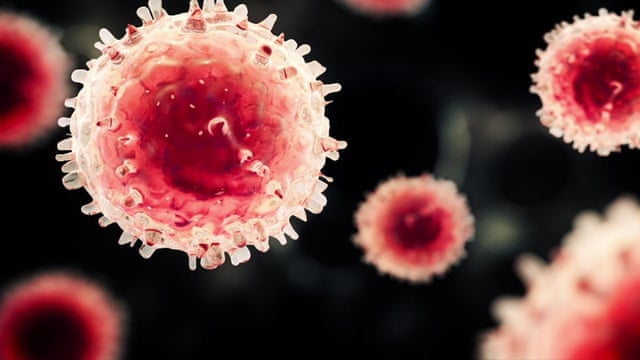
Researchers have spotted rare “flag” proteins that act as immune system targets and are displayed on the surface of all of a patient’s tumour cells (above), wherever they might be in the body.
A major British discovery is expected to lead to revolutionary bespoke treatments for patients with advanced cancer that could enter trials within two years.
Researchers have spotted rare “flag” proteins that act as immune system targets and are displayed on the surface of all of a patient’s tumour cells, wherever they might be in the body.
Normally they are shielded from the immune system, or missed because rapidly evolving cancers present too many constantly changing targets.
Once the omnipresent proteins, or antigens, are isolated, potent immune system cells called T-cells can be employed as homing missiles to zero in on them and destroy the cancer.
Such an approach, which involves mapping the DNA in a patient’s tumour sample, would help to overcome the ability of cancers to resist therapies by altering their genetic make-up.
The work is at an early stage and so far just two of the special antigens, plus the T-cells that recognise them, have been identified in two lung cancer patients.
The scientists hope to see rapid progress leading to patient trials, and are optimistic about similar targets for other cancers being found.
Prof Charles Swanton of University College London’s Cancer Institute, a leading member of the Cancer Research UK-funded team, said: “I will be disappointed if we haven’t treated a patient within two years.
“Do we think it’s going to work? I hope this is going to result in improvements in survival outcomes. If this doesn’t work I’ll probably hang my hat up and do something else.”
He pointed out that a tumour evolutionary tree was like a “snowflake or fingerprint”, unique to each patient. That presented a problem for clinicians and patients, because as tumours developed the tree grew new branches containing novel genetic mutations which helped the cancer to resist treatment.
The new research had shown there were potential immunotherapy targets from the “trunk” of the tree that are flagged up on all of a tumour’s multiplying cells.
Prof Swanton added: “This is exciting ... now we can prioritise and target tumour antigens that are present in every cell - the Achilles heel of these highly complex cancers.
“This is really fascinating and takes personalised medicine to its absolute limit, where each patient would have a unique, bespoke treatment.”
One way of exploiting the discovery would be to develop T-cell-activating vaccines based on the antigens, said the researchers, whose findings are reported in the journal Science.
Another would be to “fish out” the small number of T-cells in tumours that are naturally primed to recognise the antigens, multiplying them in a laboratory, and returning them to the patient.
Currently there are too few of the ready-primed T-cells in patients to make a difference. In the samples analysed by the scientists, they only made up 1 per cent to 2 per cent of the T-cells in a tumour.
Another hurdle to be crossed is the way cancer protects itself using proteins that are normally employed to keep the immune system in check and prevent it running out of control.
In practice, the new antigen-targeting therapies would have to be accompanied by so-called “checkpoint inhibitors” - drugs that are already being used to treat cancer patients.
Prof Peter Johnson, Cancer Research UK’s chief clinician, said: “This ... research gives us vital clues about how to specifically tailor treatment for a patient using their immune system.
“It gets us closer to knowing why some patients respond to immunotherapy treatment and others don’t, and how we might select which patients will benefit the most.”
The research was also funded by the Rosetrees Trust, set up in 1987 to support life-changing medical science.
More gold and platinum in Irish rivers than previously thought


Irish gold hunters are readying themselves for action after it emerged Ireland's rivers have more precious metals in them than previously thought.
The finding is the result of new tests by geological experts using modern technology, and is sure to spark the interest of gold panners here.
"There is more platinum, gold and precious metals in the streams and rivers of the south east of Ireland than previously believed," the Geological Survey of Ireland - the agency responsible for providing geological information - said yesterday.
"The most notable levels of platinum are found mainly in the area to the southeast of the towns of Aughrim and Tinahely on the Wicklow-Wexford border," it said. Platinum has uses in jewellery, electronics and catalytic converters in cars.
"As well as reconfirming high levels of gold in streams near the Goldmines River and Avoca regions of Wicklow, the new data identifies high gold values in streams that flow across and along the edges of the Leinster granite, a complex area long thought to be a source for the gold mineralisation in the region," said the agency.
"The recently re-analysed data . . . also highlights a broad zone of gold in Co Wicklow, north of the Sugar Loaf region where only small traces of the precious metal have been found previously."
High gold values in streams have also been identified in Co Waterford, in the Dungarvan to Stradbally area, known locally as the 'Gold Coast'.
The agency hopes the findings will spark the interest of mineral exploration companies, leading to investment in the country.
"The industry is currently suffering from a major global downturn due to low commodity prices, which coupled with a scarcity of recent economically significant discoveries, has seen Ireland's indigenous production of metals retreat with the closure of a number of mines," said Koen Verbruggen, director of the Geological Survey of Ireland.
Richard Conroy, chairman of gold exploration company Conroy Gold and Natural Resources, said the discovery of platinum for the first time in stream sediments, and more gold than previously known in Wicklow, Wexford and Waterford, is positive news for the mineral exploration industry in Ireland, which contributes significantly to the economy each year.
"It won't spark a gold rush but it will encourage local and international companies to look at Ireland with more interest," he told the Irish Independent.
The discovery could eventually lead to the creation of up to 1,000 jobs over the next decade in rural areas, he added.
"You could be looking at immediate employment of between 200 and 300, and up to 1,000, within the next decade for one significant discovery.
"I don't think we're the new Yukon, but people don't realise the hundreds of people employed in mining and spin-off industries," he added.
What the law says when it comes to panning Irish rivers for gold
Mining activity in Ireland requires a licence from the State, but "recreational" panning is allowed.
That's defined as activity that uses only hand-held, non-motorised equipment. The Department of Communications, Energy and National Resources asks panners to seek permission from various parties, including relevant landowners and the National Parks and Wildlife Service, to ensure the site they wish to use isn't environmentally sensitive.
Precious metals in the ground are the property of the State but panners are allowed to keep small quantities "as a souvenir". Any finds which return more than 20 gold flakes or individual nuggets that weigh more than two grammes are to be notified to the department.
But selling the gold is a no-no. That's defined by law as 'working' of minerals - which requires permission from the Government.
Six things we can do now to save Wildlife from Extinction


World Wildlife Day reminds us all that the future of our planet is in our hands. In the past 40 years, we have lost 52% of wildlife from the face of Earth. While it may be difficult to fathom the fact that mankind has been responsible for this enormous amount of damage, it is the reality. Some of the most iconic animals on our planet – tigers, elephants, rhinos – are closer to extinction than we realize.
More than 100 elephants are killed every day for their ivory, and a rhino is killed every eight hours by poachers, and due to the illegal pet trade, there are more tigers in people’s backyards than there are in the wild. This day is a critical reminder to our world leaders that we must chase down these criminals to end the unconscionable trafficking of these vulnerable species, but protecting these species also means changing our own habits. Here are five things you can do right now to help animals on World Wildlife Day:
- Change your food
It may seem like a hard concept to grasp, but the food choices we make every day are intrinsically tied to Earth’s destruction. Especially, our appetite for meat, dairy and eggs.
According to the United Nations Food and Agriculture Organization (FAO) the livestock system occupies 45% of global land. Our appetite for meat and dairy is destroying our rainforests and increasing our Earth’s temperature due to the sheer volume of greenhouse gases created by animal agriculture. In fact, it is estimated that the livestock industry alone could drive 175 different species into extinction!
An estimated 80% of deforestation in the Amazon rainforest is due to agriculture expansion and an area the size of Germany, France, Belgium and the Netherlands in South America has been converted to soy plantations to feed cows, chickens and pigs. In total, more than 136 million rainforest acres have been cleared for animal agriculture. This is devastating as an estimated 110 plant, animal, and insect species are lost every day due to rainforest destruction. The Pantanal jaguar, American wolf, and wild horse have paid the ultimate price for our hamburgers. Rainforests and resource destruction isn’t something most of us give much thought to when we’re chowing down on a sandwich or chicken wing, but it’s about time we start!
The incredible thing is, if every person in the U.S. were to choose more plant-based foods, we could cut our carbon footprint in half, save around 200,000 gallons of water. To start using your food choices for the benefit of the planet, join One Green Planet’s #EatForThePlanet movement!
- Avoid plastic
Convenience often trumps conservation in our daily habits. Sure, it’s easy to grab a plastic water bottle on the go, or take a single-use bag on a shopping trip, but such products that we use for just a few minutes have forever-lasting impacts on our planet and its inhabitants. Currently, around 700 marine species are faced with extinction due to the threat plastic poses to them from entanglement, pollution, and ingestion.
An international study from the University of Queensland discovered that 50% of sea turtles have plastic in their stomachs. Additionally, a recent study posited that by 2050, 99% of all seabird species will have ingested plastic waste. According to a study by the World Economic Forum, there will be one tonne of plastic for every three tonnes of fish by 2025, and if things go on business as usual, there will be more plastic in the ocean than fish by 2050! If you’re ready to kick your plastic habit to save marine animals, join One Green Planet’s #CrushPlastic campaign!
- Put down Palm oil
The production of palm oil, one of the world’s most popular vegetable oils, is destroying rainforests around the globe and in turn hundreds of animal species are suffering. Orangutanshave become the most common victims of palm oil. It’s estimated that over 50,000 orangutans have already died as a result of deforestation in the last two decades. Palm oil is certainly not a necessity and there are much kinder alternatives. Click here to learn how to kick your palm oil habit.
- Don’t support Circuses, Zoos, or attractions that hold animals in captivity
With so few elephants, tigers, and lions left in the wild, the very last thing we should be doing is capturing them from their homes and locking them up in cages for our entertainment. It’s an incredible thing to see a wild animal up close, but not at the expense of their well-being. Animals in the circus are often stolen from their families as babies and have their spirits “broken” with physical abuse until they are submissive to their trainers.
These animals will never live the way they are supposed to and will likely never see their families, or possibly even another memeber of their species again. Yes, it’s pretty cool to see these amazing beings up close, but wouldn’t we all rather see happy animals in the wild than tormented ones behind bars? Even zoos, which claim to be facilities for conservation, do nothing to help these species, as their animals are hardly ever reintroduced to the wild. Don’t let such facilities fool you – animal attractions exist for profits, not protection.
- Do not support rescues and animal rights organizations
There are some incredible people on the ground, risking their lives to protect animals. Whether tackling poachers, rehabilitating orangutans affected by the palm oil industry, orraising orphaned elephants whose parents have been killed for ivory, these individuals are working every day to help save the lives of the most vulnerable. You can be a part of their work by supporting their efforts. Click here for a list of some of the top organizations working to protect endangered species.
- Use your voice!
There is no tool more powerful than your own voice. You can help our fellow animal species by sharing articles and using social media to spread information. Every single one of us has the ability to make a difference for the future of our world and all of its beings, but we must act quickly. Whether by writing to your elected officials, speaking to your friends, or joining an organization working to protect our planet, you can speak out for animals who have no voice of their own. Start by sharing this article to maximize your impact!


 Steel Rods


