Pages

Monday, January 4, 2016

Donie's Ireland daily news BLOG

Credit union rules relaxed to allow investment in social housing

FINANCE MINISTER MICHAEL NOONAN HAS ORDERED A REVIEW INTO THE LIMITS ON THE SECTOR


MINISTER FOR FINANCE MICHAEL NOONAN TD SPEAKING TO MEDIA AT GOVERNMENT BUILDINGS FOLLOWING RENT CERTAINTY PROPOSALS AND INCREASED HOUSING SUPPORTS.

The Central Bank is scrapping a rule that prevents credit unions from investing in public projects, such as social housing.
The country’s credit unions have long campaigned to be allowed to invest in social housing. The Irish League of Credit Unions said in November that it had up to €8.5bn of members’ deposits available to help solve Ireland’s social housing crisis and that it could not understand why the Government was prohibiting this.
Department of Finance assistant secretary-general Ann Nolan confirmed to the country’s biggest credit unions that the prohibition is being scrapped last month.
“Following discussions with the Central Bank, I have been informed that regulations have been updated in relation to classes of investments for credit unions to specifically include investments in projects of a public nature, including investments in social housing,” Ms Nolan wrote on December 16.
Many other rules governing credit unions are also being reviewed, following the surprise move by Finance Minister Michael Noonan in December to order a statutory committee to probe the limits imposed on the sector, such as limitations on the nature and term of lending.
Many of these rules were originally introduced by the Central Bank, based on a 2012 report by the Commission on Credit Unions, another statutory group.
The Central Bank has been accused of implementing the Commission’s recommendations in a manner inconsistent with their spirit and intent. Some credit unions deem them onerous.
The new review, to be conducted by the Credit Union Advisory Committee, will begin this month and is expected to report by the end of June.
The Sunday Independent has seen its terms of reference and among the things the committee must take into account is “the need for credit unions to develop their business model and grow income in a prudent manner”.
The contentious €100,000 savings cap for credit unions has already been relaxed. Credit unions with more than €100m in assets may apply to the regulator to accept more than €100,000 from individual savers.
The Credit Union Development Association, which represents some of the country’s largest credit unions, wants the regulator to go further. Writing in the Sunday Independent today, CUDA chief executive Kevin Johnson called for the introduction of tiered regulation, whereby larger credit unions would be given more freedom than smaller credit unions.
“Tiered regulation, done properly, will allow some credit unions to continue to offer basic savings and loans, while allowing other credit unions to develop and offer a greater range of services, as long as they have what is necessary to manage the additional risks,” he writes.
“Credit unions need to be allowed to compete with banks… Fundamentally, credit unions offering a full range of services will drive great competition – something that is sorely lacking in Ireland at the moment.”

House prices outside Dublin up 13% as supply at decade low
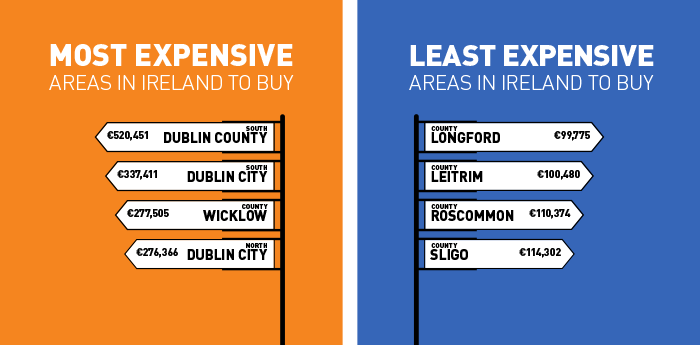
  

HOUSE PRICES OUTSIDE OF DUBLIN SOARED IN 2015, WHILE THE NATIONAL HOUSING SUPPLY NOW STANDS AT ITS LOWEST POINT IN ALMOST A DECADE.

According to the latest Daft.ie house price report, prices rose by an average of 8.5% in 2015.
However, the national average hides a significant difference between Dublin,  where prices rose by just 2.7% — and the rest of the country, where the average asking price jumped by 13.1%.
The report found the national average asking price in the final quarter of 2015 was €204,000, compared to €188,000 a year ago and €164,000 at its lowest point in early 2013.
The different trends in Dublin and elsewhere mark a turnaround from 2014, when prices rose by 21% in the capital and by 9% elsewhere.
The Daft.ie report highlights that the slowdown in Dublin inflation occurred at a time when inflation in Ireland’s other cities accelerated.
For example, house prices rose by an average of 20.7% in Cork in 2015 compared to 14.7% in 2014, and by 19.7% in Galway compared to 16.3% in 2014.
In Waterford City the rate of inflation increased significantly, with prices up 18.6%, compared to 4.1% a year ago.
However, the most dramatic change in house prices has occurred in Limerick City.
A year ago, prices in the city were falling by 1.3% year-on-year, but in the last 12 months they have risen by 22.3%.
Prices in the city are now back at mid-2012 levels.
Elsewhere in the country, inflation has accelerated from 8.8% in 2014 to 12.1% in 2015. The Daft.ie study also pointed out that the total stock of properties for sale is now at its lowest point in nearly nine years, with just over 25,000 properties for sale nationwide.
A year ago, there were nearly 30,000 properties on the market, with the bulk of the reduction coming from outside of the five main cities.
Ronan Lyons, economist at Trinity College Dublin and author of the report, said the dramatic slowdown in Dublin house prices in 2015 shows how effective the Central Bank deposit rules have been there, but that this had not been replicated elsewhere.
“This has not been the case elsewhere in the country as house prices are lower relative to incomes and thus the new rules have not been as binding.
“Some have criticised the new rules as hindering new housing supply, but the solution to a lack of supply is not stimulating demand even more.
“If supply is lacking, the solution to this must be found in reducing construction costs, not in giving borrowers access to potentially dangerous levels of mortgage credit,” he said.

Minister Frances Fitzgerald says miscarriage’s are one of Ireland’s main taboos

MINISTER RECALLS HER MISCARRIAGES, SAYS FAMILIES HAVING MISCARRIAGES AT OLDER AGE AS THEY WAIT TO HAVE CHILDREN


   

‘A LOT OF PEOPLE ARE HAVING MISCARRIAGES AT AN OLDER AGE BECAUSE THEY WANT TO HAVE BABIES AT AN OLDER AGE,’ MINISTER FOR JUSTICE FRANCES FITZGERALD SAID OF A SUBJECT THAT STILL REMAINS A TABOO IN IRELAND SHE SAYS.

Miscarriages are one of Irish society’s main taboos in an era where couples are choosing to have children later in life, Minister for Justice Frances Fitzgeraldhas said.
Ms Fitzgerald, who spoke about having had two miscarriages, said it has become an issue for an older demographic.
“A lot of people are having miscarriages at an older age because they want to have babies at an older age, so it is more stressful. Then they think: ‘Am I going to get pregnant again?’” she said in an interview with the Irish Examiner.
“Younger generations of men and women have gotten into the mindset, and that is obviously linked to the availability of contraception, there is a belief that you can plan a pregnancy.
“Of course, first of all, there are fertility issues as you get older. Secondly, the fact is a lot of pregnancies end in miscarriage, there is a shock and disbelief for people.”
More than one in five pregnancies result in miscarriage. Ms Fitzgerald said the availability of contraception had impacted on people’s perceptions around having children.
Of her own experience she recalled the shock of being told by doctors but that going on to have subsequent successful pregnancies had helped her.
“For me, I went on to have a second and a third pregnancy afterward, so you can recover from it.
“And you can kind of accept, well there was something wrong and there is a reason for it.”

First there was no shaving, then no booze and now meat and dairy face the chop

Veganuary campaign expects 50,000 people to join the likes of Vivienne Westwood, Romesh Ranganathan and Sara Pascoe for a month free of animal products

     
L-R Gwyneth Paltrow, Brad Pitt, Sara Pascoe, Romesh Ranganathan Composite: REX Shutterstock & Graeme Robertson
In the beginning, there was Movember. Then there was Stoptober. Now prepare yourself for Veganuary.
Those who have overindulged this festive period may be tempted to turn vegan for January. If so, they will not be alone. Organisers of Veganuary, now in its third year, predict that 50,000 people will take part this month, of whom around half will stay vegan.
About 3,000 people participated in the first Veganuary. Last year the figure rose to 12,800. But eschewing meat, fish and dairy products is now becoming increasingly fashionable thanks to a number of high-profile advocates.
Famous names who have tried vegan diets in the past include Bill Clinton and actor Anne Hathaway. Committed vegans include Brad Pitt, Ellie Goulding and Gwyneth Paltrow. Kat Von D, an American tattoo artist and model, crashed theVeganuary website earlier this year when she encouraged people to register.
Among the celebrities taking part this month are comedians Romesh Ranganathan and Sara Pascoe. Actor Peter Egan of Downton Abbey fame and designer Vivienne Westwood have also signed up.
Organisers of the event claim the surge in support for veganism reflects a growing awareness that it can help alleviate the world’s food crisis.
Rearing animals for consumption and dairy production produces significantly more carbon dioxide than plant-based food. In addition, animal farming is the leading producer of methane gas, a major contributor to global warming. However, organisers said that a concern for animals was still the primary motivation for people becoming vegan.
“We ask about motivation when people sign up to Veganuary and, for the past two years, animals are the primary reason by a large majority, with health coming second, and the environment third,” said Clea Grady, marketing manager of Veganuary.
“There is an increasing awareness and concern at how we treat, use and abuse animals, and this is growing year on year. Anecdotally, we know that, for whatever reason an individual approaches veganism, the lines begin to blur once education has taken place.”
The business world is now waking up to the growing vegan market. Companies such as VBites, Violife and Fry’s market products such as vegan cheese, ice-cream, “fish” fingers, burgers, sausages, schnitzels and “chicken” nuggets.
Pret a Manger has been expanding its range of vegan sandwiches; Caffè Nero labels its mince pies as vegan; and Pizza Express has a vegan pizza on its regular menu. Both Yo! Sushi and the Handmade Burger Company are doing special promotions in support of Veganuary.
“There has been a marked increase in enthusiasm in the UK over the past 12 to 18 months, and that’s extremely exciting to see,” Grady said.
“This has resulted in more media coverage, many more vegan products on our shelves, and ever-increasing numbers of Veganuary participants. We are starting to catch up with the States, but they continue to pave the way.”
Some nutritionists argue that humans cannot derive all the minerals and vitamins they need from a pure vegan diet. Both Clinton and Hathaway famously turned their backs on veganism. “I just didn’t feel good or healthy,” Hathaway once explained.
However, Grady said veganism could provide a balanced diet. “All it requires is a little knowledge and guidance, and that’s what Veganuary specialises in,” she said. “The Health and Nutrition sections of Veganuary.com were co-authored by a GP and a qualified nutritionist, so we are confident in the information we provide. We follow this up with practical guides on what to eat, and what to replace, demonstrating how easy getting the right nutrition can be.”

Which planets are habitable? Astrophysicists have a fresh insight

By looking at slight variations in the brightness of distant stars, scientists say they can determine their surface gravity, a technique that provides important clues to life-hosting properties of the planets that orbit them.
     
An international team of astrophysicists has devised a way to measure the surface gravity of distant stars to help determine if the planets in their orbit are hospitable to life.
Led by a researcher at the University of Vienna, the team calculated the surface gravity of stars that are too distant to study with conventional methods by looking at the slight variations in their brightness, which is caused by convection and surface turbulence, the same forces behind a pot of boiling soup, explains the Vancouver Sun.
Gravity is crucial to many aspects of astrophysics, say the researchers in a paper published on January 1 in the journal Science Advances, as it provides clues to the properties of stars, such as their mass and radius, and to the properties of planets in their orbits that might make them habitable.
“Our technique can tell you how big and bright is the star, and if a planet around it is the right size and temperature to have water oceans, and maybe life,” said study co-author Jaymie Matthews, a professor of astrophysics at the University of British Columbia, in a study announcement.
“If you don’t know the star, you don’t know the planet,” explained Prof. Matthews. “The size of an exoplanet is measured relative to the size of its parent star. If you find a planet around a star that you think is Sun-like but is actually a giant, you may have fooled yourself into thinking you’ve found a habitable Earth-sized world.”
To determine the gravitational pull of distant stars, the researchers used data of star brightness collected from Canada’s MOST and NASA’s Kepler satellites.
Since its launch in 2009, Kepler has already discovered more than 1,000 planets, a dozen of them less than twice the size of Earth and residing in the habitable zone of their host stars, which means these planets orbit their host stars at the right distance to make them neither too hot nor too cold to harbour liquid water. Astronomers believe the presence of water on planets is critical to life.
The team of astrophysicists behind the latest gravity-measuring technique believes that it will help future exoplanet surveys to correctly characterize the planets they find.
“I expect someone will announce the discovery of life on an exoplanet within about 20 years,” Matthews told the Vancouver Sun. 

Saturday, January 2, 2016

Donie's Ireland daily news BLOG

Tánaiste Joan Burton staff salaries up to €52k more than pay cap

   
Tánaiste Joan Burton has claimed there is nothing wrong with two of her senior advisers being paid up to €52,000 more than strict pay caps allow because the salaries are still lower than under previous governments.
The Labour leader was forced to defend the salaries of her chief of staff, Ed Brophy, and her economic adviser, Terry Quinn, after it emerged their pay packets, of €144,550 and €114,424, respectively, exceed the €92,672 ceiling set when the Coalition came to office.
The figures, revealed by Fianna Fáil social protection spokesman Willie O’Dea last night, show Mr Brophy is earning €51,878 more than the cut-off point introduced by the Government in 2011.
He joined Ms Burton’s backroom team in late 2011 as a special adviser on a €127,796 salary, before being promoted to the role of chief of staff in July 2014.
Mr Quinn, who joined as an economic adviser just after the Coalition came to power, is earning €21,752 more than pay-cap rates for special advisers allow.
Mr O’Dea said the figures “illustrate the hypocrisy” of the Government.
Describing the pay-cap breaches as “just another example of this Government saying one thing and then doing another”, Mr O’Dea said plans to reform pay are “in reality just another broken promise” and “galling” for people on social welfare.
A spokesman for Ms Burton last night said the high salaries are justified as Mr Brophy took a 33% pay cut when he came from the private sector and Mr Quinn’s salary is “exactly in line” with his pay level at the Central Bank, from which he was seconded in 2011.
The spokesman said the salaries are “still significantly less” than salaries under the Fianna Fáil-led coalition, “which spent enormous sums on themselves and advisers”.
The Coalition introduced the €92,672 pay cap in 2011 following adviser pay scandals that hit the previous administration. These included €5m for ex-taoiseach Bertie Ahern’s backroom team, including a 119% rise, to €229,918, for his programme manager Gerry Hickey between 1998 and 2009.
However, Fine Gael and Labour ministers have subsequently struggled to stay within the pay ceiling themselves. Environment Minister Alan Kelly, Finance Minister Michael Noonan, Communications Minister Alex White, and Agriculture Minister Simon Coveney all sought increases for advisers following the summer 2014 cabinet reshuffle.

Next government faces a health service crisis says I.M.O.


THE NEXT GOVERNMENT WILL INHERIT “A CRISIS OF ENORMOUS PROPORTIONS” IN THE HEALTH SERVICES, DOCTORS HAVE WARNED.

The Irish Medical Organisation has vowed to keep health at the forefront of the imminent general election campaign.
In a special new year statement, IMO president Dr Ray Walley said 2015 would be regarded as a year of acute crisis across the health services.
The health service was on its knees; patients were suffering unacceptably; crisis management was the order of the day and the morale of medical professionals was at an all-time low.
“Years of austerity have caused many problems across the country, but no section has suffered as much and for as long as the health services and the patients who depend on it,” said Dr Walley. The IMO chief said: “The new government will inherit a crisis of enormous proportions in this sector and must prioritise an urgent injection of resources if the system is not to collapse entirely.”
Dr Walley said there were four critical areas that the next Government must address.
  • Afour-year investment programme across the health services;
  • Sustained investment in bed capacity in hospitals, nursing homes and rehabilitative settings;
  • A resourced modern GP service for those most in need of the delivery of chronic care;
  • Asolution to the ongoing retention and recruitment of doctors.
Dr Walley said the current crisis was the inevitable consequence of years of austerity.
“Everything we warned about has come to pass,” he said. Successive health ministers had focussed on day-to-day crisis management rather than on long-term strategic planning.
“The promotion of different pay for people doing the same job, overcrowding in emergency departments, uncontrollable waiting lists for out-patients, the piling on of unresourced extra demands on general practice, and the widespread culling of hospital beds, have all contributed to the current crisis.”
Dr Walley was particularly critical of the “wasted distraction” — universal health insurance. It had served to move attention away from the health services and the urgent need for action.
He also believed there was an urgent need to change the focus of the debate on health services — that it was a drain on the nation’s resources.
“Investing in health services is an investment in our economy, our community and our society and is as critical to the recovery of this country and its people as any other investment in any sector of the economy,” said Dr Walley.
The National Association of General Practitioners (NAGP) said GPs should have commensurate rates of pay with hospital consultants — reflecting their expertise, training and responsibility.

Smoking in cars carrying children illegal from today in Ireland


NEW LAWS MAKING IT AN OFFENCE TO SMOKE IN ANY CAR CARRYING CHILDREN CAME INTO EFFECT AT MIDNIGHT.

IF CAUGHT, OFFENDERS FACE A FIXED FINE OF €100.

ASH Ireland has encourages people to give up smoking today, claiming that 100 people die each week in Ireland as a result of smoking.
The group, which aims to reduce the impact of tobacco on Irish society, is urging smokers to visit the quit.ie website and make a plan to give up smoking.
Chairperson of ASH Ireland, Dr Ross Morgan, said that initial research seems to indicate that e-cigarettes are marginally healthier than tobacco, but should not be seen as a long-term alternative.
“I’d encourage everybody who is a current smoker to stop smoking for their health, it’s the most important thing they could do,” he said.
“And for their pocket it’s going to be really important as well.
“And whatever mechanism and whatever helps them to do that, and if it’s an electronic cigarette, great, but I would say try to get off the electronic cigarette eventually as well.”

Alcohol link to obesity:

5 pints has same calories as 3 BURGERS


Alcoholic drinks should carry a calorie warning to fight obesity say experts.

Alcoholic drinks should display calorie counts to help fight the obesity epidemic, say many local councillors
Although the link between booze and cancer is known, people are ignorant that drink can make them fat, according to the Local Government Association.
Drinking five pints of beer at 4% strength over 24 hours is the equivalent of eating more than three burgers, which would take 90 minutes to run off.
And a bottle of wine – roughly four 175ml glasses – has the same calorie count as more than two burgers and would take longer than an hour to run off. So the LGA now wants breweries to put calorie counts on all bottles and cans.
Spokeswoman Izzi Seccombe, said: “Prevention is the only way to tackle obesity.”

Road deaths for 2015 in Ireland are second lowest in over half century

165 PEOPLE DIED ON STATE’S ROADS IN 2015, AND A FURTHER 74 IN THE NORTH

    
A total of 165 people died on the State’s roads in 2015 – the second lowest number since records began.
Some 165 people died on the State’s roads in 2015 – the second lowest number of road deaths since records began in 1959.
Provisional figures from the Road Safety Authority (RSA) show there were 165 fatalities during the year – 28 fewer than in 2014 and a total drop of 15 per cent.
There were 158 fatal collisions in 2015, a 12 per cent drop on the number in 2014.
The RSA said the significant decline reversed an upward trend in road deaths in 2013 (188) and 2014 (193).
“It is also the second lowest number of road deaths since recording began in 1959. The safest year was in 2012 when 162 lives were lost.”
Chief Supt Mark Curran of the Garda National Traffic Bureau welcomed the reduction in road deaths but noted that 20 people had died on Irish Roads in December, with 15 killed in the last two weeks alone.
He said this made it the worst December for road deaths since 2007.
  • Man in his 70s dies after Westmeath car crash
  • Male motorcyclist dies in collision in Co Galway
  • Road traffic deaths in December approach record numbers
In Northern Ireland, there was also a drop in the number of road fatalities: from 79 in 2014 to 74 in 2015.
A total of 41 people were killed in incidents on rural roads compared with 21 deaths on urban roads. Twelve people died in motorway or dual carriageway incidents, according to the PSNI figures.
Thirty-four of those killed in the North were drivers, 17 were passengers, 19 pedestrians and four motorcyclists died in accidents.
Minister for Transport Paschal Donohoe said that while every death on the roads was “one death too many”, he hoped the figures for the Republic would reflect a return to the steady progress being made up to 2012 to make the roads safer for everybody.
“A reduction of 15 per cent in the number of fatalities is a positive development but the number of lives tragically lost, especially in recent weeks, reminds us that we must continue to focus on the most effective ways of reducing the number of deaths and serious injuries on our roads,” he said.
Mr Donohoe said he would be progressing legislation in January to tackle drug driving.
He asked that all motorists, cyclists and pedestrians play their part this year in making our roads as safe as they can be.
Chair of the RSA Liz O’Donnell said it was difficult to describe 2015 as a “success” when 165 people had died on the roads “and especially after the carnage we witnessed in the final weeks of year”.
“But the number of people being killed on the road is the only way we can measure success or failure – and it’s important that people know progress is being made and their efforts are making a difference,” she said.
“So, to put it simply, because road users took greater care on the road last year, they saved one life every two weeks compared to 2014. But we can save so many more lives – and my appeal to all road users is to make a pledge to practise more good road safety habits in 2016.
“I would also urge people to be extra vigilant over the next few weeks of anticipated bad weather and resultant flooding.”
Ms O’Donnell said it was important to acknowledge and thank those on the “front line” in road safety, including gardaĂ­, ambulance and paramedic crews, fire brigade personnel, nurses, doctors and carers.
RSA chief executive Moyagh Murdock said the agency’s focus this year would be on the challenges posed by driver distraction, in particular mobile phone use, and “the consequences of this behaviour for vulnerable road users”.

How to help your company prepare for climate change in 2016


WITH THE PARIS AGREEMENT ON THE BOOKS NOW, IT IS TIME TO LOOK AT HOW CLIMATE CHANGE AND ITS MITIGATION WILL IMPACT OUR BUSINESSES, AND HOW THEY CAN ADAPT

World leaders celebrate the adoption of a climate agreement during the Paris talks earlier this month.
As 2015 comes to a close, we can now look forward to starting a new year with a global climate change agreement that has been signed by 95% of the world’s governments. We’re equippedwith a multitude of reports that parse all of its endless details. But the deal leaves many companies with a big question: how can they continue to grow while cutting their environmental impacts in line with the new climate goals?
Several businesses have attempted to answer this question, but most have acknowledged that they won’t be able to significantly grow their efforts without strong policy support . With this in mind, it’s clear that the focus of business and governments must now shift from advocacy and cheerleading to implementation, whether that involves true funding of new product innovation or rolling out localized plans for sustainable development.
As we start our journey into 2016, climate change news will likely recede to make room for other headlines. But the initiatives outlined in the Paris agreement – which the International Energy Agency estimates will cost $16.5tn by 2030 – are likely to emerge as a critical tool for companies.
Among other things, they will enable planners to align their growth plans, assess their product portfolios, refine their innovation pipelines, redefine their key performance metrics and take stock of all the programs and processes needed to address these changes.
Hand in hand with these programs and processesis a big elephant in the room: cost mitigation. The White House projects that the incremental costs of an additional degree of warming will reach $700bn by 2030. And that’s a recurringyearly cost, not a one-time penalty.
Companies will likely bear the brunt of this expense. With that in mind, here are five key considerations to help clarify the breadth of the scope of this change – and how it is likely to affect business:
What can a global temperature rise of 1.5-2C mean for businesses?
A recurring theme at COP21’s business events was the growing awareness of climate science. Whether the people talking were CEOs, energy professionals or NGOs, they all displayed a rising consciousness of climate science.
Companies looking to weather climate change need to address this problem in scenario planning. They must ask where their suppliers live and operate, and what will happen to those regions if business continues as usual – or, alternately, if regulation intervenes.
They need to weigh whether it would be cheaper to find new partners or work with their current ones on adaptation tools and technologies. They need to address customer behavior and consider whether it will shift based on resource availability, weather conditions and new lifestyles. For those in the service industry, this translates into the need for a lot more knowledge. For example, accountants must brush up their sustainability accounting standards, doctors must now weave sustainability elements into the science of healthcare and cleaners must understand what components go into the products they use and what impact those can have on the environment.
Many of these service professionals will also need to address the issue of how best to continue to grow their businesses without harming the environment. For a bank, law firm or brick and mortar store, this could mean understanding how opening more branches, stores and offices could help open access for communities but potentially hurt the local environment through increased emissions caused by infrastructure, transportation, waste and other factors.
What is the potential cost of climate change?
From the dangerous levels of pollution in Delhi and Beijing to the haze in Indonesia and the water crisis in California, we’re already seeing financial impacts from climate change. These costs will extend across a range traditional economic indicators. For instance, warmer winter temperatures on the US East Coast are costing retailers money in sales of cold weather gear. Further south, Miami is facing serious infrastructural issues as its sea level rises – and, in response, it’s creating innovative financing models to tackle situations in which traditional funding won’t suffice.
Accounting for these unintended costs will give companies greater predictability and a surer path to growth, but doing so will also require broadening the scope of their accounting sheets and potentially attaching a price to every resource they consume. Some companies, like Microsoft, are already leading the way by adopting internal carbon pricing. (Microsoft says its program has reduced its emissions by 7.5m metric tons and saved it $10m per year.)
How will climate change impact a company’s valuation?
The financial services sector is refining its investment criteria and strategies to address climate change, and companies should take note of how these evaluations can impact their stock performance. It’s hardly coincidental thatGoldman Sachs and Citi both recently updated their respective environmental and social risk management policies to prominently incorporate climate and other environmental, social and corporate governance (ESG) factors into their investment strategies. For that matter, it’s hardly surprising that Citi has also decided to reduce its coal lending.
With six of the largest US banks calling for a strong climate agreement earlier this year, chances are the trend towards embedding ESG metrics into investment criteria will continue. To successfully adapt to this change, companies will need to get their investor relations teams in the same room with their sustainability teams, risk management teams and their boards.
Do employees understand how climate change links to their business?
Amid a tsunami of news and information, awareness of the impacts of climate change is growing and deepening. Educating employees about the specifics of how climate change will affect their jobs will require consistent and deliberate outreach, opportunities for engagement, and informal and formal conversations at all levels.
It will become vital for workers to understand the links between planetary boundaries and a company’s product portfolio, between their decisions and the company’s future, and between consumer behavior and the company’s pipeline – same as above. Understanding how every element of your work can impact the natural environment and resulting social conditions.
It will become vital for workers to understand the links between planetary boundaries and a company’s product portfolio, between their decisions and the company’s future, and between consumer behavior and the company’s pipeline. They will need to understand how every element of their work can impact the natural environment and resulting social conditions. .
Do different departments talk to each other?
For companies hoping to adapt to climate change, communication between departments is vital. The investor relations team needs to connect with the marketing department so that they can communicate more cohesively on issues including ESG disclosure, sustainability stories and stock performance. The board of directors needs to link up with the chief financial officer so that corporate governance and business accounting stay aligned with new scorecards and demands for transparency – and so the CFO understands and recognizes these metrics of business performance.
The same goes for corporate philanthropy: it needs to move from a linear, foundation-led activity to one that aligns with the company’s business strategies. Doing so could help ensure that all of a company’s efforts – the sum of its collective action, including business and philanthropy – lead to clear, tangible impact on the world’s social and environmental conditions.
As for decision makers, they need to understand how climate change could impact their companies’ procurement policies and market growth so they can consider how best to adapt their companies’ structures and processes to these changes.
There’s a lot more to dig into of course, based on a company’s sector, industry, ambition and appetite. However, the inevitability of climate change has never been clearer. It’s no longer a question of if climate change is going to happen or why a company needs to prepare, but when it is coming, what its impacts are going to be and how a company plans to adapt. For many companies, it’s time to reach for a scratch pad and start plotting a new course.