Ireland’s tax revenues lower than expected for last month of July due to VAT shortfall
LATEST EXCHEQUER RETURNS SHOW TAX REVENUE OF €26.6BN COLLECTED IN FIRST SEVEN MONTHS
 -
- 
AT THE END OF JULY, THE EXCHEQUER RECORDED A SURPLUS OF €862 MILLION VERSUS A DEFICIT OF €648 MILLION FOR THE SAME PERIOD LAST YEAR.
Tax revenues came in below target in July due to a shortfall in VAT receipts, while corporation taxes and excise duties also came in lower than expected. The figures indicate that consumer spending growth may have slowed in the run-up to the Brexit vote.
Tax revenues remain ahead of target for the first seven months as a whole, but analysts and government officials will now be closely monitoring the monthly figures to see if weaker trends persist in the run up to the Budget. Official forecasts for next year will be finalised in October and will determine whether, as expected, there will be €1 billion available for additional tax and spending measures on Budget day.
The latest exchequer returns show tax revenue of €26.6 billion was collected in the first seven months of the year, up €2 billion or 8.5% versus the same period in 2015 and €644 million or 2.5% ahead of target.
However, total tax revenue for the month of July were down €98 million or 2.3% below expectations as VAT receipts came in €61 million or 3.3% below the €1.83 billion target.
On a cumulative basis, Vat receipts are now down €292 million or 3.5% below expectations. However, they are still 4.2% ahead in year-on-year terms for the first seven months. This suggests that consumer spending is running ahead of last year, but that the rate of growth may have slowed in recent months.
Income tax receipts of €1.5 billion were collected in the month of July, up €65 million or 4.5% versus the same month a year earlier and on target. This reflects rising employment and some increase in wages.
IN A NUTSHELL WHAT ARE THE EXCHEQUER RETURNS?
The monthly exchequer returns provide details of taxes collected by the Exchequer and government spending. They are one of the most up-to-date indicators of activity in the economy. The figures for each month are published on the second working day of the following month.
The figures give details of taxes collected in all the main areas – such as income tax, VAT, corporation tax and so on. They also show how much each Government department spent. The key comparisons are usually with the same month last year, and with the targets set by the Department of Finance.
Corporation tax receipts were 16.5% or €23 million lower than forecast for the month. However, on a cumulative basis, corporation receipts are up €482 million or 17.2% higher than expected at €3.3 billion. Corporation taxes have been very volatile, and some large one-off payments boosted figures in earlier months.
Also suggesting some weakness in spending, excise duties were €25 million or 5% below target in July. Duties of €3.6 billion were recorded at the end of the month, this is €376 million or 11.5% ahead of target and up €723 million or 24.7% in year-on-year terms.
Stamp duties receipts were €3 million above expectations at €114 million. In cumulative terms, stamp duties of €581 million at the end of July were down €35 million or 5.7% against target but up 11.8% versus the same period a year ago.
The exchequer returns show €21 million was collected in local property tax receipts last month, bringing the total for the year to date to €315 million.
At the end of July, the exchequer recorded a surplus of €862 million versus a deficit of €648 million for the same period last year. The Department of Finance attributed the improvement to a year-on-year rise in tax revenue, which was partially offset by increased expenditure and reduced non-tax revenue.
The latest returns show non-tax revenue of €2.27 billion at the end of July, were down €224 million or 9.1% versus last year. The decrease was largely due to a one-off dividend of €203 million received by the Exchequer from ESB early in 2015.
A MIXED BAG?
Conall Mac Coille, chief economist at Davy described the latest returns as a “mixed bag.”
“On balance, the weakness in the month probably reflects volatility and the unwinding of some of the strength in corporation taxes earlier in the year,” he said.
Elsewhere, Peter Vale, tax partner at Grant Thornton said the exchequer figures would reassure the Government that there will be some fiscal space in October’s budget, notwithstanding the impact of Brexit.
“Slightly worryingly, the figures show VAT receipts continuing to lag behind target. If this trend accelerates post Brexit, we could see the VAT figures falling further behind at the end of September. A resultant drop in VAT receipts could impact on the scope for tax cuts or spending increases in the Budget,” said Mr Vale.
“On the positive side, income tax figures remain on track, reflecting the strong labour market. Again, it will likely be some time before we see the impact of Brexit flowing through to the tax numbers, he added.
Philip O’Sullivan, chief economist at Investec said he saw little reason to quibble with the Department of Finance’s cautious guidance of a full-year deficit of €2 billion versus a deficit of €1.5 billion for the first seven months of 2016. for the same period a year earlier, a € 3.1 billion deficit was recorded.
Ireland’s youth unemployment rate rises to 16% for month of July
CSO FIGURES SHOW OVERALL UNEMPLOYMENT UNCHANGED FROM JUNE, BUT DOWN FROM LAST YEAR

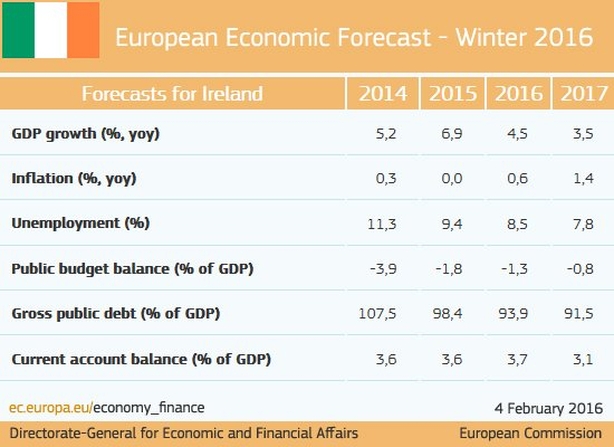
THE NUMBER OF PEOPLE UNEMPLOYED IN IRELAND IN JULY WAS 169,000, A RATE OF 7.8%, DOWN BY 29,800 FROM JULY 2015, ACCORDING TO CSO DATA.
The unemployment rate was unchanged at 7.8% in July versus June, but was down from 9.2% compared to the same month a year ago.
New figures from the Central Statistics Office (CSO) show the number of people unemployed last month was 169,000. This marks a decline of 29,800 compared to July 2015.
The youth unemployment rate rose to 16% from 15.4% last month, the latest data show.
The number of males unemployed fell by just 100 from June to July to 107,900. The number of women unemployed rose by 100 versus the previous month to 61,200.
Overall, the unemployment rate for men stood at 9.1% at the end of last month, unchanged from June and down from 10.6% for July 2015. The unemployment rate for women was unchanged versus June at 6.2% but declined from 7.6 per cent compared to the same month a year earlier.
Davy economist Conall Mac Coille said that while the latest figures should be taken as evidence of a slowdown in the labour market, initial estimates tend to be revised heavily. He added that it is too early to discern any negative impact from Brexit on hiring patterns.
Leo Varadkar wants new sugar tax in next October’s Irish Budget


LEO VARADKAR BELIEVES THE MEASURES SHOULD BE INCLUDED IN NEXT OCTOBER’S IRISH BUDGET.
SOCIAL PROTECTION MINISTER LEO VARADKAR HAS SAID HE IS IN FAVOUR OF INTRODUCING A SO-CALLED ‘SUGAR TAX’ IN THE BUDGET.
A ten cent levy on a can of fizzy drink would yield the exchequer €100m, according to pre-budget documents published by the Department of Finance.
While Mr Varadkar said he believes the measures should be included in October’s Budget, he warned that a sugar tax is not the complete solution to tackling obesity.
“Yeah. I think a sugar tax is a good idea. I don’t think it’s the solution to obesity. A lot of different measures are going to be required to get on top of obesity,” he said.
The Dublin West TD also acknowledged Independent.ie reports that the drinks industry is considering legal action to stave off such a tax.
“I suppose when you introduce any change, any new tax, or any change to the law, there’s always the risk it could be challenged legally by those who don’t agree with it,” Mr Varadkar said.
Mr Varadkar made the remarks at the launch of the 23rd edition of the ‘Working for You’ handbook by the Irish National Organisation of the Unemployed (INOU).
At the event in Dublin City on Wednesday, INOU chairperson Ann Fergus called on Mr Varadkar to fully restore the Christmas Bonus in the budget.
The minister told reporters the issue will be considered during discussions with Public Expenditure Minister Paschal Donohoe.
Galway City sets sights on All-Ireland Fleadh Cheoil for 2020


PICTURES FROM FLEADH CHEOIL NA HÉIREANN IN SLIGO LAST YEAR 2015.
GALWAY MAY HOST FLEADH CHEOIL NA HÉIREANN FOR THE FIRST TIME IN 2020.
Galway will be applying to host Fleadh Cheoil na hÉireann in 2020, a festival that could boost city coffers to the tune of €50m.
Never before held in Galway City, the massive event was only ever staged in County Galway in 1955 when it took place in Loughrea.
The application to host the event in the city is being made by the Moycullen branch of Galway Comhaltas. The chairman of the Moycullen branch, Caomhan Ó Fatharta, told the Galway City Tribune they were laying the groundwork for their application by manning a stand at the All-Ireland Fleadh in Ennis from August 9, urging other counties to throw their support behind the bid.
The branch has received a commitment from NUI Galway to host the event in three years’ time after successfully holding the county final last year, with plans to hold the Connacht finals there next year.
“Galway never had the facilities to apply for this before but now the university has two big halls – the Bailey Allen and the Kingfisher – that can hold 2,200 people. We will possibly need a third venue such as the Big Top which holds 1,000,” explained Caomhan.
“We have a lot of work done on this in the Moycullen branch. We’re trying to sort out meetings with the City Council, County Council and councillors to all get behind this as well as the 2020 team because of the enormous cost implications of staging this – it costs €800,000 to run.
“But we plan to definitely submit an application for 2020 after this year’s All-Ireland.”
The spin-offs are huge. In 2013 the jamboree of music, song and dance went north for the first time to Derry City, which staged the biggest event ever held in Comhaltas’ history when 430,000 attended.
There is no reason why Galway could not be even bigger.
Ennis will stage the event this year and next 2016-17, with a destination yet to be decided for 2018 and 2019. Sligo was the venue for the past two years where it was claimed by those in the know that it was one of the most successful Fleadh Cheoil’s ever.
The venue is decided by votes from branches from across the county and internationally. The week before the Fleadh – which generally takes place on the second or third week of August – is also a hive of activity as young musicians undertake week-long tutoring.
Peadar Brick, chairperson of the Galway Comhaltas, declined to comment ahead of a meeting on the issue next week.
He did point out that NUIG boasted the most appropriate facilities in the county as they were compact, capable of holding large crowds with 20 venues on site for different competitions.
The event is generally held in a location for two years in a row. Due to its timing, it will not clash with the other flagship events in the city such as the Galway International Arts Festival or the Galway Races.
Recently the head of Comhaltas Ceoltóirí Éireann told the Galway City Tribune that he would welcome an application to host a future Fleadh Cheoil na hÉireann in Galway City.
Labhrás Ó Murchú, director-general of Comhaltas Ceoltóirí Éireann, remarked: ”Galway City is a wonderful place, it’s such a vibrant city in so many ways because of the language and being so close to the Connemara Gaeltacht and it’s so compact – that’s why Derry was so successful, everything was near together.
“Personally, I spent my younger days in the Connemara Gaeltacht and we used to come into Galway City. I’ve often thought, gosh, wouldn’t this be a great location for the Fleadh Cheoil. The fact that Galway is well used to holding big events like the Galway Races is another Brownie point for Galway that it could well handle large crowds.”
Dwindling prey putting big cats and other carnivores on the brink of extinction


WHILE DIRECT INTERFERENCE BY HUMANS IS STILL A MAJOR REASON WHY LARGE CARNIVORES ARE UNDER THREAT, PREY DEPLETION COULD PROVE THEIR ULTIMATE KILLER.
A new report into prey species across hundreds of different animals makes for worrying reading, with large carnivores’ dinner menu shortening by the day.
AN WIDESPREAD ISSUE?
Noting the clouded leopard, tiger, dhole and Ethiopian wolf in a particularly worrying state, each have at least 40% of their prey classified as threatened on the International Union for the Conservation of Nature (IUCN) Red List.
Replace the Ethiopian wolf with the leopard and the collection have over 50% of their prey in decline. Other carnivores like snow leopards are seeing prey declines, too. Sadly protected areas won’t do the job, with just 6.9% of the 494 prey species studied actually traversing in protected zones.
Of course of the carnivores that themselves are on the IUCN Red List, a higher rate of prey depletion was apparent.
The Ethiopian wolf has less prey now than in years past,
AN ENDANGERED SPECIES
“There is a strong relationship between prey and carnivore abundance,” reads the study, led by Christopher Wolf from Oregon State University College of Forestry.
“Approximately 10,000kg of prey supports about 90kg of large carnivore biomass, regardless of species.
“When sufficient prey is unavailable, large carnivore populations will decline, possibly becoming locally extinct. This can be compounded by large carnivore conflicts with livestock, which increase as carnivores search for alternative food sources.”
The study shows just how complicated conservation is, with numerous stakeholders – some unwitting, some not needed to come together and try to thrash out a plan to aid big cats and other predators.
TIGERS AND WOLVES
Earlier this year a report into tiger habitats around the world found that a doubling (and even trebling) of numbers in the wild is possible, as long as the remaining forested areas where they live survive.
Last summer we spoke with Mike Balzer, an Englishman charged with heading up the WWF’s Tigers Alive initiative. At the time, he was hopeful that the drop in the number of wild tigers around the world – which has gone from 100,000 at the start of the 20th century, to just 3,200 now – had stopped.
TIGERS NEED SIGNIFICANT AMOUNTS OF PREY TO SURVIVE,
National, rather than international, approaches can work on occasion, too. For example Yellowstone National Park in the US has worked wonders on wolf populations.
Though in many examples of numbers bouncing back, human intervention is a common ingredient.
Large predators are said to be “ecologically important” in Wolf’s prey report. As well as keeping crop-damaging herbivores in check, they played a vital role in attracting tourists to developing countries.
“These results show the importance of a holistic approach to conservation that involves protecting both large carnivores directly and the prey upon which they depend,” reads the report.


 The website of Fleadh Cheoil na hÉireann 2015, taking place in Sligo.
 On Sunday, when he launched the eight-day 2015 Fleadh at the “Wild Atlantic Way gig rig” in the centre of Sligo, the President pointed out that over 350,000 people are expected to attend this year.